Forging A New Alliance: The UK-India Textile Machinery Coalition
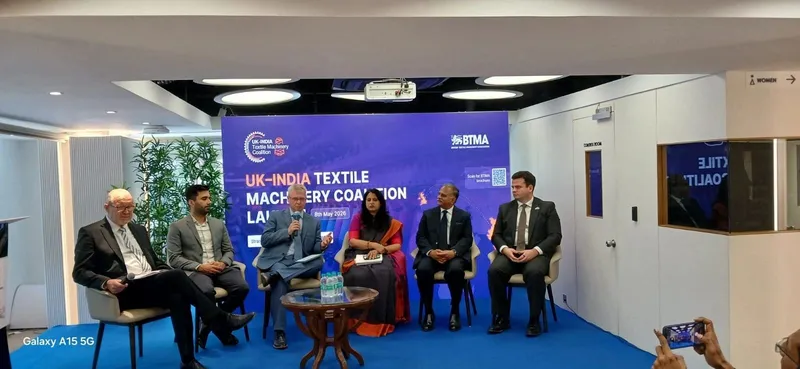
Jason Kent, CEO, BTMA, and Mark Jarvis, Chief Strategy Officer, Fibre2Fashion, on technology, trade, and a once-in-a-generation opportunity
In a move that signals renewed ambition for bilateral industrial engagement, the British Textile Machinery Association (BTMA) has launched the UK-India Textile Machinery Coalition — a structured platform aimed at deepening ties between two of the world's most significant textile economies. Speaking about it, BTMA CEO Jason Kent and Fibre2Fashion Chief Strategy Officer Mark Jarvis sat down for an in-depth conversation with the TVC Media team, covering technology transfer, market re-entry strategy, policy alignment, and what truly sets British textile machinery apart in a fiercely competitive global landscape.
A Unique Technology Proposition
The opening question went straight to the heart of the matter: are British manufacturers genuinely prepared to share their R&D with Indian counterparts, given that R&D is the very core of competitive advantage?
Kent was direct. "We are world leaders in a number of technologies — for example, fibre extrusion technology. We make machinery to extrude very advanced fibres in very unique ways and produce nonwoven products that can't be competed with on the world stage, even with European manufacturers. We are quite unique, supplying into the medical textile industry and others."
The edge, he explained, goes well beyond machinery design. Over the past decade, BTMA member companies have undergone a quiet but significant internal transformation — pivoting from traditional engineering competencies toward a deeply science and technology-driven workforce. "We're now seeing within our members' companies lots of science and technology-based academics who are chemists, biologists, and AI specialists. This is where the added value is — this is where the differentiation is happening in a big way."
This intellectual capital, Kent noted, draws from a deep well — the academic heritage of northern England, whose universities have been incubators of industrial innovation since the Industrial Revolution. It is precisely this fusion of historic institutional strength and modern STEM capability that the coalition seeks to channel into India.
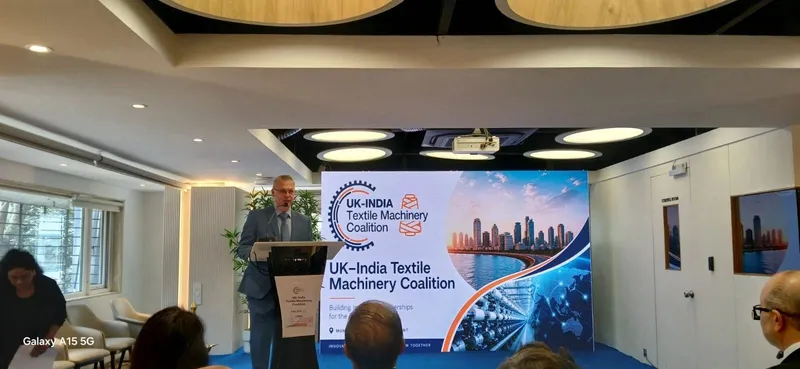
Source: Dr. Gurudas Aras LinkedIn
More Than Technology Transfer
When it was suggested that the coalition was primarily about technology transfer, Kent pushed back — not to diminish that dimension, but to expand it.
"It's more than a technology transfer. It's an enabler of many interested parties. It's not just about the technology; it's about the leadership, the thought management behind it, and the whole decision-making process. That takes a number of different disciplines." No single player, he stressed, can deliver on this vision alone. "It's more than the BTMA can achieve on its own, or just the manufacturers on their own. We need the government, we need academia, we need specialist advice in sustainability and policy. The coalition aims to bring all of that together."
He was equally firm on what differentiates this initiative from prior efforts: a commitment to action over deliberation. "There's been too much talking in the last few years. We're excited to actually start making it happen today — forging those relationships, getting the message out there. I think we've got a wonderful opportunity here for growth for both nations." And with an eye toward accountability: "We will be judged on our outcomes."
Reclaiming a Lost Foothold — Mark Jarvis and Jason Kent on Strategy
One of the most pointed questions of the conversation addressed a historical reality that the coalition must reckon with: British machinery once had a significant presence in India. Today, German and Swiss manufacturers dominate large swathes of the market. What changed — and what is the realistic path back?
Jarvis traced the inflection point to deliberate policy choices made in the 1980s, when the UK government actively pursued de-industrialisation, effectively offshoring manufacturing capacity to countries including India and China. The domestic textile machinery sector bore the long-term consequences. "Fast forward to where we are now, and the current government has an industrial strategy that clearly is aimed at growing the skills and the businesses that we've lost along the way."
On market positioning, Jarvis was equally clear. The UK's re-entry strategy is not a frontal challenge to German or Swiss dominance across the board. British strengths lie in well-defined and highly specialised niches — testing equipment, colour management software, advanced fibre processing, and other technology-led solutions. "We remain very strong — whether that's around testing, whether that's around colour management software and other types of software. We have a niche that is not only quite unique but also complements very well some of the challenges that the market here is facing."
This framing — complementarity rather than direct competition — is central to the coalition's market positioning. Rather than attempting to replicate what German or Swiss manufacturers do, UK companies are targeting the adjacent and often underserved spaces where precision, specialisation, and innovation-led differentiation matter most.
A Once-in-a-Generation Reset
What gives BTMA particular confidence at this juncture is a rare convergence of conditions — policy, trade frameworks, and market momentum moving in alignment simultaneously, for what Kent described as perhaps the first time in a generation.
"With the change in government policy and the free trade agreement being ratified, and where we're seeing the biggest potential growth within the Indian market, I think it's a once-in-a-generation reset — and we need to act now. We've got to have the first-mover advantage on that. Our member companies are perfectly aligned to deliver that solution for India."
He also acknowledged that the shift in the UK's domestic industrial policy — the current government's formal industrial strategy recognising textiles and textile machinery as pivotal sectors — has removed a structural barrier that hobbled previous efforts. "Our current government recognises that the textiles and textile machinery industry is quite pivotal to that strategy. They are now very committed to supporting bilateral trade between the UK and India. So everything's becoming aligned for the first time in perhaps a generation — and we're excited about that. We really are."
Built for Outcomes
What distinguishes the UK-India Textile Machinery Coalition from earlier dialogue initiatives is its explicit orientation toward measurable results. It is conceived not as a platform for exchange or a memorandum of intent, but as an operational mechanism accountable to real-world outcomes in technology collaboration, sustainability, and trade growth.
For Indian manufacturers, the proposition is access to capabilities occupying a distinct space in the value chain — cutting-edge nonwoven production, AI-integrated process management, precision testing infrastructure, and digital solutions in colour and quality management. For British companies, it represents the opportunity to re-establish relevance in one of the world's fastest-growing textile markets before the window narrows.
As Kent put it at the close of the conversation: "We've got an opportunity here, and it's a wonderful opportunity for growth for both nations."