Footfall Intelligence: How AI is Changing the Way Fashion Stores Understand Their Customers
Aniket Gaikwad
Fashion Management Scholar, Master of Fashion Management (MFM)
National Institute of Fashion Technology (NIFT), Daman
Ministry of Textiles, Government of India
Abstract
The paper examines the role of AI in the analysis and understanding of the movement of customers within a fashion store, a concept called footfall analysis. It is based on a review of existing academic and industry publications, but no experiments were conducted.
There are three key questions that this paper attempts to answer. What AI technology is currently being used in fashion stores, and how effective is this technology? How does this technology impact the decision-making of fashion retailers, for example, in terms of the layout of their stores, the products they stock, and the products they should buy? What are the ethics of this technology, for example, in relation to customer privacy?
The main conclusion is that AI footfall tools are actually useful for fashion retailers and can provide them with information that they never had before, although it is only possible for this information to be of any value if the business has invested in the people and processes required to use it effectively, and has been open and honest with its customers regarding what data it collects.
Key words: footfall analysis, AI in retail, fashion store management, customer behaviour, visual merchandising, data ethics
Introduction
You make hundreds of small choices without even knowing it when you walk into a clothing store. Which way do you go? What part of the rack catches your eye? How long do you stay near the sale section before you leave? For most of the history of retail, store managers didn't know the answers to these questions. They could only see how many people came in through the door.
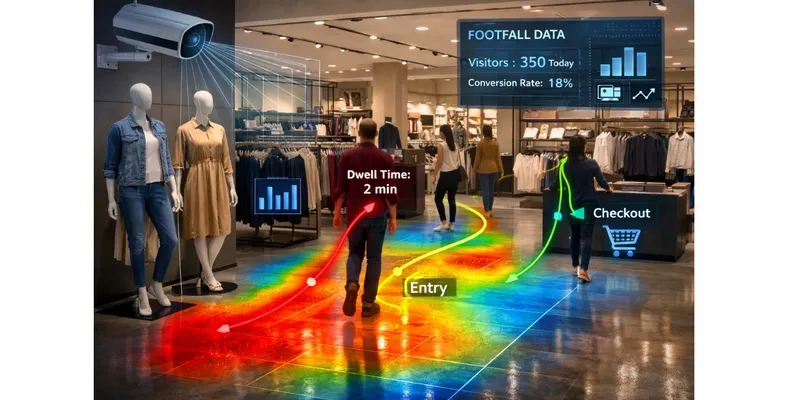
AI technology is changing that today. Cameras, sensors, and computer software can monitor where people are going within a store, where they are stopping, how long they spend near each product display, which areas they are walking straight past. This is referred to as footfall analysis, and it is one of the most significant tools in the management of a fashion retail.
This paper explains what this technology is, how fashion businesses are using this technology to make better decisions, and what this technology means in terms of risk and ethics. It is designed for anyone working in, or interested in, fashion retail and wants to know about this technology without having to know a lot about data science or computing.
In simple terms, Footfall analysis used to mean the number of people who walked into a store. Now, with the help of AI, it means understanding everything about the people and how they move and behave when inside the store.
The paper is structured by three research objectives:
- What are the AI tools used for footfall analysis, and what are their advantages and disadvantages?
- How does footfall analysis influence fashion business decisions regarding store layout, visual merchandising, and buying?
- What are the ethical concerns surrounding footfall analysis technology, and how can fashion businesses address them?
Literature Review
1. How footfall analysis started
Falk & Campbell, 1997, The concept of tracking the number of customers within a store or group of stores is not new. In fact, for many years, retailers have used basic electronic counters at the entrance of their stores to count the number of customers who enter the store on a daily basis. In the past, this basic information has been useful for comparing busy and quiet periods, or whether a marketing campaign has been successful in attracting more customers into the store.
Underhill, 1999, however, just counting the number of customers does not tell us much about what actually happens once the customer has entered the store. In fact, as far back as 1999, an American researcher, Paco Underhill, published a book called Why We Buy, which involved observing customers within stores for thousands of hours. His research found that many factors, such as the amount of space available for customers to browse without being knocked into by other customers, or the distance from the door where a product is placed, can make a huge difference in whether or not the customer will make a purchase.
Popa et al., 2010, This problem has been solved with the help of the introduction of AI and computer vision technology, which enabled cameras and sensors to automatically perform the tasks previously done manually by humans, and in real-time, in all stores
2. Why the store environment matters so much in fashion
Kozinets et al., 2002. The in-store experience is very important for fashion retail. When it comes to buying clothes, it is an experience rather than a straightforward transaction, as it is with food or electronics. The customer wants to touch and feel the clothes, see how they fit on a mannequin, and get inspired. The store design, lighting, and layout have a huge effect on how a customer feels and what they buy.
Mehrabian & Russell, 1974, environmental psychology is a field of study that looks at how the physical environment affects people's moods and behavior. A good environment makes the customer relaxed and therefore more inclined to browse the store. A poor environment causes the customer to behave in a manner where they quickly exit the store without making a purchase.
Mary Jo Bitner (1992), a researcher, came up with the concept called ‘servicescape’ which describes how the environment of a store affects the behavior of both the staff and the customers. AI footfall analysis is actually a means of evaluating the effectiveness of a fashion store's services cape.
If a customer spends 30 seconds looking at a display and then walks away without making a purchase, there is something wrong with that display. It could be the positioning of the product, the sizing of the product, or the styling of the product. AI-powered footfall helps you spot these issues before you lose sales.
3. The arrival of AI in retail analytics
Liciotti et al., 2017. AI technology can be useful in retail analytics once computers are able to analyze video footage. Currently, an AI system can view a video feed from a fashion store and immediately monitor the movements of all people within the store, calculate how long people spend at different fixtures, and determine areas where there are people and where there are no people at all.
This technology has come a long way. For instance, what used to require a number of analysts viewing video footage can now be done instantly. This means fashion retailers can now have access to a constant flow of information that they did not have before.
Objective 1: The AI tools. What they are and how they work
1. Computer vision
Liciotti et al., 2017. Computer vision is the most important technology for AI footfall analysis. This software can take a video feed of a camera and understand what it is seeing, including people, what they are doing, and where they are going.
If you had a very observant person sitting above the store and watching through a glass ceiling, drawing lines on a map to show where each customer walked, that would be manual footfall tracking. Computer vision does this for every customer, all day long but automatically.
This means that fashion stores can see things like:
- What path do most customers take when they walk into the store
- What product displays people are looking at
- What areas of the store nobody ever seems to visit, called dead zones
- How long the lines are at the fitting rooms or checkout
Research has shown that these systems are able to track customers with over 90% accuracy in a normal store setting (Liciotti et al., 2017). However, these systems are not as accurate in a store that is extremely busy, which is a problem for a fashion retailer in a busy sale season.
2. Heat maps
It's hard to make sense of thousands of individual customer paths on their own. This is where the process of heat mapping comes in. Heat mapping takes all of the customer movement data and creates a color-coded picture of the store’s floor plan.
Hahn & Hyun, 2015, The colors work as follows:
- Red and orange areas: - lots of customers spend lots of time in this area.
- Yellow area: - a moderate number of customers pass through this area.
- Blue and green area: - very few customers pass through this area.
This creates a visual image for visual merchandisers and store managers of which areas of the store are working well, and which are not. A large blue cold spot in the middle of a womenswear area, for example, tells the manager immediately that something needs to be changed in this area.
Example:
Tokatli, 2008, Zara, which operates under the Inditex group, is also well-known for utilizing footfall and dwell time statistics to inform decisions on the placement of products within their stores. Since Zara replenishes their stores with new products as often as twice a week, they require timely information on what is working well, and AI-powered footfall data offers this to them
3. WiFi and sensor tracking
Demir et al., 2018, not all methods of tracking footfall use cameras. A different approach is to use the WiFi signal emitted by the mobile phone of a customer to track their movement in a store. When a mobile phone is looking to connect to a WiFi network, it sends out a signal, which can be detected by a sensor placed in a store. By analyzing the strength of the signal, the location of the phone, and hence the customer, can be determined.
This is a good approach to use in very large stores or shopping centers, where equipping the entire area with cameras would be very expensive. It is not a detailed approach, but it can provide a good overview of the general movements of people in a space.
Predictive analytics
Kim & Kim, 2019. The most advanced footfall prediction systems not only tell you what has happened but also tell you what is going to happen. This is because these systems use not only the footfall history but also the weather forecast, local events, and even social media trends to make reasonable predictions about the footfall in a particular store on a particular day.
This kind of prediction is extremely useful to a fashion retailer. For instance, the system might predict a very busy Saturday because of a local event and good weather, and the manager might make sure the shop is well-staffed, the fitting rooms are in good working order, and the best-selling items are in full stock.
4. What these tools cannot do
Pine & Gilmore, 1998, it is important to be realistic about what AI footfall technology can and cannot do. The biggest problem with footfall data is that it can tell you what people have done, but it cannot tell you why they have done it. For example, a customer might stand in front of a rail for two minutes and then walk off without buying anything. The footfall data will tell you that they stood there for two minutes, but it will not tell you why they did not buy. Was it because it was too expensive? Was it because their size was not available? Was it because they were just browsing and did not plan on buying anything? Or was it because they did not like it?
To get a complete understanding of why people are behaving in a certain way, footfall data needs to be supplemented with other information, for example, sales data, customer feedback, and return rates.
Objective 2: The Busine Impact: How footfall data changes Fashion Decisions
1. Visual merchandising
Visual merchandising (VM) is the "art and science of designing the presentation and display of fashion products in a manner that is attractive and inviting to customers and motivates them to purchase." It involves decisions on what products go on what rails, how the mannequins are dressed, how products are grouped together in terms of color or type of product, etc.
Kerfoot, Davies & Ward, 2003, traditionally, these decisions were taken on the basis of a combination of company guidelines, the visual merchandising team's own creative decisions, and general principles of retailing as understood from the team's own experience. AI footfall data brings a new dimension to this process in that it provides hard evidence of what decisions are actually working.
Example:
Picture a fashion store with a beautiful new display for a new season jacket in the middle of the store. However, the heat map created by the AI will have identified that most customers are walking straight past this beautiful display without stopping. This is a problem, which could mean that the display is in a low-traffic area of the shop, or the display itself is not grabbing the customers’ attention in the way that the VM team wants.
Footfall data can also highlight areas of the shop that are ‘dead zones’or areas that customers are walking straight through. Dead zones are a big problem in the fashion industry, as any product placed in this area will not sell well, regardless of its quality. Using AI data, dead zones are immediately identifiable.
2. Buying
One of the most important and risky parts of running a fashion retail business is the buying function, which involves deciding which products to order, how many of each, and which stores to send them to. Excessive buying of a non-selling item results in a loss of margin, whereas insufficient buying of a best-selling item hurts sales and disappointed customers.
Traditionally, the process of buying has been based on past sales data, trend forecasting and the intuition of buyers. The addition of AI-generated footfall data provides something extra: a real-time indicator of consumer behavior with products before sales data becomes available.
Kim & Kim, 2019, if a new product being introduced to the store is experiencing a high degree of dwell time at its fixture, that is the customers are spending a lot of time looking at this particular product, this serves as an early indicator that the product is capturing the interest of customers. Along with this, the conversion rate of customers serves as an early indicator to customers, which helps them make decisions with respect to reordering or repositioning the products.
Tokatli, 2008, At a broader level, the footfall data from various stores of a particular chain of stores may indicate that different stores have very different customer behavior patterns. A store located in a city center with a high degree of footfall but a low degree of dwell times may require a different mix of products than a store located in a destination store where customers are spending a lot of time browsing through the store. AI data may help the buying teams order products according to the profile of the store.
3. Store design
AI-powered footfall data also has implications for the long-term, strategic design of fashion stores. By collecting data over a period of months and/or years, fundamental patterns of customer movement through a space may be identified, and this is largely based on the layout of the space.
Sorensen (2009) found that a lot of people buy things in stores within the first few meters of the store entrance. This has a direct effect on where fashion stores should put their most important items. New arrivals, full-price hero pieces, and high-margin accessories should be near the entrance, where the most customers will see them.
Grewal, Levy, & Kumar (2009), suggested that when a fashion brand is looking to design a new store or re-design an existing one, AI footfall modelling can be used to test out the design in a number of ways before any construction work is done. For instance, the design team can use technology to see which design is most likely to result in good business performance.
Objective 3: The ethical questions: What are the risks?
1. Do customers know they are being tracked?
One of the most important questions that AI footfall technology brings up is this is: do customers know it is happening?
Norberg, Horne & Horne, 2007, in an online store, people are constantly reminded that their activity is being tracked. In a physical store, there is no such reminder. A person walking through a fashion store may have no idea whatsoever that an AI is tracking their every move through the store.
Norberg, Horne & Horne, 2007. This is sometimes called the ‘privacy paradox’, it is the gap between what people say they care about and what they actually know. Most people, it seems, would tell researchers they are uncomfortable with their activity being tracked in a store without their knowledge. But in reality, hardly any people bother to check for notices, and even fewer bother to opt out.
The core ethical issue:
Just because it is legal to collect this kind of data does not necessarily mean it is ethical. Fashion brands need to ask themselves, “If our customers knew exactly what kind of data we were collecting and exactly what we were doing with it, would we still be comfortable with it?” There is a privacy law in Europe, such as the GDPR, which states that the collection of data in a public space must be disclosed. The most ethical solution for fashion brands would be to be completely transparent, not only in the legal sense but in a way the customer can understand.
2. Is the technology fair to all customers?
The second ethical concern is whether AI footfall systems are fair to all customers. Some of the more advanced systems use what the camera can see to guess things about customers, like their age or gender. This is called demographic inference.
The problem is that the data they produce is not always accurate and may be less accurate for some groups of customers than others. A study by Buolamwini and Gebru (2018) found that some AI image recognition systems make significantly more mistakes when they analyze darker-skinned customers or women compared to lighter-skinned men. Such bias means that the data produced by the AI is less accurate for certain groups of customers.
From a fashion retail point of view, this is important because decisions made in the buying and merchandising process using biased information could potentially work against a particular group of customers. Fashion retailers using AI systems with demographic inference capabilities must test the accuracy of the systems and be willing to cease the use of a particular aspect of the system if it is deemed biased.
3. Who is responsible for how the data is used?
A third ethical issue revolves around organisational responsibility. Once a fashion retailer has gathered detailed information about how thousands of customers behave in their stores, who is responsible for ensuring that information is used properly and kept secure?
Brynjolfsson and McAfee (2012) claimed that data analytics value is only achieved within an organisation that also invests in people, processes, and governance to properly harness data analytics. In the case of a fashion retailer, this would involve establishing proper internal policies on who can access footfall data, for how long it can be retained, and what it can and cannot be used for.
Floridi et al., 2018. Fashion retailers that take data responsibility seriously would, however, be rewarded commercially. This is because consumers are becoming increasingly aware of the manner in which their data is being used, and fashion retailers that are able to demonstrate true and proper ethical standards within their use and approach to AI would be rewarded with higher customer loyalty.
Findings
Looking at all three objectives, some clear patterns emerge with regards to what the footfall technology can or cannot do for the fashion retail industry.
First off, the technology works. Computer vision, heat maps, sensor tracking, and predictive analysis are all highly evolved technologies that can provide the fashion retail industry with a degree of insight into their customer behavior that was simply not possible before. The fact that you can literally see where the customer is going, where the customer is stopping, or where the customer is failing to go is valuable information to the retailer.
However, this technology is not a magic solution and can only be of value if and only if the business has the right people and processes to exploit this data. A fashion retailer that uses AI cameras in all stores but does not have a single person with the ability to interpret this data will not reap any benefits from this technology. This technology is a tool and can only be as good as the person using it.
The power of AI footfall data comes from its combination with human experience and judgment. A good visual merchandiser who understands the data will perform better than the data or the skills alone.
The ethical side is probably the least understood aspect of this kind of technology. Most conversations about AI in retail talk about the business benefits, and privacy and ethics is something that needs to be ‘managed’ rather than actually being taken seriously. As consumers increasingly understand the value of their own data, fashion brands that have a history of being honest and having a good approach to ethics will have a significant competitive advantage.
Conclusion
In this paper, the topic of AI footfall analysis in the context of fashion retail has been examined from the perspective of the technology itself, the effect of the technology on business decisions, and the ethical implications of the technology. The main conclusion is that the technology of AI footfall analysis is a genuinely powerful tool which can give fashion retailers access to information about their customers which they would never have been able to obtain before.
However, there are three things that need to be in place for this technology to bring its full value to an organisation:
- The data also needs to be brought together with other data – like sales information and consumer feedback to provide a comprehensive view. Footfall data does not provide an explanation for consumer behavior.
- The organisation also needs to have the right people and processes to react to the data. This technology will not be enough on its own; people will also need to have the skills and power to react to the data.
- The technology also needs to be implemented in an ethical way with transparency to consumers, fairness and bias, and with clear internal processes and procedures.
Therefore, it is important for fashion professionals to be familiar with AI footfall technology, as it is already being utilized by some of the biggest brands in the world, and its use is going to increase in the future. It is important to know what it can do, what it cannot do, and how it should be used, as it is a skill that will be required throughout one's career in fashion retail.
The area of future research should be the actual business benefit of AI footfall investment. While it is possible to see if the technology works, it would be beneficial to understand if it actually works for the business. Research that includes the views of the people in the business, the visual merchandiser, the buyer, the store manager, about how they think the technology is being used would also be useful in understanding the impact of the technology on professional practice in the fashion retail industry.
References
- Baker, J., Parasuraman, A., Grewal, D., & Voss, G. B. (2002). The influence of multiple store environment cues on perceived merchandise value and patronage intentions. Journal of Marketing, 66(2), 120–141.
- Bitner, M. J. (1992). Servicescapes: The impact of physical surroundings on customers and employees. Journal of Marketing, 56(2), 57–71.
- Brynjolfsson, E., & McAfee, A. (2012). Race against the machine. Digital Frontier Press.
- Buolamwini, J., & Gebru, T. (2018). Gender shades: Intersectional accuracy disparities in commercial gender classification. Proceedings of Machine Learning Research, 81, 1–15.
- Demir, B., Gür, M., & Özgür, A. (2018). Indoor positioning and footfall analysis using WiFi signals in retail environments. Sensors, 18(7), 2235.
- Falk, T., & Campbell, C. (1997). Spatial analysis of retail store performance. Journal of Retailing and Consumer Services, 4(1), 49–58.
- Floridi, L., Cowls, J., Beltrametti, M., Chatila, R., & Vayena, E. (2018). An ethical framework for a good AI society. Minds and Machines, 28(4), 689–707.
- Grewal, D., Levy, M., & Kumar, V. (2009). Customer experience management in retailing. Journal of Retailing, 85(1), 1–14.
- Hahn, K. H., & Hyun, J. (2015). The effect of store atmosphere on purchase intention. International Journal of Retail & Distribution Management, 43(6), 521–537.
- Kerfoot, S., Davies, B., & Ward, P. (2003). Visual merchandising and the creation of discernible retail brands. International Journal of Retail & Distribution Management, 31(3), 143–152.
- Kim, H., & Kim, J. (2019). Predicting retail footfall using machine learning. Expert Systems with Applications, 135, 116–127.
- Kozinets, R. V., Sherry, J. F., DeBerry-Spence, B., Duhachek, A., Nuttavuthisit, K., & Storm, D. (2002). Themed flagship brand stores in the new millennium. Journal of Retailing, 78(1), 17–29.
- Liciotti, D., Contigiani, M., Frontoni, E., Mancini, A., Zingaretti, P., & Placidi, V. (2017). Shopper behaviour analysis using a depth camera for retail store operations. International Journal of Advanced Robotic Systems, 14(2), 1–13.
- Mehrabian, A., & Russell, J. A. (1974). An approach to environmental psychology. MIT Press.
- Norberg, P. A., Horne, D. R., & Horne, D. A. (2007). The privacy paradox. Journal of Consumer Affairs, 41(1), 100–126.
- Pantano, E., & Naccarato, G. (2010). Entertainment in retailing. Journal of Retailing and Consumer Services, 17(3), 200–204.
- Pantano, E., & Viassone, M. (2015). Engaging consumers on new integrated multichannel retail settings. Journal of Retailing and Consumer Services, 25, 106–114.
- Pine, B. J., & Gilmore, J. H. (1998). Welcome to the experience economy. Harvard Business Review, 76(4), 97–105.
- Popa, M., Koc, M., Rothkrantz, L. J. M., Shan, C., & Wiggers, P. (2010). Detecting and analyzing shopping groups in a supermarket. Proceedings of the IEEE International Conference on Advanced Video and Signal Based Surveillance, 1–8.
- Sorensen, H. (2009). Inside the mind of the shopper. Wharton School Publishing.
- Tokatli, N. (2008). Global sourcing: The case of Zara, a fast fashion retailer. Journal of Economic Geography, 8(1), 21–38.
- Underhill, P. (1999). Why we buy: The science of shopping. Simon & Schuster.
- Voigt, P., & von dem Bussche, A. (2017). The EU General Data Protection Regulation (GDPR): A practical guide. Springer.