Flexible Phase-Change Thermal Textile Market to Surpass USD 4.8 Billion by 2032 with 12.9% CAGR
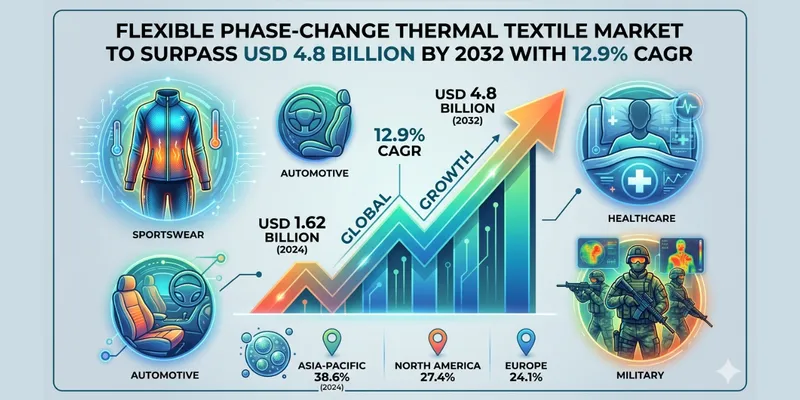
The global Flexible Phase-Change Thermal Textile market is witnessing accelerated growth as smart textile technologies gain traction across healthcare, sportswear, military, automotive, and industrial sectors. According to insights highlighted by Marketintelo, the market was valued at nearly USD 1.62 billion in 2024 and is projected to reach USD 4.8 billion by 2032, expanding at a robust 12.9% CAGR during 2025–2032.
Flexible Phase-Change Thermal Textile materials are increasingly integrated into performance apparel and wearable systems due to their ability to regulate temperature dynamically. Between 2020 and 2025, global demand for thermoregulating textiles increased by 41%, while investment in smart textile R&D crossed USD 3.4 billion globally in 2024 alone.
Key Numerical Highlights
• Global Flexible Phase-Change Thermal Textile market size reached USD 1.62 billion in 2024
• Forecast valuation expected at USD 4.8 billion by 2032
• CAGR estimated at 12.9% from 2025–2032
• Asia-Pacific accounted for 38.6% market share in 2024
• Sportswear applications contributed nearly 29% of total revenue
• Healthcare smart textile adoption increased by 34% YoY in 2025
• Military textile contracts surpassed USD 920 million globally in 2024 • PCM microcapsule production volume exceeded 78,000 metric tons in 2024
• Europe invested over USD 680 million in sustainable thermal fabrics during 2023– 2025
• North America smart wearable textile revenue crossed USD 1.1 billion in 2025
The Flexible Phase-Change Thermal Textile industry has evolved significantly over the last decade. In 2016, the market size stood at just USD 540 million. By 2020, the value climbed to USD 980 million, representing a five-year growth rate of nearly 81.4%. Rising adoption in temperature-sensitive clothing and energy-efficient textiles has fueled continuous expansion.
Between 2021 and 2024, global production of PCM-integrated fabrics increased from 112 million square meters to 187 million square meters, reflecting a 67% increase.
Manufacturers are investing heavily in bio-based phase-change materials to improve flexibility, durability, and sustainability.
Year-over-Year Market Growth Trends
Year | Market Size (USD Billion) | YoY Growth |
2020 | 0.98 | 8.2% |
2021 | 1.08 | 10.2% |
2022 | 1.24 | 14.8% |
2023 | 1.41 | 13.7% |
2024 | 1.62 | 14.9% |
2025 | 1.84 | 13.5% |
The Flexible Phase-Change Thermal Textile market is benefiting from rapid innovation in wearable electronics. Over 63% of smart textile companies integrated thermal-regulating components into wearable products during 2024. Additionally, more than 420 patents related to flexible PCM textiles were filed globally between 2022 and 2025.
Regional Market Insights
Asia-Pacific
Asia-Pacific dominates the Flexible Phase-Change Thermal Textile market with nearly 38.6% revenue share in 2024. China, Japan, South Korea, and India collectively contributed over USD 625 million in regional revenue. China alone accounted for approximately 44% of global smart textile manufacturing output.
India’s technical textile sector recorded investments exceeding USD 1.7 billion under government-linked production initiatives from 2022–2025. Demand for thermal sportswear in Asia-Pacific grew by 26% YoY in 2024.
North America
North America held approximately 27.4% market share in 2024. The United States remains a key innovation hub, with over 150 research projects focused on wearable thermal management technologies. Defense applications generated nearly USD 310 million in PCM textile procurement contracts during 2024.
The healthcare sector in North America saw adoption rates increase by 31%, particularly in patient monitoring garments and temperature-adaptive medical bedding.
Europe
Europe accounted for 24.1% of global revenue in 2024. Germany, France, and the UK collectively invested more than USD 680 million into sustainable smart textile manufacturing. European automotive interiors using Flexible Phase-Change Thermal Textile materials increased by 22% between 2022 and 2025.
The EU’s sustainable textile regulations also pushed recycled PCM textile adoption up by 18.5% YoY.
Application Segment Analysis
Sportswear remains the largest application segment, generating nearly USD 470 million in 2024 revenue. Smart athletic apparel sales increased by 28% YoY, supported by rising consumer demand for comfort and body-temperature regulation.
Healthcare applications are expected to grow at the fastest CAGR of 14.6% through 2032. Hospitals globally increased procurement of thermoregulating patient textiles by 21% in 2024. Meanwhile, military and defense applications accounted for nearly 17% of total market demand.
The automotive segment is also emerging rapidly. Vehicle seat fabrics integrated with Flexible Phase-Change Thermal Textile technology increased production by 19 million units globally during 2023–2025.
Competitive Landscape and Investments
Global smart textile manufacturers increased capital expenditure by 23% in 2024. More than USD 2.2 billion was allocated toward next-generation thermal fabric innovation between 2023 and 2025.
Leading producers are focusing on:
• Nano-encapsulated PCM technology
• Bio-based phase-change compounds
• AI-integrated wearable thermal systems
• Lightweight conductive fabrics
• Recyclable smart textile materials
Corporate partnerships in the smart textile ecosystem rose by 37% YoY in 2024, indicating aggressive commercialization strategies.
Future Outlook
The future of the Flexible Phase-Change Thermal Textile market remains highly promising as industries prioritize energy efficiency, comfort optimization, and wearable intelligence. By 2030, global smart clothing shipments are expected to exceed 450 million units annually, significantly boosting PCM textile demand.
By 2032, healthcare and defense applications alone are projected to contribute over USD 1.9 billion in combined revenue. With continuous innovation, rising R&D expenditure, and growing sustainability initiatives, the Flexible Phase-Change Thermal Textile industry is expected to maintain double-digit growth throughout the forecast period.
The market’s projected rise from USD 1.62 billion in 2024 to USD 4.8 billion by 2032 underscores the increasing strategic importance of thermoregulating smart fabrics across global industries.
Read A Full Report: https://marketintelo.com/report/flexible-phase-change-thermal-textile market