fischer and Purdue University Validate Earthquake Retrofitting Solution for Existing Buildings
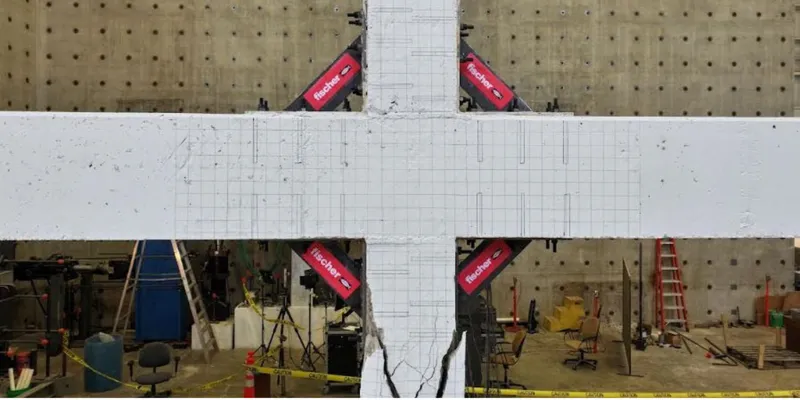
Full-scale reinforced concrete tests demonstrate bonded anchor system designed to improve beam-column joint performance under seismic loading.
Earthquakes remain one of the most significant risks to structural safety worldwide, particularly for buildings constructed before the introduction of modern seismic design standards. To address this challenge, Unternehmensgruppe fischer and Purdue University (USA) carried out a large-scale research project to evaluate a new approach for strengthening existing reinforced concrete structures against seismic forces.
According to the US Geological Survey (USGS), approximately 500,000 earthquakes are recorded globally each year. Areas including the Pacific Ring of Fire, the Himalayas, the Mediterranean, Central America, and the Caribbean are among the regions most exposed to seismic activity. In addition to natural tectonic movement, activities such as oil and gas extraction, fracking, geothermal drilling, and the construction of large reservoirs can also contribute to seismic events.
For buildings located in earthquake-prone regions, structural engineers must ensure not only the stability of the primary structure but also the integrity of non-load-bearing components such as pipes, cables, suspended ceilings, cable trays, air-conditioning units, and façades. Many existing buildings, however, were built before current earthquake standards were introduced and require structural strengthening to improve their resilience.
Full-Scale Seismic Testing
As part of the research project, fischer and Purdue University conducted extensive testing on full-scale reinforced concrete structures. The study focused on the behavior of beam-column joints, which experience significant stresses and horizontal forces during earthquakes.
“These node points in supporting structures are subjected to particularly high stresses and significant force caused by horizontal loading during an earthquake”, explains Dr Margaritis Tonidis, a former PhD Candidate at Purdue University and leading Project Engineer of the project.
The research identified these joints as critical structural elements because failure at these locations can result in the collapse of the supporting system.
Bonded Anchor System Evaluated
The research team tested a reinforcement system consisting of bonded anchors and haunch elements, using Fischer injection mortar in combination with threaded rods.
According to the study, the bonded anchor system demonstrated minimal deformation under load while efficiently transferring forces. The retrofit solution modifies the force flow between beams and columns by redistributing loads into adjacent structural elements. Defined failure mechanisms were also incorporated to reduce the risk of complete structural collapse during seismic events.
Comparative Test Results
“The injection mortar proved to be a highly reliable adhesive anchor for post-installed strengthening even under very high seismic demands and led to achieving ground breaking results during the tests”, emphasises Prof Akanshu Sharma, Associate Professor at Purdue University and former Endowed Professor at the Institute of Materials Science at the University of Stuttgart. “We were able to demonstrate a significantly improved performance of the strengthened structure under seismic loading”. During the comparative test, the structural system without strengthening demonstrated major damages in beam-column joints, while the structure strengthened with the Fischer system displayed superior performance. “The fischer bonded anchor system can also be installed while the building is in use, without causing any major interruption,” Prof Sharma adds.
Research Collaboration
“The project was a fantastic and unique opportunity to review and test the results and concepts we gained in our previous research under realistic conditions,” emphasises Dr Erik Johannes Stehle, Head of Development FiXperience at fischer. “This once again demonstrated that the success of a seismic reinforcement solution such as this highly depends on the performance of the anchorage. This is where our bonded anchor system was able to achieve impressive results at both the structural level and within the beam-column joints, demonstrating high rigidity and low deformation at high-load levels.”
Dr Erik Stehle also highlighted the role of international research partnerships in advancing engineering innovation.
Dr Erik Stehle emphasises, “We need international research collaboration. By communicating with each other, we gain inspiration, ideas and impetus for new innovations while strengthening our position as a global innovator.”
Prof Sharma meanwhile highlights the importance of international cooperation between the scientific community and businesses, “At Purdue University, we’re proud to have already conducted several groundbreaking research projects with the fischer Group of Companies, including the world’s first seismic test using full-scale structures with a post-installed reinforcement solution for joints with haunch elements.”
According to the research partners, the validated solution provides a practical approach for improving the seismic resilience of existing buildings while helping protect infrastructure during earthquakes.
Perspective for India
Commenting on the relevance of the technology for the Indian market, Mayank Kalra, Managing Director, fischer India, said, "India is among the fastest-growing infrastructure markets in the world and has several regions that are vulnerable to seismic activity. While modern construction follows advanced earthquake-resistant design standards, strengthening existing buildings remains equally important. This validated seismic retrofitting solution demonstrates how innovative fixing technologies can enhance structural safety, extend the life of existing infrastructure and contribute to more resilient cities.
At fischer India, we are committed to bringing globally proven engineering solutions to the Indian market and supporting safer, more sustainable infrastructure development."