First Garment Lot Should Determine Which Colourways Earn Repeat Orders
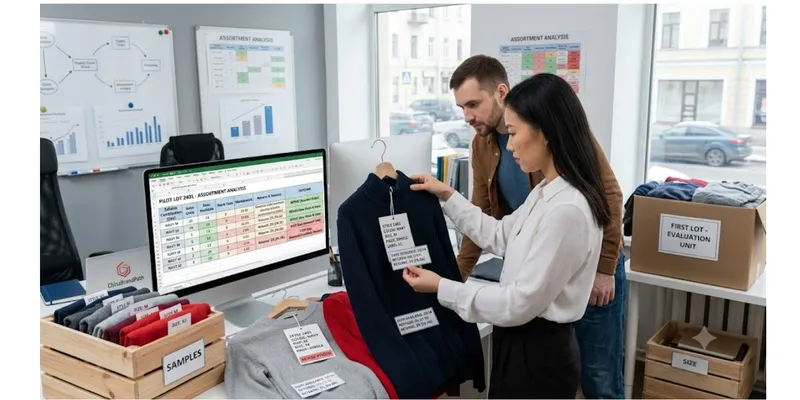
A structured pilot at the sellable-unit level can help apparel importers distinguish genuine demand from availability effects and make more controlled assortment decisions
An apparel importer can approve a garment, place an initial order and still gain limited insight into which parts of the assortment are actually working. Overall sales can be influenced by a particular colour, size curve, marketplace promotion or retailer, making it risky to expand every colourway based on one aggregate result.
For a Russian importer assessing a new apparel supplier, the first garment lot should provide a clearer answer: which sellable combinations deserve a repeat order, which require changes, and which should be discontinued?
Define the Pilot at the Sellable-Unit Level
A factory style and the product ultimately sold through a marketplace, store or distributor are not necessarily the same unit. The channel may sell a particular combination of colour, size, pack and label version.
If all these combinations are grouped under a single style code, an importer may see an acceptable overall performance while overlooking weaker individual combinations.
Before placing the order, the importer can create an assortment map in which each row represents a specific sellable combination. This can include:
- Colour
- Size range
- Pack quantity
- Sales channel
- Garment version
- Packaging version
The objective is not to create an unnecessarily complex data system. Instead, the map preserves the exact unit on which the next purchasing decision will be based.
This becomes particularly important when the same garment is sold through multiple channels. A marketplace may sell individual units, an independent retailer may purchase mixed inner packs, while a regional distributor may require a different size curve. Treating all of these as one pilot can prevent the importer from determining whether the economics are repeatable across each channel.
Separate Demand From Availability
The combination with the highest sales is not necessarily the one with the strongest underlying demand. It may simply have been available for a longer period, stocked in more stores or supported by a promotion.
The pilot should therefore record several contextual indicators alongside sales, including:
- Days available
- Stock-outs
- Markdown or voucher periods
- Cancellations
- Return reasons
- Channel-specific pack restrictions
These details do not need to be combined into a universal performance score. Their purpose is to help the importer distinguish genuine demand signals from availability effects.
For example, a neutral colour may sell through quickly because it was consistently in stock, rather than because customers inherently preferred it. Similarly, a slow-moving size may have been repeatedly unavailable in the channel where demand for it was strongest.
The first lot should make these uncertainties visible instead of requiring an assortment-wide decision based on one aggregate sales figure.
Use Returns as Assortment Evidence
Returns are often assessed at the overall style level and treated primarily as an indicator of product quality. For assortment decisions, however, return information can provide more specific evidence.
A return reason may indicate that a particular size curve is poorly described, a product photograph creates an incorrect expectation, a pack configuration is inconvenient for a retailer, or a label version causes customer confusion.
The importer should connect each return signal to the precise sellable combination rather than treating every return as a judgement on the supplier or the entire garment.
This does not mean treating every customer comment as definitive. Instead, the objective is to record enough product identity to determine whether the same issue repeatedly occurs with the same combination.
A recurring fit-related comment associated with one size run can therefore support a different purchasing decision from scattered preferences across the broader assortment.
Give Each Combination One of Three Outcomes
At the end of the first lot, the importer does not need to make one decision for the entire style. Each sellable combination can be assigned one of three outcomes:
Repeat: The version, channel and basic economics are sufficiently clear to justify another bounded order.
Revise: The combination may remain commercially viable, but its size curve, imagery, packaging, labelling or product information requires a defined change before another order.
Stop: The available evidence does not support additional inventory, or the supplier cannot reliably reproduce the accepted version.
These categories make the pilot evidence operational by turning findings into specific purchasing instructions.
For example, instead of concluding that “customers liked the style,” an importer could decide to repeat the black colourway in the accepted size curve for the marketplace, revise the blue product photography before relisting, and stop the mixed retail pack until its inner quantity becomes workable.
Protect Decisions When Product Versions Change
An assortment result applies to the specific version that was tested. If the supplier changes the fabric, trim, colour reference, label or pack configuration, the importer should not automatically carry the previous result into the next order.
The change may be acceptable, but it should be explicitly connected to the original pilot record. The importer needs to determine whether it remains the same sellable combination with a documented update or represents a new version requiring a smaller repeat test.
Without this distinction, the second order could scale a product version that the channel has never actually tested.
For this reason, the assortment map should include a reference to the accepted sample or product version. This keeps sales evidence connected to the exact product identity that generated it.
Expand Only What the Channel Has Explained
The first garment lot is most valuable when it reduces uncertainty. Its purpose is not simply to establish whether units sold, but to identify which combinations the channel can successfully describe, stock, sell, support and reorder.
Expanding every colour and size after one encouraging aggregate result can turn a limited pilot into a much larger inventory commitment without adequately controlling risk.
A more measured expansion strategy is uneven: strong combinations move forward first, ambiguous combinations return with specific revisions, while weak or unreproducible combinations are stopped.
This gives merchandising decisions a stable reference point: the exact garment combination, sold through the specific channel and in the version that generated the evidence.
That is how the first garment lot earns the right to become a broader range rather than simply becoming more inventory.