Financial Analysis: Supertex Industries Limited (FY 2024-2025)

1. Introduction
The Indian textile manufacturing industry had a critical year in terms of its performance in the 2024-2025 fiscal year as these industries were characterized by a mix of domestic strength and global instability. India's overall economy has experienced significant success with a 9.2% increase in GDP during FY 2023-24; however, there was significant slowdown in the textile and apparel sectors. The principal cause of the decline was the reduction of inventory levels in the West and the continuing changes in the cost of raw materials. The investigation of Supertex Industries Limited during this period is strategically very valuable; it shows how medium sized manufactures continue to operate under normal conditions even when demand for exports disappears and accounting entries cover real improvements in performance.
Supertex Industries Limited is a specialized manufacturer of polyester and nylon yarns; an important part of the synthetic fibre supply chain. While there is modest growth of 3.2% globally, the company exists in a global environment that remains sensitive to political realignment and sectoral instability. This paper is an analysis of Supertex Industries Limited's operational flexibility and financial stability during a three year period (2023-2025). Importantly, this paper will help to understand the difference between non-cash accounting entries and the ability to generate cash and will therefore provide a clear picture of how well the company's base is able to remain stable during and beyond this period.
2. Company Overview
In the capital-intensive filament yarn market, a manufacturer’s competitive edge is derived from its operational footprint and the versatility of its business model. Supertex has developed a multifaceted approach, combining direct manufacturing with a strategic "Jobwork" component. In the Jobwork model, the company processes materials owned by third parties. While this reduces the inventory ownership, it ensures the factory maintains throughput and covers fixed costs during periods of low direct sales.
Geographic Operational Spread
Unit | Location | |
Units I & II | Piperia Industrial Estate, Silvassa (Dadra & Nagar Haveli) | |
Unit III | Dharampur, Valsad, Gujarat |
Incorporated in 1986, Supertex’s core activities—Texturising, Twisting, Draw Warping, and Sizing—transform partially oriented yarn (POY) into high-value beams and specialized yarns for the weaving industry. By maintaining facilities in both Silvassa and Gujarat, the company leverages proximity to raw material suppliers and major domestic textile clusters. As we explore the leadership driving this footprint, it becomes evident that the company’s survival strategy is deeply rooted in a philosophy of personal commitment from its founders.
3. Promoter & Founder Introduction
A lot of family-owned businesses in India operate under the principle of "Trusteeship," which means that the person starting the company considers himself a steward of the company’s future and not just an owner. Supertex's governance reflects this. The leaders have put their needs behind the company’s finances.
Key People in Leadership
- R K Mishra- Chairman and Managing Director
- S. K. Mishra- Chief Financial Officer & Executive Director
- Harshvardhan Mishra- Director/CEO-elect
A further analysis would show that "Trusteeship" is more than just words. An example of this strong promoter commitment is that there is a voluntary waiver of two months’ remuneration by all of the directors for the period of June 2024 through to the end of March 2025. In addition to this, as evidenced in Note 12 of the financial statements, the promoters have provided a total of ₹502.91 Lakhs in unsecured loans to the company. Essentially, the leadership is not only working without pay but is also personally financing the company's working capital needs.
4. Financial Statement Analysis (3-Year Comparison)
A three-year trend analysis is vital for a company like Supertex, as it prevents short-term accounting entries from obscuring long-term operational trends.
Income Statement Analysis
Metric (₹ in Lakhs) | FY 2022-23 | FY 2023-24 | FY 2024-25 |
Total Revenue | 6,817 | 9,083 | 7,359 |
Profit Before Tax (PBT) | 20 | 32 | 38 |
Net Profit (PAT) | 4 | 11 | (8) |
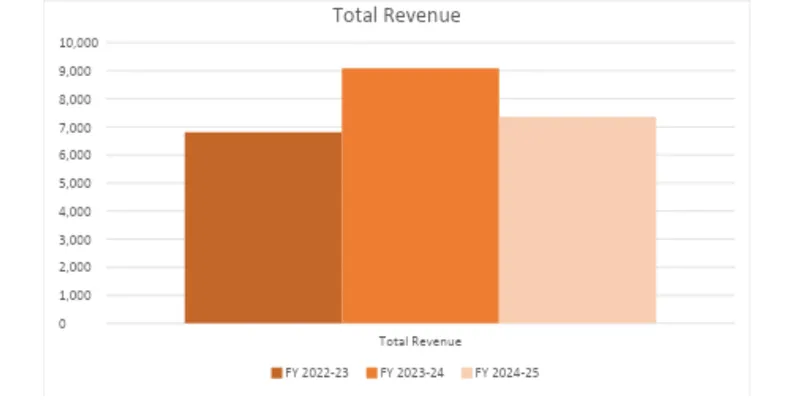
The "So What?" Layer: For the casual observer, the move from a ₹11 Lakh profit in 2024 to an ₹8 Lakh loss in 2025 suggests a decline. However, a professional analyst will note that Profit Before Tax (PBT) actually increased by 18% year-over-year. The "loss" was caused by a significant non-cash Deferred Tax adjustment of ₹(46.07) Lakhs. Operationally, the company became more efficient in 2025, maintaining profitability despite a 27% drop in production volume and the total cessation of exports (which fell from ₹503 Lakhs to zero).
Key Financial Ratios
Ratio | 2023 | 2024 | 2025 |
Net Profit Margin % | 0.06% | 0.10% | (0.12%) |
Return on Equity % | 0.13% | 0.36% | (0.27%) |
Stock Turnover Ratio | 10.50 | 12.67 | 7.60 |
Creditors Turnover Ratio | N/A | 4.03 | 2.97 |
The "So What?" Layer: The drop in the Stock Turnover Ratio is a result of the company’s shift toward Jobwork. Since Jobwork involves processing materials owned by third parties, the company does not hold the raw material on its balance sheet, making traditional inventory turnover ratios less representative of actual factory activity.
Crucially, while "Debtor Days" (189 days) show an optical improvement, the aging schedule in Note 7.1 reveals a significant risk: ₹1,603.10 Lakhs in trade receivables are outstanding for over six months. This indicates that nearly 42% of the company's total receivables are "aged," creating a serious liquidity crunch and increasing the risk of further credit impairment beyond the ₹92.79 Lakhs already marked.
5. Key Insights & Interpretation
Transforming raw data into intelligence requires balancing the company's cost-containment successes against its regulatory hurdles.
Strengths & Modernization
Supertex is aggressively pursuing "bottom-line" growth through cost reduction. This includes the installation of LED lighting in workshops and the ongoing exploration of solar energy systems for its plants. In an energy-intensive industry, these are pragmatic moves to lower the "per-unit" cost of production and improve margins as demand recovers.
Weaknesses & Statutory Issues
Despite operational improvements, the company’s cash flow stress is evident in its statutory compliance. A professional observer must prioritize the following Audit Qualifications and notices:
- Unpaid Dues: As of March 31, 2025, the company had not deposited ₹11.12 Lakhs in TDS, ₹10.25 Lakhs in PF, and ₹1.28 Lakhs in Profession Tax.
- Tax Demand Notices: The Secretarial Audit Report highlights major demands, including a demand from the Sales Tax Officer, Valsad (FY 2019-20) and notices from the Assistant Commissioner of Central GST regarding ineligible Input Tax Credits (ITC).
Risk Factors & Future Outlook
The primary threats remain external: cheaper imports and volatile oil prices impacting raw material costs. However, management’s "debottlenecking" strategy aims to optimize production lines for Technical Textiles (such as geo-textiles). This segment offers higher margins and more stability than the volatile mass-market apparel segment.
6. Conclusion
Supertex Industries Limited exists in a state of high-tension equilibrium. On one hand, the company is operationally resilient, showing PBT growth and improved factory management during a difficult year. On the other hand, it is hemmed in by a significant cache of aged receivables and mounting statutory demands. The 2024-25 net loss is primarily an accounting artifact of deferred tax, yet the liquidity pressure it represents is very real.
Final Evaluation: The company’s survival depends on its ability to convert its ₹3,803 Lakhs in receivables into cash and successfully navigate the GST/Tax demands. The transition toward Technical Textiles and the promoters' willingness to personally fund the company are positive indicators of long-term viability. For the investor or practitioner, Supertex is a "high-operational-efficiency" story currently masked by a "liquidity-constraint" reality.
Data Source: 39th Annual Report (2024-25) of Supertex Industries Limited and verified market data. & Company website