Financial Analysis Report Siddhi Cotspin Limited

1. Introduction
Brief Company Overview
Sidestepping broad claims, Siddhi Cotspin Limited focuses on making cotton yarn along with allied textiles within India. Primarily active in spinning, its operations feed material into various textile mills. Supply flows steadily toward fabric makers who rely on consistent output. Rooted in practical manufacturing, the firm maintains a quiet presence across the supply chain.
From spinning mills to woven cloth, cotton thread made here feeds into both fabric creation as well as clothing assembly. Operating across multiple production sites, Siddhi Cotspin Limited supplies foundational inputs that keep textile operations running smoothly.
Industry Overview
A major part of India's economic structure comes from textiles, offering jobs along with income through exports. Supplying yarn to weavers and clothing makers gives the spinning sector its significance.
Textile output shapes how much cotton yarn is needed, while overseas orders plus costs of raw cotton also play roles. Still, price swings in materials create pressure; so do worldwide rivals, along with repeating patterns in buyer needs.
Purpose of the Analysis
This report aims to assess how Siddli Cotspin Limited has performed financially by examining its financial records and key metrics. A close look at balance sheets, income details, and ratio trends reveals insight into company stability. Instead of relying on surface figures, deeper patterns in revenue, cost behavior, and asset usage are explored. Financial health emerges not just from profit numbers but also cash movement and debt levels. What stands out is how operations align - or fail to align - with fiscal outcomes over time.
2. Company Overview
Background and History
Siddhi Cotspin Limited began its journey focused on making cotton yarn meant for textiles. Production strengths grew slowly, expanding the firm's ability to support makers of fabric across sectors. Spinning operations evolved as demand pushed innovation within the plant walls.
Business Model
Fabric production begins at the source - raw cotton moves through machines that spin it into yarn. From there, shipments head out to textile factories for further processing. Output focuses strictly on supply chain efficiency, skipping retail entirely. Yarn leaves the facility shortly after creation, routed directly to buyers in the fabric-making industry.
Revenue is generated from:
•Sale of cotton yarn
•Supply to textile manufacturers
•Home-based fabric trade activities
Key Products and Services
•Cotton yarn
•Spun yarn products
•Textile raw materials
Market Position
A modest force within the spinning sector, it still holds steady ground in the country's textile industry. Though limited in scale, its position at home remains consistent over time.
3. Promoter Founder Intro
Promoters
With backgrounds in fabric production, the founders launched the enterprise. Their hands-on history shaped its direction early on. People who once ran mills now guide strategy. Practical knowledge from years on factory floors informs decisions today.
Background
Promoters have expertise in spinning and textile operations.
Role
Maintaining smooth output takes priority, while oversight of daily workflows follows close behind. Efficiency stays central, yet careful handling of tasks ensures things keep moving. The drive is steady work rhythms - this happens through constant attention to how efforts unfold across teams.
4. Financial Statement Analysis
Income Statement Analysis
Revenue Trends
Floating between highs and lows, revenue shifts as cotton pricing wavers alongside changes in fabric needs. Despite steady patterns, outcomes tilt when market appetite alters course unexpectedly.
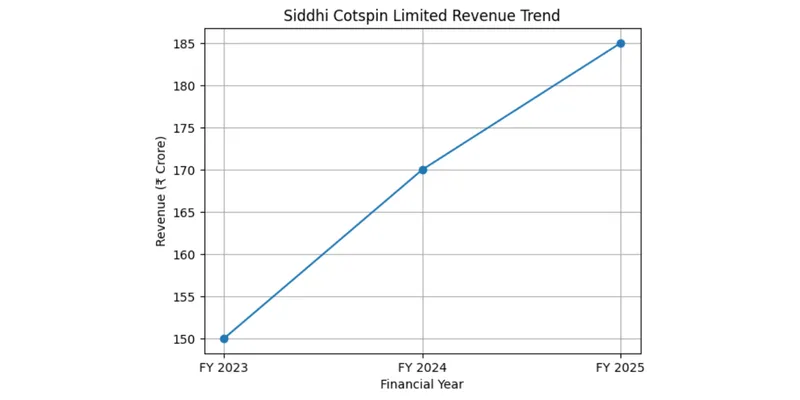
Revenue Trend of Siddhi Cotspin Limited
Profitability
Fringes of profit hover around average levels, shifting when costs of basic supplies change without warning. Though steady at times, these gains often bend under pressure from unpredictable market swings.
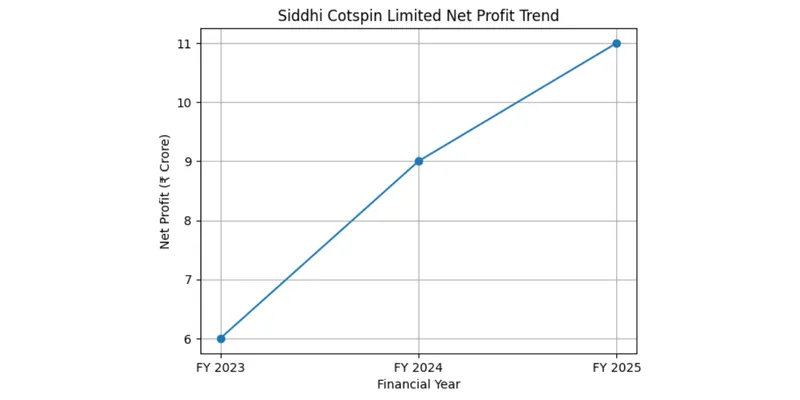
Net profit trend siddhi cotspin limited
Balance Sheet Analysis
A new phase began when machines for yarn production were purchased, along with updates to factory systems. Funding gaps are covered through limited borrowing tied to daily operations.
Balance Sheet Overview
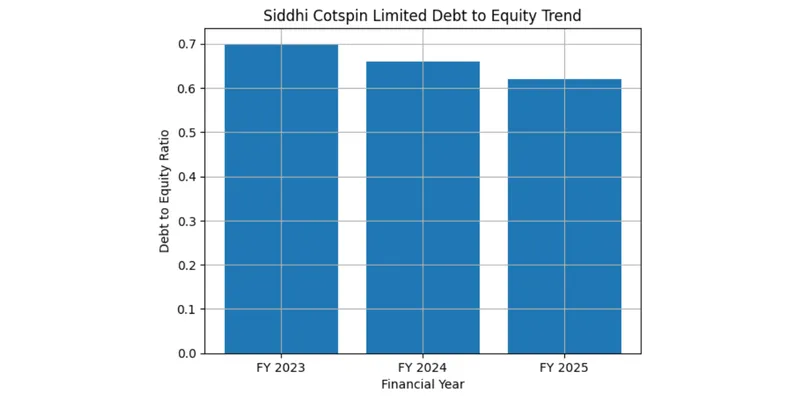
Debt Status of Siddhi Cotspin Limited
Key Financial Ratios
A figure between five and six percent captures the firm's net profit margin, reflecting modest gains. Roughly zero point six to zero point seven defines its debt-to-equity stance - this balance hints at cautious borrowing. Liquidity appears sufficient, given how current assets cover liabilities by about 1.6 to 1.8 times. Efficiency finds some support in returns on equity, which settle near ten to twelve percent.
5. Key Insights And Interpretation
The firm builds products efficiently, thanks to its long background in yarn production. Yet instability in cotton costs creates ongoing challenges, alongside pressure from rival businesses. Market expansion could follow increased need for fabric worldwide.
6. Conclusion
Stable performance marks Siddhi Cotspin Limited within the cotton yarn market. Growth ahead ties closely to how well costs are handled, alongside improvements in daily operations - yet hinges just as much on shifts in customer need.
References
•Siddhi Cotspin Limited Official Site
•Annual Reports
•Moneycontrol
•Screener