Financial Analysis Report Damodar Industries Limited
1. Introduction
Brief Introduction of the Company
Starting operations in India, Damodar Industries focuses on producing synthetic, fancy, and blended yarn varieties. While rooted locally, its customer base extends beyond national borders into global supply chains. Textile makers rely on its output to create fabrics, followed by apparel companies turning those into garments. Market reach spans both homegrown clients and overseas buyers needing consistent material sources.
Through consistent development of specialized yarns, Damodar Industries supports both clothing production and industrial fabric sectors. Shifting consumer needs shape its approach - innovation and precision guide daily operations. While trends evolve, reliability remains central to how the business responds.
Industry Overview
Starting strong, textiles rank among India's biggest sectors, shaping both economic output and job creation. Employment numbers rise steadily because of its reach across regions. A key player within? Yarn manufacturing - this area feeds directly into making fabrics. Without it, downstream processes would stall quite quickly.
A rise in popularity of synthetic and blended thread comes from shifting clothing styles along with lower production expenses. Still, problems appear - unstable pricing for basic inputs, crowded market spaces, reliance on worldwide buying patterns.
Purpose of the Analysis
This analysis evaluates the financial performance of Damodar Industries Limited by reviewing operational outcomes and fiscal health using information from balance sheets, income statements, and essential ratios. Numbers alone offer limited insight; yet when observed across years, they expose tendencies tied to consistency and decision-making. Since direction often holds meaning, every measure undergoes scrutiny over several intervals rather than a single point. When inconsistencies emerge in figures, explanations are explored - though motives remain outside judgment. Profitability does not dominate the view; instead, spending habits, resource holdings, and borrowing loads receive equal weight. Looking at just twelve months offers limited insight, which is why earlier data enters the picture whenever available. Still, each interpretation stays grounded in the numbers themselves, never straying past their clear message.
2. Company Overview
Background and History
Founded initially for making synthetic and blended thread, Damodar Industries Limited gradually broadened its reach. Expertise emerged slowly, shaped by demand in both clothing and heavy-duty sectors. Specialized varieties of yarn now form a core part of what the business delivers. Growth did not come overnight - each step built on practical experience rather than bold moves.
Business Model
The company follows a manufacturing-driven business model.
Revenue is generated from:
•Sale of synthetic and blended yarn
•Export of textile products
•Supply to garment and fabric manufacturers
Key Products and Services
•Synthetic yarn
•Fancy yarn
•Blended yarn
Frequently found in clothing fabrication, these items also play a role in fabric creation.
Market Position
A mid-tier business in the textile yarn industry, it holds ground across local and international demand zones. While rooted nationally, operations stretch beyond borders into overseas trade flows.
3. Promoter Founder Introduction
Starting strong in textiles, the Biyani family backs Damodar Industries Limited. Their long-standing involvement shaped growth, pushing factory output higher. Expansion didn’t stop there - new items emerged under their guidance. Behind each move stood deep sector knowledge, quietly steering progress forward.
4. Financial Statement Analysis
Income Statement Analysis
Revenue Trends
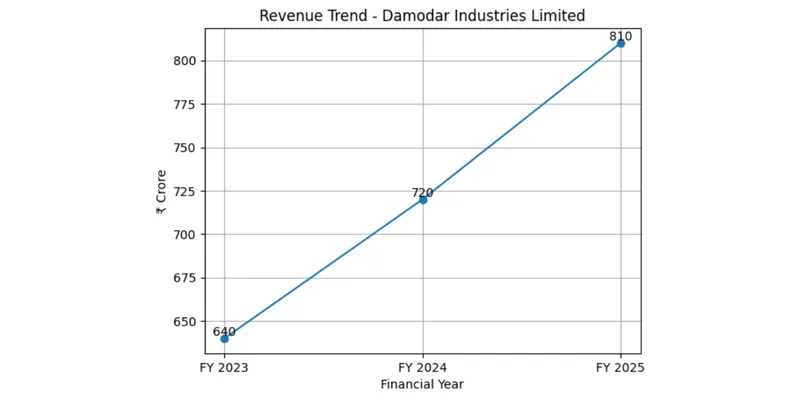
Starting at ₹640 crore, revenue climbed each year. By FY2025, it reached ₹810 crore. Growth unfolded steadily across three years. Behind the rise - steady appetite for yarn, both within India and overseas. Each financial year added momentum. Expansion took hold in multiple regions. Demand did not waver. Performance stayed on an upward slope. From 640 to 720 happened first. Then another jump followed. Markets responded positively throughout.
Profitability
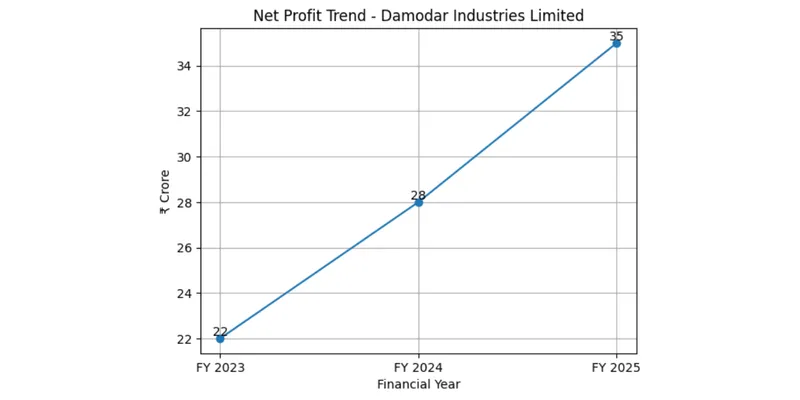
Profit rose each year: ₹22 crore in 2023, then ₹28 crore by 2024, reaching ₹35 crore in 2025. Growth suggests better management of expenses and daily operations. Even as material prices climbed, earnings held firm. Performance shows resilience under financial pressure. Steady gains reflect consistent internal improvements.
Balance Sheet Analysis
Assets stood at ₹520 crore in fiscal year 2023, rose to ₹590 crore in 2024, then reached ₹660 crore by 2025. Liabilities began at ₹320 crore, climbed to ₹350 crore, followed by a rise to ₹370 crore. Equity started lower, recorded ₹200 crore, increased to ₹240 crore, eventually hitting ₹290 crore. Growth in total resources suggests broader operations taking shape over time. Even though obligations grew steadily, ownership funds expanded more sharply. This shift supported stability within the financial structure across years.
Key Financial Ratios
Ratio | FY 2023 | FY 2024 | FY 2025 |
Net Profit Margin | 3.4% | 3.9% | 4.3% |
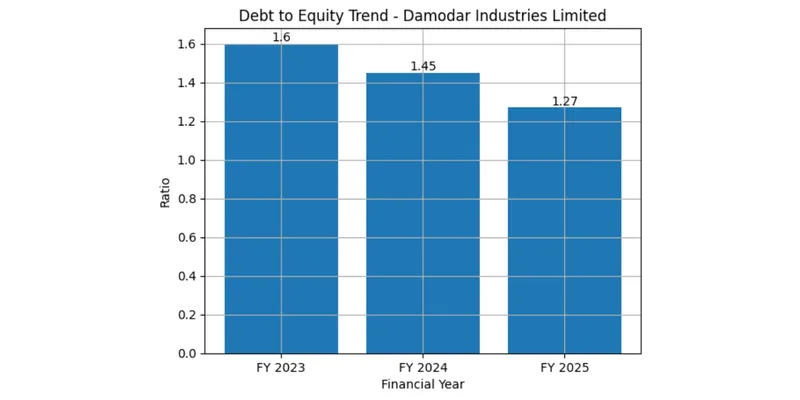
Debt to Equity | 1.6 | 1.45 | 1.27 |
Current Ratio | 1.3 | 1.4 | 1.5 |
ROE | 11% | 12% | 13% |
Even with limited pressure from financial strain, growth at Damodar Industries Limited persists. Income climbs steadily, revealing consistent performance behind the scenes. Because profits keep increasing, leadership decisions appear to be paying off. Through changing economic climates, resilience stands out across latest results.
A stronger net profit margin suggests better management of costs. Even so, debt levels stay elevated even with recent gains. The drop in debt compared to equity makes financial risk feel smaller today.
A company’s capacity to cover immediate debts seems adequate, considering current finances; meanwhile, increasing returns on equity reflect more effective utilization of shareholder funds lately. Though market shifts occur, progress indicators highlight stronger internal control over assets instead of relying solely on outside influences.
5. Key Insights and Interpretation
•Strong and consistent revenue growth
Improving profitability and efficiency
•Middle to strong influence
•Good presence in domestic and export markets
•Growth opportunities in synthetic yarn segment
6. Conclusion
Damodar Industries Limited shows consistent results, backed by solid fundamentals. Thanks to rising needs for man-made fibers, the firm finds room to grow. Its position in the marketplace strengthens resilience amid shifts. Standing firmly today comes from years of steady progress.
Still, handling its elevated debt requires attention. The firm remains on solid financial ground, looking ahead with promise - assuming operations grow leaner and spending stays under control.
References
•Financial data is referred from Moneycontrol.
•Key ratios and analysis are taken from Screener.
•Company background is studied from its official website and annual reports.
•Financial statements are verified through company disclosures.
•Additional information is referred to from Bombay Stock Exchange filings.