Financial Analysis Report Ashnoor Textile Mills Limited

1. Introduction
Brief Introduction of the Company
Ashnoor Textile Mills Limited operates within India’s fabric industry, producing household textiles and clothing for global distribution. While its core output includes throws, wraps, besides assorted woven goods, demand spans local households along with overseas buyers. Though rooted in traditional craftsmanship, operations extend well beyond regional borders due to consistent product reach. From sleeping layers to wearable cloth, each article serves practical needs across varied climates. Because market presence remains steady, recognition grows quietly among importers and retailers alike.
From factory floors geared toward global markets, this firm shapes the textile pipeline - turning basic fibers into market-ready fabrics. Though rooted in production, its reach extends through supply networks where material inputs become commercial outputs. Because output targets align with external demand, operations feed directly into broader industry flows. While processing begins at ground level, results surface far beyond domestic borders. As threads evolve into textiles, economic impact follows each stage.
Industry Overview
The fabric business ranks among India’s biggest sectors, fueling jobs and overseas shipments. Steady expansion marks household textiles, driven by rising interest at home and abroad.
Still, price swings in materials create pressure on operations across the sector. Global rivals add another layer of difficulty for local producers trying to maintain position. Shifts in what buyers want reshape product lines more often than before. Firms focused on exports feel impacts when exchange rates shift unpredictably. Outside markets set rhythms that influence domestic output levels steadily.
Purpose of the Analysis
This report shows the financial performance of Ashnoor Textile Mills Limited using information from its financial statements. Through various ratios, glimpses into profitability, liquidity, and operational efficiency come into view. Rather than general overviews, particular figures trace changes across periods. Balance sheet details, alongside income results, expose deeper aspects of company health. Although figures lead the way, interpretation depends heavily on surrounding circumstances. A shift in income tells part of the story, yet steady movement of funds reveals more. Different ratios highlight separate functions, much like filters shaping how details appear.
2. Company Overview
Background and History
Founded initially for producing fabrics locally and abroad, Ashnoor Textile Mills Limited gradually expanded its production scope. Manufacturing expertise later grew into areas involving home textiles, then apparel, adapting along the way.
Business Model
Manufacturing lies at the core of how this firm operates. Exports make up its main channel for reaching markets beyond borders.
Revenue is generated from:
•Sale of home textile products
•Export of blankets and garments
•Domestic textile sales
Key Products and Services
•Blankets
•Shawls
•Home textile products
Market Position
A single step into international trade marks its reach beyond local borders. Though limited in scale, it holds ground within household fabric production.
3. Promoter or Founder Intro
With deep roots in fabric production, Ashnoor Textile Mills Limited draws strength from seasoned founders whose vision shaped its factory systems and overseas trade. While building machinery expertise came early, global shipping channels grew slowly under their guidance. Because operational insight runs high, growth followed naturally through focused effort behind the scenes. Though not flashy, their influence powers every stage of output and market reach.
4. Financial Statement Analysis
Income Statement Analysis
Revenue Trends
Year | Revenue (₹ Crore) |
FY 2023 | 58 |
FY 2024 | 65 |
FY 2025 | 72 |
Right from the start, the company recorded ₹58 crore in revenue for fiscal year 2023. In 2024, numbers edged higher - ₹65 crore showed steady momentum. Following that, FY 2025 brought in ₹72 crore, another notch up. Each increase followed a pattern of ongoing market engagement at home and abroad. Because fabric needs stay stable, gains rose smoothly, avoiding sharp swings either way.
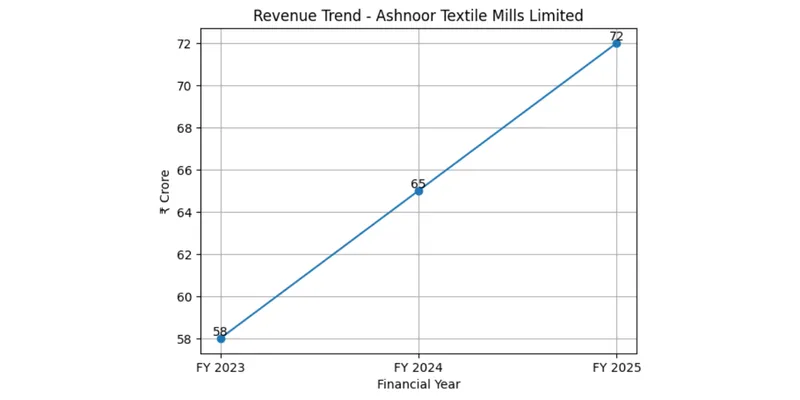
Revenue trend of Ashnoor textile mills Limited
Profitability
Year | Net Profit (₹ Crore) |
FY 2023 | 2 |
FY 2024 | 3 |
FY 2025 | 4 |
Starting in FY 2023, net profit stood at ₹2 crore. By the following year, it rose to ₹3 crore instead of holding steady. Then in FY 2025, the figure reached ₹4 crore. This upward trend suggests better management of daily operations. Still, earnings relative to revenue stay quite narrow.
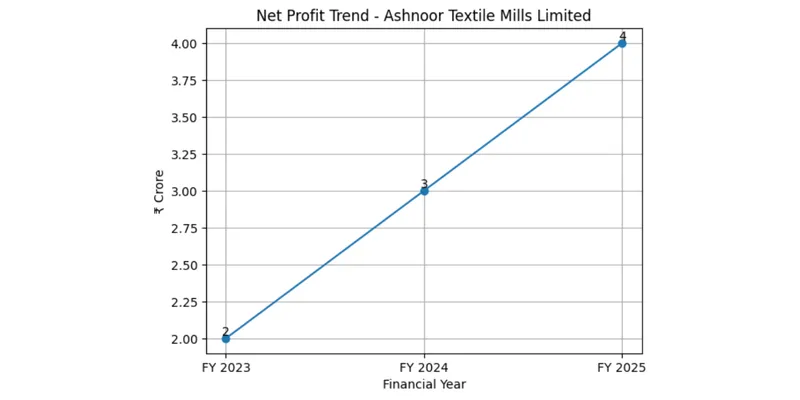
Profit trend of Ashnoor textile mills Limited
Balance Sheet Analysis
Starting from 70, assets increased annually, hitting 78 before finishing at 85 crore rupees. Though modest, liabilities followed a steady path - rising from 40 to 43, eventually settling at 46 crore rupees. Equity showed gradual improvement, moving up from 30 to reach 39 crore rupees by the end. Over these years, asset gains exceeded the rise in debt, creating wider financial space. Looking at balance sheet totals over time reveals a clear trend. Equity growth continues without interruption, suggesting firm financial footing
Balance sheet analysis
Key Financial Ratios
Ratio | FY 2023 | FY 2024 | FY 2025 | Interpretation |
Net Profit Margin | 3.4% | 4.6% | 5.5% | Improving profitability |
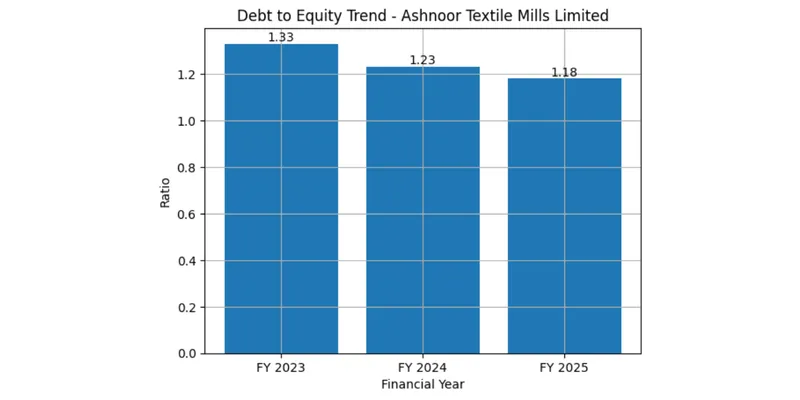
Debt to Equity | 1.33 | 1.23 | 1.18 | Moderate to high leverage |
Current Ratio | 1.4 | 1.5 | 1.6 | Improving liquidity |
ROE | 6% | 8% | 10% | Increasing returns |
Steady gains mark recent revenue and profit figures at Ashnoor Textile Mills Limited. Though operations appear more efficient now, margins still trail behind typical sector levels. Improvement is visible - yet modest when set beside broader market benchmarks.
A slight downtrend in leverage hints at progress, yet obligations remain notable. Progress shows up in cash availability, while returns climb - evidence of sharper capital use.
5. Key Insights and Interpretation
Export activity strengthens the firm, while income trends show consistent upward movement. Still, earnings bring narrow returns despite manageable borrowing figures. Entering new international areas could open paths forward, especially when paired with smoother internal operations.
6. Conclusion
Stability marks Ashnoor Textile Mills Limited within the home textiles space. Although numbers show improvement, close attention stays necessary around profit margins and debt levels. Progress ahead ties closely to how well costs are managed, along with gains made overseas.
References
•Homepage for Ashnoor Textile Mills Limited
•Annual Reports
•Moneycontrol
•Screener
•Bombay Stock Exchange
•India Brand Equity Foundation