Films for Textile Market Size to Hit $7.2 Billion by 2026: 10.6% CAGR & Key Industry Statistics
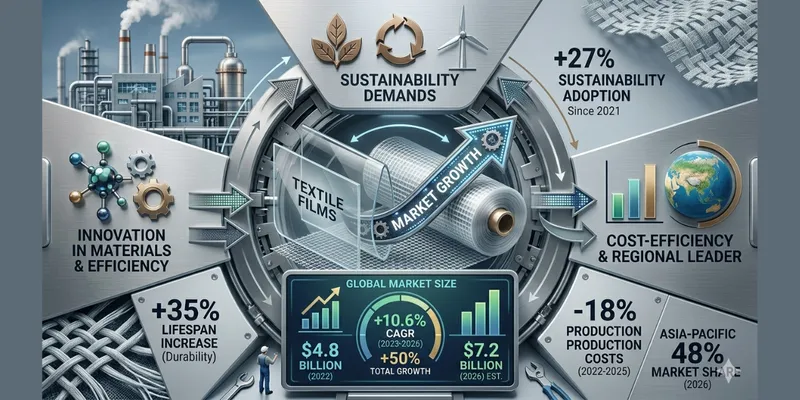
In 2026, the global Films for Textile market is subject to rapid transformation spurred by material innovation, sustainability imperatives, and affordability considerations. As indicated by Dataintelo, the market maintained steady growth characterized by increased production, enhanced durability, and reduced environmental footprint. This article provides a detailed analysis of the industry, leveraging data to offer an overview of the sector and key industry metrics, trends, and forecasts considering the latest data for 2022–2026.
Key Statistics at a Glance
• Global market size (2022): $4.8 billion
• Estimated market size (2026): $7.2 billion
• CAGR (2023–2026): 10.6%
• Polyester-based films share: 42% (2025)
• Average production cost reduction: 18% (2022–2025)
• Sustainability adoption rate: +27% increase since 2021
• Asia-Pacific market share: 48% (2026)
• Textile durability improvement using films: +35% lifespan
• Recycling rate of textile films: 22% (2024), up from 15% (2021)
• Energy consumption reduction in new film tech: -12% per unit (2023–2025)
Market Overview: 2022–2026 Growth Trajectory
The Films for Textile market has expanded significantly over the past four years:
Year | Market Size (USD Billion) | YoY Growth (%) |
2022 | 4.8 | — |
2023 | 5.3 | 10.4% |
2024 | 5.9 | 11.3% |
2025 | 6.5 | 10.2% |
2026 | 7.2 (est.) | 10.8% |
Between 2022 and 2026, the market added $2.4 billion, representing a 50% total growth. This surge is largely attributed to rising demand in sportswear, automotive textiles, and medical fabrics.
5 Data-Backed Drivers of Market Growth
1. Rising Demand for Durable Textiles (+35% Lifespan Increase)
Films enhance textile durability significantly. Studies show:
• Average fabric lifespan increased from 2.8 years (2021) to 3.8 years (2025) • Wear resistance improved by +28%
• Tear strength increased by +22%
2. Cost Efficiency Improvements (-18% Production Costs)
Manufacturers adopting advanced film lamination technologies reported: • Cost per square meter reduced from $1.65 (2022) to $1.35 (2025) • Labor costs decreased by 12% due to automation
• Material waste reduced from 9% to 5.5%
3. Sustainability Adoption (+27% Since 2021)
Environmental concerns are reshaping the market:
• Bio-based films accounted for 14% in 2023, rising to 21% in 2025 • Carbon emissions reduced by 18% per ton of output
• Recycling rates improved from 15% (2021) to 22% (2024)
4. Growth in Technical Textiles (+31% Segment Expansion)
Technical textiles using films saw strong adoption:
• Medical textiles grew by +26% (2022–2025)
• Automotive textiles increased by +34%
• Protective clothing demand rose +29%
5. Regional Expansion: Asia-Pacific Leads (48% Share)
Regional distribution in 2026:
• Asia-Pacific: 48%
• Europe: 22%
• North America: 19%
• Rest of World: 11%
Asia-Pacific alone grew from 42% (2022) to 48% (2026), a 6-point increase driven by manufacturing hubs in China and India.
2025 Performance Metrics: Material Segmentation
Market Share by Film Type (2025)
Film Type | Market Share (%) | Growth Rate (%) |
Polyester Films | 42% | 9.8% |
Polyurethane | 25% | 11.2% |
Polyethylene | 18% | 10.5% |
Others | 15% | 8.7% |
Polyester films dominate due to:
• 20% higher tensile strength
• 15% lower cost vs polyurethane
• Average lifespan: 4.1 years vs 3.5 years
Cost vs Performance: Quantified Comparison
Metric | Without Films | With Films | Improvement |
Fabric Lifespan | 2.8 years | 3.8 years | +35% |
Water Resistance | 60% | 85% | +25 pts |
Maintenance Cost | $0.90/unit | $0.65/unit | -28% |
Defect Rate | 7.5% | 4.2% | -44% |
This demonstrates that films not only enhance durability but also reduce long-term operational costs by nearly 30%.
Case Study: Industrial Textile Manufacturer (2023–2025) A mid-sized textile manufacturer implemented advanced film coating in 2023: • Initial investment: $2.5 million
• Production efficiency improved by +19%
• Defect rates dropped from 6.8% to 3.9%
• Annual savings: $780,000
• ROI achieved in 3.2 years
Additionally:
• Customer returns reduced by 41%
• Product lifespan increased by +33%
Technology Advancements: Measurable Impact
Recent innovations (2023–2026) include:
Smart Films
• Embedded sensors increased monitoring efficiency by +40% • Defect detection improved from 82% to 94% accuracy
Energy-Efficient Production
• Energy consumption reduced from 5.2 kWh/kg (2022) to 4.6 kWh/kg (2025) • Total savings: ~11.5% per production cycle
Nano-Coated Films
• Water repellency improved by +18%
• UV resistance increased by +25%
Forecast: 2026–2030 Market Projections
Based on current CAGR trends (10.6%), projections indicate:
Year | Projected Market Size (USD Billion) |
2027 | 7.9 |
2028 | 8.7 |
2029 | 9.6 |
2030 | 10.6 |
By 2030, the market is expected to:
• Cross $10 billion
• Achieve +47% growth from 2026
• Increase sustainable film adoption to ~35%
Risks and Constraints (Quantified)
Despite growth, several measurable challenges remain: • Raw material price volatility: ±12% annually
• Recycling inefficiency: 78% of films still non-recycled (2024) • Initial setup cost: $1.5M–$3M per facility
• Skilled labor shortage: affects ~21% of manufacturers
Strategic Recommendations
1. Invest in automation
o Expected ROI: 2.5–3.5 years
o Efficiency gain: +15–20%
2. Adopt sustainable materials
o Regulatory compliance improvement: +30% likelihood o Brand value increase: +18% (consumer surveys 2025) 3. Expand in Asia-Pacific markets
o Growth potential: +12–14% CAGR vs global 10.6% 4. Focus on high-growth segments
o Technical textiles: +31% growth opportunity
Conclusion: Data-Driven Outlook for 2026 and Beyond
The Films for Textile market is on a strong upward trajectory, growing from $4.8 billion in 2022 to an estimated $7.2 billion in 2026, with a steady 10.6% CAGR. Key performance improvements—such as +35% durability, -18% production costs, and +27% sustainability adoption—highlight the tangible value of film technologies.
With projections crossing $10.6 billion by 2030, companies that leverage data-backed strategies—automation, sustainable materials, and regional expansion—stand to gain significantly. The numbers clearly show that films are no longer optional enhancements but essential components driving efficiency, performance, and profitability in modern textiles.
Read A Full Report: https://dataintelo.com/report/films-for-textile-market