Fashion for Good Launches Cotton Reloop Matrix Project to Assess Recycled Cotton Yarn Quality
Cross-industry initiative will compare commercially available recycled cotton yarns across quality, price and recycled content
Fashion for Good has announced the launch of the Cotton Reloop Matrix Project, a cross-industry initiative aimed at mapping and physically validating the quality of commercially available recycled cotton yarns against brand specifications.
The project will provide the industry with a data-backed view of how quality, price and recycled content intersect in mechanically recycled cotton yarns. The initiative is convened with Fashion for Good partners Arvind, BESTSELLER, C&A, Interloop, Reformation and Shahi, along with ecosystem partner Uster.
Mechanical recycling remains an important pathway
Cotton accounts for 19% of global fibre production and remains a significant part of the global material mix. While alternative recycling pathways can utilise cotton-rich textile waste as feedstock, these processes do not produce a cotton output.
As a result, mechanical recycling remains an important pathway for using textile waste to produce recycled cotton yarns and fabrics.
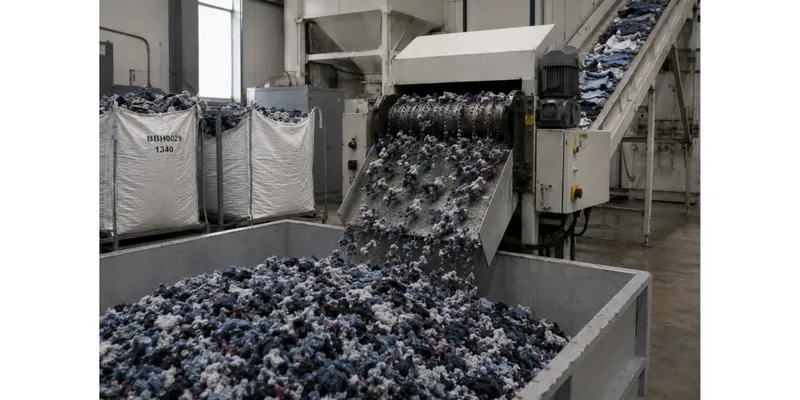
In mechanical recycling, textile waste is shredded and re-opened into loose fibres, which can then be spun into yarn. However, the process shortens and weakens the fibres. According to the project, only 45–50% of the input survives as usable material, while the remainder is lost as short fibres and processing waste.
The fibres that remain are shorter than virgin cotton, limiting the proportion that spinners can blend into new yarn. In practice, this results in most yarns being capped at around 10% recycled content, as higher proportions can affect fabric durability for commercial applications.
Project focuses on quality and commercial requirements
Although recyclers have available capacity, incorporating meaningful levels of recycled cotton into products remains challenging for brands. Quality and price are among the factors involved in evaluating recycled cotton blends.
The project identifies another challenge in the current testing process: recyclers and brands often work with separate datasets, without a shared reference for comparing yarn performance.
Brands may also assess recycled cotton blends against 100% virgin cotton standards, creating a difficult basis for comparison because recycled fibres have different performance characteristics.
The Cotton Reloop Matrix Project aims to address this gap by generating a common, data-backed overview of commercially available recycled cotton yarns and their performance against brand requirements.
The initiative argues that wider market adoption will require a shift from seeking “virgin parity” to “fit for purpose”. This approach would involve matching the performance characteristics of recycled fibres with suitable product applications and using targeted quality-enhancement pathways where higher performance is required.
Through the project, the participating organisations will work toward improving the understanding of the relationship between recycled content, yarn quality and commercial requirements, potentially supporting more informed decisions around the use of mechanically recycled cotton.