Fabrics That Fight Microbes: Inside the Antimicrobial Textile Revolution
Overview
A textile may look like an ordinary piece of fabric, but advances in medical engineering are giving fabrics much more specialized functions. Antimicrobial textiles are designed to inhibit or reduce the growth of microorganisms such as bacteria and fungi on their surface.
This technology is becoming increasingly relevant to medical engineered materials, where advanced materials are being developed for medical devices, disposables, wearables, and wound-care applications.
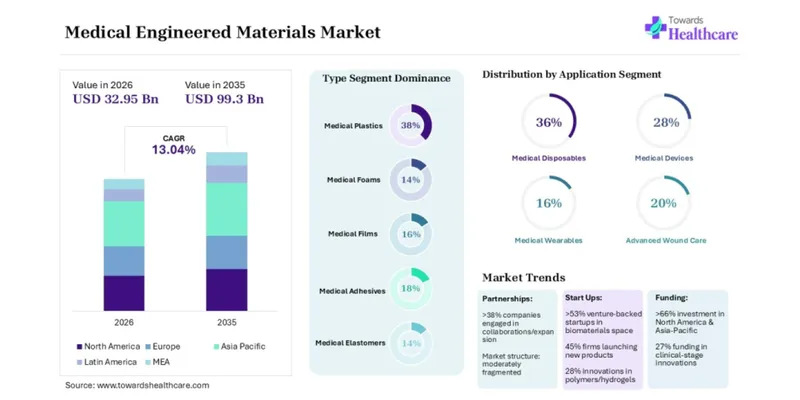
Towards Healthcare estimates that the global Medical Engineered Materials Market was valued at USD 29.15 billion in 2025 and is projected to reach USD 99.3 billion by 2035, growing at a CAGR of 13.04% from 2026 to 2035.
What Are Antimicrobial Textiles?
Antimicrobial textiles are fabrics treated or engineered with substances that can inhibit the growth or survival of microorganisms.
The antimicrobial function can be built into the fiber itself or added through coatings, finishes, or other treatment processes. Common technologies include silver, copper, zinc oxide, quaternary ammonium compounds, and selected organic antimicrobial agents.
The choice depends on the intended application, durability requirements, safety considerations, and performance of the finished textile.
How Do They Work?
The basic idea is simple: create a textile surface that makes it difficult for microorganisms to survive and multiply.
For example, silver-based technologies can release silver ions that interact with microbial cells and interfere with important cellular processes. Copper-based materials can also affect microorganisms through multiple mechanisms.
Other antimicrobial approaches may disrupt microbial cell membranes or create surface conditions that limit microbial growth.
The actual performance depends on factors such as the antimicrobial agent, concentration, fabric structure, moisture, contact time, and method of application.
Where Are Antimicrobial Textiles Used?
Healthcare is one of the most important application areas.
Antimicrobial textiles can be incorporated into:
- Hospital gowns and uniforms
- Surgical textiles and drapes
- Bed linens and mattress covers
- Patient clothing
- Curtains and privacy fabrics
- Wound-care materials
- Face masks and protective products
- Healthcare facility furnishings
Beyond healthcare, antimicrobial textiles are also being explored in sportswear, footwear, home textiles, hospitality, and personal-care applications.
Supporting Infection Control
Hospitals use multiple measures to control infection, including hand hygiene, environmental cleaning, sterilization, disinfection, and appropriate use of personal protective equipment.
Antimicrobial textiles are not a replacement for these measures. Instead, they can provide an additional material-level approach to managing microbial growth on textile surfaces.
This is particularly relevant for frequently handled or repeatedly exposed textile products.
Why Are Antimicrobial Textiles Attractive?
Longer-Lasting Fabric Performance
Some antimicrobial treatments are designed to remain effective through repeated use and washing.
For reusable healthcare textiles, durability is especially important because the antimicrobial performance needs to remain compatible with the product's intended lifecycle.
Added Protection
Antimicrobial properties can help reduce microbial growth on the textile surface, potentially supporting broader hygiene strategies.
However, the level of protection varies by technology and product, so performance claims need to be supported by appropriate testing.
Multiple Material Options
Manufacturers can select different antimicrobial technologies depending on the desired application.
Silver, copper, zinc-based materials, chemical finishes, and emerging bio-based approaches provide different performance and processing characteristics.
Challenges and Limitations
Antimicrobial textiles also face important challenges.
Durability: Some treatments can lose effectiveness after repeated washing, abrasion, or exposure to chemicals.
Safety: Materials used in products that contact skin or patients need appropriate safety assessment. Potential toxicity, irritation, and exposure must be considered.
Microbial resistance: Continued and inappropriate use of antimicrobial substances can raise concerns about microbial adaptation and resistance, depending on the active agent and application.
Cost: Advanced antimicrobial materials and treatment processes can increase manufacturing costs compared with conventional textiles.
Performance claims: "Antimicrobial" does not automatically mean that a textile prevents infection. Laboratory antimicrobial activity and real-world clinical outcomes are different measures and should not be treated as equivalent.
Sustainability Question
The antimicrobial textile industry is also facing a sustainability challenge.
Some products combine synthetic fibers with chemical or metal-based antimicrobial treatments, making end-of-life management more complicated.
This is encouraging research into durable finishes, lower-impact manufacturing processes, recyclable materials, and bio-based antimicrobial technologies.
The goal is not simply to make textiles antimicrobial, but to develop products that balance performance, safety, durability, cost, and environmental impact.
Conclusion
Antimicrobial textiles represent an important shift in how fabrics can be designed for healthcare and other demanding environments.
From hospital gowns and bedding to wound-care products and protective textiles, these materials show how traditional fabrics can take on more specialized functions.
As material science advances, the next generation of antimicrobial textiles is likely to focus on smarter formulations, longer-lasting performance, safer materials, and more sustainable production. The fabric may still look ordinary, but the technology working within it is becoming increasingly sophisticated.
About Author
Payal Rabde is a Healthcare Market Research Analyst at Towards Healthcare Research & Consulting with over 4+ years of experience in pharmaceutical, biotechnology, medical device, and healthcare market research. She holds an MBA in Pharmaceutical-Biotechnology Management and a B.Pharm, specializing in market analysis, forecasting, competitive intelligence, and strategic healthcare insights.
About Us

Towards Healthcare Research & Consulting is a global strategy consulting firm with a presence in both Canada and India. We provide innovative solutions tailored to the healthcare sector, helping business leaders overcome challenges and accelerate growth. We specialize in delivering advanced technological solutions, clinical research services, and powerful data analytics. Our focus is on building meaningful partnerships that foster innovation and deliver actionable insights to drive success in healthcare.
Reference:
https://pmc.ncbi.nlm.nih.gov/articles/PMC8275915/
https://www.towardshealthcare.com/insights/medical-engineered-materials-market-sizing
https://www.towardshealthcare.com/insights/medical-clothing-market-sizing