European Commission Imposes Provisional Anti-Dumping Duties on PET Spunbond Imports from China
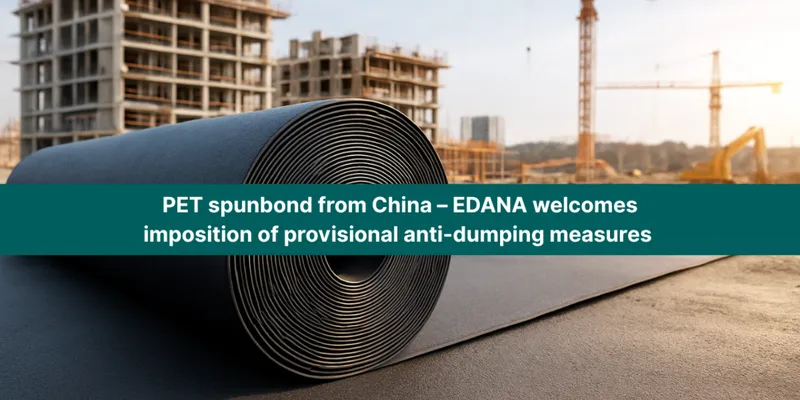
EDANA says EU measures aim to address market distortion and support fair competition for European nonwovens producers
Brussels, Belgium, 15 May 2026 – The European Commission has imposed provisional anti-dumping duties ranging from 45.6% to 50.0% on imports of PET spunbond from China following an eight-month investigation completed on 13 May 2026.
EDANA stated that the measures reflect the Commission’s efforts to address unfair trade practices affecting EU manufacturers of PET spunbond materials.
According to the Commission’s findings, Chinese producers exported PET spunbond products into the EU market at dumped prices, resulting in material injury to the European industry. The investigation identified impacts including declines in production, sales, and profitability among EU manufacturers.
The provisional anti-dumping measures are intended to restore fair market conditions, support European industrial operations, and maintain competitiveness within the EU manufacturing sector.
“It is encouraging to see the EU institutions are determined to support EU industries during these globally difficult times. EU production creates a lot of added value to our economy, and it is essential for the stability and prosperity of our continent that EU industrial value chains are not exposed to unfair, state-supported market behaviours on their home markets”, said Jacques Prigneaux, Market Analysis & Economic Affairs Director at EDANA.
The provisional duties will remain applicable until 13 November 2026. During this period, the European Commission will continue its assessment before deciding whether to impose definitive anti-dumping duties for a five-year term. The Commission may also decide to apply definitive measures retroactively for up to 90 days before the provisional measures entered into force.
Jacques Prigneaux added: “EDANA and the EU industry will continue to cooperate fully with the Commission during the remainder of the proceedings. We look forward to final measures which maintain a level playing field on the EU market. We also want to remind all parties of the legal requirement to declare imports under the correct customs code. Accurate use of TARIC codes is fundamental to ensuring the proper application of trade measures and avoiding material risks in customs compliance and import processing.”
The products covered by the investigation include certain non-woven needle-punched sheets of polyester filaments, whether or not reinforced with glass fibers, weighing more than 70 g/m² and with a thickness exceeding 0.5 mm but not exceeding 1.8 mm. The products are impregnated with one or more binders, contain less than 30% glass fibers by weight, and are not coated or covered.
The affected products fall under CN codes ex 5603 13 90, 5603 14 20, and ex 5603 14 80, including TARIC codes 5603 13 90 70 and 5603 14 80 70.