EU Textile EPR Rules: Industry Seeks Clarity on PPE and Medical Gear
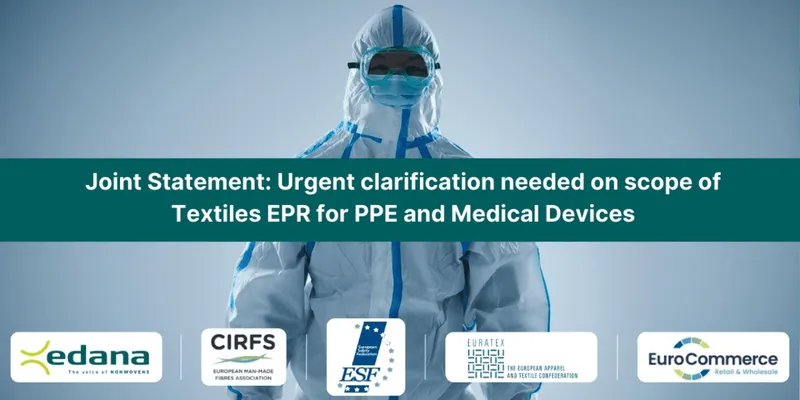
European industry bodies warn that current EPR wording risks misclassifying PPE and medical textiles.
A joint statement from five associations urges the European Commission to clarify that protective and medical-grade textiles should not fall under standard EPR obligations due to safety, regulatory, and circularity constraints.
Five leading European industry bodies have jointly called for urgent clarification on how the EU’s new Extended Producer Responsibility (EPR) rules for textiles will apply to Personal Protective Equipment (PPE) and Medical Devices (MD).
In a coordinated appeal, EDANA, representing the nonwovens sector, joined CIRFS, EURATEX, the European Safety Federation (ESF), and EuroCommerce to raise concerns over the implementation of Directive (EU) 2025/1892, the targeted revision of the Waste Framework Directive.
As Member States begin transposing the legislation, the organisations warn that Annex IVc fails to differentiate between everyday clothing and specialised PPE or medical textiles. The CN codes listed in the Directive group all textile-based products together, creating a regulatory overlap that could compromise both health and environmental safety.
The joint statement underscores that PPE and Medical Devices are designed for frontline protection against chemical, biological, and radiological hazards. Once used, these items often become contaminated and are classified as hazardous waste, which must be managed through incineration—commonly with energy recovery—rather than recycling.
Including such high-risk products within standard EPR schemes for household textiles, the associations argue, could have serious consequences:
- Cross-contamination risks: Combining hazardous PPE waste with consumer textiles could endanger workers, the public, and the environment.
- Regulatory inconsistency: Disposal of contaminated PPE is already governed by strict rules under Articles 13, 17, 18, and 19 of the existing Waste Framework Directive.
- Minimal circularity potential: PPE represents less than 1% of textile waste, and 80–90% of it is treated as hazardous. The remaining small fraction offers negligible environmental benefit when recycled, particularly when weighed against the transport needed to consolidate such low volumes.
The statement further requests clarity on safety shoes, which face the same contamination issues and limited recyclability. Manufacturers, the organisations note, cannot guarantee warranties or regulatory conformity for reused protective footwear, and there is still no explanation of how EPR fees will scale for heavy PPE items such as steel-toed boots.
The associations point to Recital 28, which explicitly states that products posing safety or hygiene risks should be excluded from the scope of textile EPR. Despite this, several national approaches, including in Spain and the Netherlands, are reportedly disregarding this consideration.
To prevent misapplication of the legislation, the signatories are urging the European Commission to issue firm guidance confirming that textiles falling under the PPE Regulation (2016/425) and the Medical Devices Regulation (2017/745) are outside the scope of the new Textiles EPR obligations.