Essentials of Employment-Oriented Skilling in the Textile Industry – SAMARTH
Dr. Muralidhara K. S Joint Director Textiles Committee, Ministry of Textiles, Govt. of India
Abstract India’s demographic advantage, with a young and expanding workforce, presents both an opportunity and a challenge for sustainable economic growth. While initiatives like Skill India and PMKVY have expanded the skilling ecosystem, a significant gap persists between workforce capacity and industry requirements, particularly in the textile sector—one of India’s largest employers and contributors to GDP. To address this, the Ministry of Textiles launched the Scheme for Capacity Building in the Textile Sector (SAMARTH) in 2017, a demand-driven and placement-oriented program aimed at enhancing employability and supporting industry-led job creation. SAMARTH operates through a structured institutional framework and targets training 10 lakh individuals across diverse sub-sectors of textiles, excluding organised spinning and weaving. By July 2025, the scheme had trained over 4.65 lakh candidates, with more than 70 percent placed in organised industry roles, ensuring social inclusivity with significant participation from women and marginalised groups. The Textiles Committee, acting as the Resource Support Agency (RSA), standardises curricula, training infrastructure, assessments, and trainer development to align with National Skills Qualifications Framework (NSQF) standards. With a strong focus on practical, industry-relevant training, SAMARTH not only bridges critical skill gaps but also strengthens the long-term competitiveness of India’s textile sector, contributing to both employment generation and global market expansion.
Introduction
Historically, powerful nations are built on the strength and skill of its people. Driven by its vast industrial hubs and armies of skilled workers, China rose as a global manufacturing powerhouse during the 20th century. India stands at a similar crossroads today. By 2025, the nation is projected to have a workforce of nearly 750 million, offering a tremendous demographic dividend. However, unlocking this potential depends on equipping workers with the right skills. India currently is the fastest-growing major economy in the world. However, the skilling was not a national policy till the beginning of 21 century. When India’s growth rate accelerated from 3.5 percent (1980s) to 5.4 percent (1990s), early signs of a skills gap began to appear. The challenge became even more evident when GDP growth surged to 7.3 percent during 2002–2007, prompting a major shift in policy discussions. For the first time, the 11th Five-Year Plan included a dedicated chapter on the skill development challenges confronting the nation (Planning Commission, 2008). India’s economic transformation is being shaped by a powerful demographic shift with far-reaching implications for skills development. A significant share of the country’s GDP growth has been driven by the rising proportion of working-age individuals within the total population. Today, India is among the youngest nations globally, with more than 54 percent of its population under the age of 25 and over 62 percent within the working-age bracket of 15–59 years. Over the coming decade, the population pyramid is expected to swell further in this age group. However, this demographic advantage is not indefinite—it is projected to last only until 2040. In contrast, China’s demographic dividend ended by 2015 (World Bank, 2012). India, therefore, has a limited window of opportunity to leverage its demographic potential and address critical skill shortages.
Shortage of Skilled Manpower
Off the late Indian industry faces a severe shortage of well-trained, skilled workers. It is true in blue-collar as well as white collared job roles, more pronounced at the shop floor level. India is currently facing a 64 per cent skill shortage at all industrial levels. Formal skill training in India is significantly lower than in many other countries. Only 2.3% of India's workforce has received formal training, a stark contrast to the high rates seen in nations like South Korea (96%), Japan (80%), Germany (75%), the UK (68%), and the USA (52%). Large sections of the educated Indian workforce have little or no job skills, making them largely unemployable. Therefore, India must focus on scaling up skill training efforts to meet the demands of employers and drive economic growth. Due to the government initiatives as well as industry participation the India's skilling capacity is growing. However, it is still insufficient for its massive workforce and objective to put itself in the China plus one policy. It is observed that nearly 50 per cent of college passouts are not directly employable as there exists a significant skills gap. The enormity of India’s skilling challenge is further aggravated by the fact that skill training efforts cut across multiple sectors and require the involvement of diverse stakeholders such as multiple government departments at the centre and state levels, private training providers, educational and training institutions, employers, industry associations, assessment and certification bodies and trainees. Efforts like the Skill India Mission, Pradhan Mantri Kaushal Vikas Yojana (PMKVY), Deen Dayal Upaday Grameen Vikas Yojana (DDUGKY), Viswakarna and other ministry-specific skilling programs have trained millions, focusing on industry-relevant skills and upskilling. However, a coordinated, scaled-up approach is needed to bridge the gap between the enormous labour force and the available skilled jobs. From 2013 to 2022, the National Skill Development Corporation (NSDC) analysed the growing need for skilled workers in 24 key industries. The findings were published in a series of Human Resource Requirement Reports. These reports provide sector-specific overviews, assess skill demand, identify key job roles, map supply-side infrastructure, and offer actionable recommendations.
Important Skill Initiatives of the Government Sector
Employment Linked Skill Development Program
Developing skills is essential for raising productivity levels and helping workers secure decent work. Skill development is only effective when paired with job creation. By fostering the growth of small and medium-sized enterprises (SMEs), the government plays a pivotal role in creating additional employment opportunities and engaging the entire workforce. India is confronted with the challenge of a growing labour force, with millions of youth entering the labour market very year. There are currently about 122 million young people in the 15–19 age group. More than 90% of India's workforce is in the unorganised sector, where jobs are often low-skilled and low-paying. A major contributor to this problem is a lack of training—four out of five new workers entering the workforce have never had the chance to receive skills training. Appropriate skills policies can also contribute to more inclusive growth and reduce gaps between men and women, rural and urban areas, and organised and unorganised employment. Countries operating a vocational training system with a strong component of training in enterprises combined with training in vocational schools or training centres have lower levels of youth unemployment. The most famous example is Germany’s dual apprenticeship system, but other countries, including emerging and developing countries in all regions of the world, have developed different mechanisms to integrate more closely learning and work, including through the development of programs that combine entry-level training with workplace training. The great example is the “Scheme for Capacity Building in Textile Sector (SAMARTH) – Employment Linked Program of Ministry of Textile, Govt. of India.
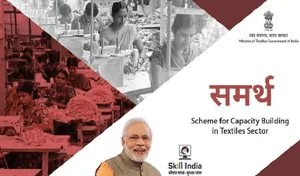
“Scheme for Capacity Building in Textile Sector (SAMARTH) – Employment Linked Program (SAMARTH)
The textile industry is a key pillar of India’s economy, contributing over 2 per cent to the national GDP and holding a 4 per cent share in the global textile market. With a Compound Annual Growth Rate (CAGR) exceeding 15 per cent, this industry ranks as the second-largest employer in the country, providing direct employment to approximately 4.5 crore people and indirectly supporting another 6 crore. India’s textile sector is characterised by small-scale, non-integrated spinning, weaving, finishing and apparel-making enterprises. In the recent past, Indian textile production has increased significantly to fulfil the needs of both domestic and international markets. According to recent projections, the value of textile exports from India is well on its way to meeting the USD 100 billion target by the end of this decade. By the end of 2030, the Indian textile industry is expected to show a whopping 3X increase in productivity. What’s more, this sector also has the potential to generate more than 15 million new employment opportunities. However, the acute shortage of skilled manpower is one of the major constraints to meeting the target. It is estimated that seven out of every ten workers in the textiles sector have a very basic education. Therefore, they are unable to take their skillset forward or help the sector grow beyond a certain point. Faced with twin challenges of unemployment and job creation, it is the need of the hour for policymakers and industry leaders to think about how the textile sector can boost new opportunities and overcome the acute shortage of skilled manpower. The skill development activities should be such that they enhance the skill set, along with creating new job opportunities and drive the skilled person to high-paying job roles. One of the key initiatives of the Ministry of Textiles, Government of India, is the employment-linked “Scheme for Capacity Building in Textile Sector (SAMARTH)”, launched in 2017. The scheme was designed to provide demand-driven, placement-oriented skill development programs, thereby supporting industry efforts to create jobs in the organised textile and related sectors while ensuring sustainable livelihoods across diverse sections of society throughout the country. SAMARTH operates through a well-defined institutional framework comprising an Inter-Ministerial Committee, an Empowered Committee, a Project Management Unit, and a Resource Support Agency (RSA). With an ambitious target of training 10 lakh people, the scheme has been extended up to 2026. The objectives of the SAMARTH scheme are as follows
- To provide job-focused training that meets the National Skills Qualifications Framework (NSQF) standards. This program is designed to meet the industry's need for skilled workers in the organised textile and related sectors, but it excludes the spinning and weaving segments.
- To enhance skills and upgrade the abilities of artisans and workers in traditional Indian sectors like handlooms, handicrafts, sericulture, and jute.
- To enable the provision of sustainable livelihood, either by wage or self-employment, to all sections of society across the country.
The SAMARTH scheme has the concept of creating a workforce from Non-Worker to Worker who will be compatible with the industry's needs. Anyone non-working person of age 14 or more with able to read and write is eligible to be enrolled as a trainee with implementing partners. The other component of SAMARTH skilling is up-skilling and re-skilling of existing workers. The industry and the industry association are the implementing Partners of the program. Providing employment is an essential part of the SAMARTH. At least 70 per cent of trained persons need to be placed for completion of the project by Implementing Partners. Currently, there are 164 Implementing Partners providing skilling training through nearly 4000 training centres across the warp and weft of the country. The skill training is spread into 10 sub-sectors of the textile production cycle, excluding organised weaving and spinning. The 10 sub-sectors include Garment, Knitting, Processing, Handicraft & Carpet, Textile & Handloom, Silk, Jute, Man-Made, Wool and Technical Textile. As on July 2025, more than 4.65 lakh people have been trained through the entry-level skilling SAMARTH scheme and another 2200 trained under the Reskill/Upskill program. More than 70 percent trained in the organised sector, like garment, knitting, processing, etc, are employed in the industry. One of the features of the SMARTH scheme is that it has maintained social balance in the skilling program, as trained from scheduled cast constitute 26.94 per cent, scheduled tribe constitute 12.67 percent. The skilling the extended through 114 NSQF-aligned courses across all value chain except spinning and weaving. There are 6 courses engaged for Upskilling & Re-skilling purposes. The top-performing state of SAMARTH includes
Resource Support Agency (RSA)
The Ministry of Textiles has designated the Textiles Committee as the Resource Support Agency (RSA) for the Samarth for providing resources in various sectors like Garment, Knitting, Processing, other unorganised Textile sector and traditional sectors like Jute, Silk, Handloom, Handicraft & Carpet. The Main Objectives of the RSA include
- To identify and finalise the skill development needs in consultation with the Sector Skill Councils (SSCs) and industry.
- To standardise the course content and to develop the content.
- To specify the Training Centre’s infrastructure with reference to the NSQF courses.
- To standardise the admission, assessment, certification and accreditation processes in consultation with the SSCs and industry to ensure consistency and acceptability by various stakeholders.
- To empanel Assessment Agencies and to monitor their performance.
- To conduct Training of Trainers (ToTs) and Training of Assessors (ToAs) in coordination with the respective SSCs.
- To conduct skill gap studies from time to time and build up a skill database for the industry.
- To study the global scenario and best practices in skilling in the textile sector.
The RSA has developed 80 entry-level training courses. The contents for each course are needs-based to meet the highest standards and requirements of the related industry segment, including awareness about the labour laws. Courses duration standardised to 300 hrs. Syllabus developed with stress on practical competency, 70 per cent to be spent on practical and 30 per cent on theoretical inputs. The theoretical inputs include basic terminologies, description of parts and function of the machine, activities involved in the operation of the machine, instructions for shift change, safety aspects, etc. Each training centre will be run by a qualified and trained trainer and support staff. The capacity of trainers will be enhanced through a comprehensive Training of Trainers (ToT) Program. There are more than 3500 trained trainers present. The RSA has also made an exhaustive infrastructure required to run each of the training programs. These infrastructure requirements are mandatory. RSA has empanelled 59 assessment agencies to carry out the Assessment of trainees. There is a pool of more than 4000 assessors conducting assessments both on theory as well as practice.
Conclusion
The SAMARTH scheme represents a pivotal step in addressing the acute skill shortages that constrain India’s textile sector, one of the nation’s largest employers and economic contributors. By aligning skilling initiatives with industry needs, ensuring social inclusivity, and emphasising employment-linked training, the program not only empowers workers but also strengthens the sector’s global competitiveness. With over 4.65 lakh individuals already trained and a strong institutional framework in place, SAMARTH has laid a foundation for sustainable livelihoods, productivity enhancement, and balanced regional growth. However, to fully harness India’s demographic dividend and meet the ambitious targets of employment generation and export growth, continued collaboration among government, industry, and training partners is essential. SAMARTH is thus not merely a skilling initiative but a transformative force in shaping the future of India’s textile industry and its workforce.