ERP Software for Apparel & Textile Industries Market to Surpass USD 18.7 Billion by 2033 Amid 14.2% CAGR Growth
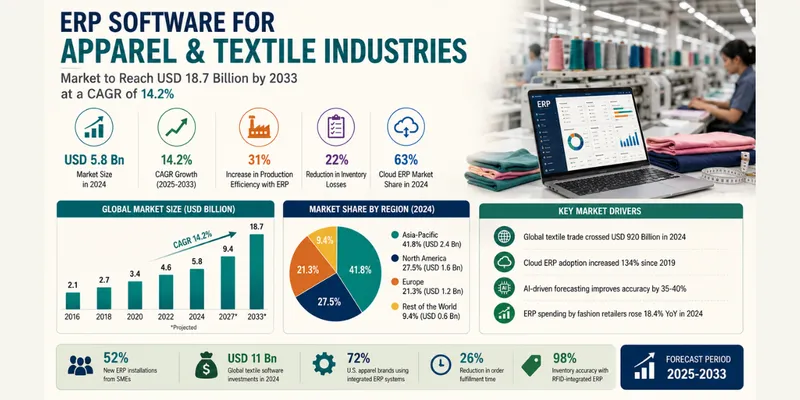
The global ERP Software for Apparel & Textile Industries market is witnessing accelerated adoption as textile manufacturers and apparel brands digitize supply chains, inventory systems, and production management. According to recent industry estimates highlighted by Dataintelo, the market was valued at nearly USD 5.8 billion in 2024 and is projected to exceed USD 18.7 billion by 2033, expanding at a robust 14.2% CAGR during 2025–2033.
The increasing complexity of global textile trade, which crossed USD 920 billion in 2024, has pushed apparel manufacturers toward integrated ERP solutions. More than 68% of apparel manufacturers now use cloud-based enterprise software compared to just 29% in 2018. Rising automation, AI-driven inventory forecasting, and real-time supply chain visibility are major growth accelerators for the ERP Software for Apparel & Textile Industries market.
Key Numerical Highlights
• Global market size reached USD 5.8 billion in 2024
• Forecast valuation expected at USD 18.7 billion by 2033
• CAGR projected at 14.2% from 2025 to 2033
• Cloud ERP adoption in textile firms increased by 134% since 2019
• Apparel inventory losses declined by 22% after ERP implementation • Textile production efficiency improved by 31% using AI-integrated ERP systems • Asia-Pacific accounted for 41.8% market share in 2024
• North America generated over USD 1.6 billion revenue in 2024
• ERP spending by fashion retailers increased 18.4% YoY in 2024
• SMEs represented 52% of new ERP installations globally
Historical Market Performance (2016–2024)
The ERP Software for Apparel & Textile Industries market has demonstrated consistent expansion over the past decade. In 2016, the global market size stood at approximately USD 2.1 billion. By 2020, the market had already crossed USD 3.4 billion, driven by Industry 4.0 investments and growing digitization in textile factories.
Between 2021 and 2024, demand accelerated significantly due to post-pandemic supply chain disruptions. Textile companies increased ERP-related investments by nearly 27% annually to improve operational resilience and inventory planning.
Year-wise Market Growth Snapshot
Year | Market Size (USD Billion) | YoY Growth |
2016 | 2.1 | 7.2% |
2018 | 2.7 | 9.1% |
2020 | 3.4 | 10.8% |
2022 | 4.6 | 12.7% |
2024 | 5.8 | 14.1% |
2027 | 9.4 | 15.2% |
2033 | 18.7 | 14.2% CAGR |
Cloud ERP Driving Major Revenue Growth
Cloud deployment models dominate the ERP Software for Apparel & Textile Industries market, accounting for nearly 63% of total deployments in 2024. This share was only 38% in 2019, indicating rapid migration away from on-premise systems.
Cloud ERP solutions reduce operational IT costs by nearly 32%, while implementation timelines have shortened from 14 months in 2017 to just 6–8 months in 2025. Subscription based ERP spending in textile manufacturing surpassed USD 2.9 billion in 2024.
AI-powered ERP modules are also improving forecasting accuracy by 35–40%, helping apparel brands minimize overproduction and reduce warehouse costs.
Regional Analysis of ERP Software for Apparel & Textile Industries
Asia-Pacific
Asia-Pacific remains the largest regional market with 41.8% global revenue share in 2024. Countries such as China, India, Bangladesh, and Vietnam dominate textile manufacturing output.
The region generated over USD 2.4 billion in ERP revenue during 2024. Textile exports from Asia-Pacific crossed USD 410 billion, increasing the need for real-time production and compliance management software.
North America
North America held approximately 27.5% market share in 2024. The regional market surpassed USD 1.6 billion, supported by strong investments in AI-enabled ERP platforms.
More than 72% of U.S. apparel brands now utilize integrated ERP systems for omnichannel retail management. ERP implementation reduced order fulfillment times by an average of 26% across North American textile companies.
Europe
Europe accounted for nearly 21.3% share of the global market in 2024. Sustainability regulations in the European Union are accelerating ERP adoption for compliance tracking and carbon reporting.
German and Italian textile manufacturers increased ERP modernization spending by 19% YoY in 2024. Smart factory investments in Europe exceeded USD 3.8 billion last year.
Industry Trends and Enterprise Investments
The ERP Software for Apparel & Textile Industries market is increasingly integrating AI, IoT, and predictive analytics. Nearly 48% of textile enterprises now use AI-driven ERP analytics for demand forecasting.
Major apparel firms allocate between 3% and 6% of annual revenue toward digital transformation initiatives. In 2024 alone, global textile software investments crossed USD 11 billion.
Key industry developments include:
• RFID-integrated ERP systems improving inventory accuracy by up to 98% • Automation reducing manual processing costs by 25–30%
• Mobile ERP usage among textile sales teams rising by 44% since 2021 • Real-time production monitoring improving factory utilization rates by 18%
Future Outlook Through 2033
The future of the ERP Software for Apparel & Textile Industries market remains highly promising as smart manufacturing expands globally. By 2030, nearly 82% of large apparel manufacturers are expected to operate fully cloud-based ERP ecosystems.
AI-enabled ERP platforms are projected to contribute over USD 6.2 billion in annual market revenue by 2033. Asia-Pacific is forecast to maintain dominance with more than 44% share by the end of the forecast period.
Growing textile exports, sustainability compliance requirements, and omnichannel retail expansion will continue driving demand. With the market anticipated to climb from USD 5.8
billion in 2024 to USD 18.7 billion by 2033, the ERP Software for Apparel & Textile Industries sector is positioned as one of the fastest-growing enterprise software segments globally.
Read A Full Report: https://dataintelo.com/report/erp-software-for-apparel-textile industries-market