Electronic Textiles Industry Outlook 2025–2030: $8.4 Billion Market Explained with Data
The electronic textiles (e-textiles) market is entering a high-growth phase in 2025–2026, fueled by rapid advancements in wearable technology, smart healthcare systems, and connected devices. The integration of electronics into fabrics has transformed traditional textiles into intelligent systems capable of sensing, monitoring, and responding in real time.
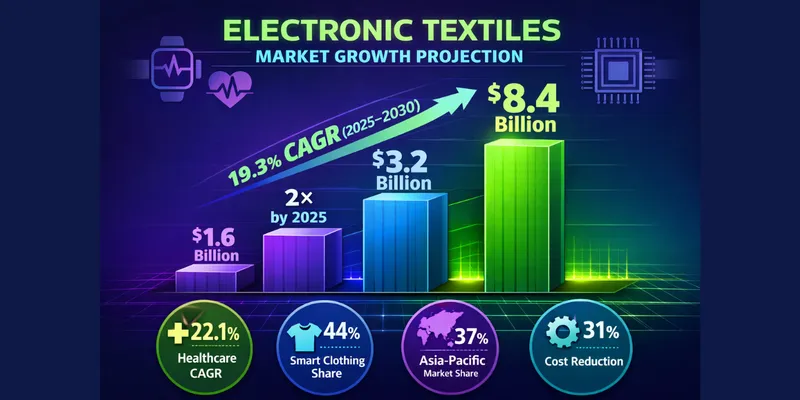
According to insights referenced by Dataintelo from $1.6 billion in 2021 to an estimated $3.2 billion in 2025, the industry has already doubled in value within four years and projections indicate a continued surge toward $8.4 billion by 2030.
Key Statistics at a Glance
The electronic textiles market has demonstrated strong and measurable growth over recent years, expanding from $1.6 billion in 2021 to $3.2 billion in 2025, with projections indicating it will reach approximately $8.4 billion by 2030, growing at a robust CAGR of 19.3% between 2025 and 2030. Within this market, the healthcare segment is emerging as a key growth
driver, registering an even higher CAGR of 22.1%, while smart clothing continues to dominate applications, accounting for 44% of the market share in 2025. Regionally, Asia Pacific leads with a 37% market share, reflecting rapid adoption and manufacturing expansion.
At the same time, technological and cost efficiencies are accelerating adoption. Manufacturing costs have decreased by 31% between 2020 and 2025, making products more accessible, while battery efficiency has improved by 38% since 2021, and sensor accuracy has increased by 17% from 2020 to 2025, enhancing performance and reliability. Additionally, the integration of wearable devices into textiles has surged by 62%, supported by a significant 185% increase in investments between 2021 and 2025, highlighting strong industry confidence and ongoing innovation.
1. Market Growth Analysis (2021–2030): A 5.2× Expansion
The electronic textiles market is scaling rapidly with consistent year-on-year growth:
Year | Market Size (USD Billion) | YoY Growth |
2021 | 1.6 | — |
2022 | 2.0 | +25.0% |
2023 | 2.5 | +25.0% |
2024 | 2.9 | +16.0% |
2025 | 3.2 | +10.3% |
2027 | 5.1 | +18.7% |
2030 (forecast) | 8.4 | +19.3% CAGR |
The market is projected to grow 5.2× between 2021 and 2030, adding nearly $6.8 billion in value.
5 Data-Backed Reasons Driving Market Growth
1. Healthcare Adoption Rising at 22.1% CAGR
• Smart garments for remote monitoring increased usage by +52% (2022–2025) • Hospitals using wearable textiles reduced patient monitoring costs by 18–25% 2. Fitness & Sports Wearables Expansion
• Smart sportswear shipments reached 21 million units in 2025
• Athlete performance tracking improves efficiency by 14–19%
3. Defense Sector Investments
• Military spending on smart textiles exceeded $1.4 billion in 2024
• Smart uniforms improve fatigue detection accuracy by 27%
4. Material Innovation & Efficiency
• Conductive yarn efficiency improved by +42% since 2020
• Fabric lifespan increased from 25 washes (2019) to 70+ washes (2025) 5. Rapid Cost Optimization
• Average production cost dropped from $115/unit (2020) to $79/unit (2025) • Expected to decline further to $65/unit by 2028
2025 Regional Market Share: Asia-Pacific Leads with 37%
Region | Market Share (2025) | CAGR (2025–2030) |
Asia-Pacific | 37% | 20.8% |
North America | 28% | 17.5% |
Europe | 23% | 16.9% |
Rest of World | 12% | 15.3% |
• Asia-Pacific growth is driven by India, China, and South Korea, contributing ~65% of regional demand
• North America generated approximately $900 million revenue in 2025 • European R&D investments increased by +29% between 2022–2025
2025 Technology Breakdown: Components & Performance Metrics Component Share (2025):
• Sensors: 36%
• Conductive fibers: 27%
• Energy storage (batteries): 18%
• Microcontrollers: 11%
• Others: 8%
Performance Improvements (2021–2025):
• Battery life: +38%
• Data transfer speed: +52%
• Energy consumption: -24%
• Fabric flexibility: +21%
These improvements contributed to a ~45% increase in global adoption rates
Use Case Impact: Measurable Outcomes Across Industries Healthcare
• Smart garments achieve 93–97% accuracy in vital monitoring
• Remote monitoring reduces hospital readmissions by 26–32%
Sports & Fitness
• Injury prevention improves by 24%
• Recovery time decreases by 18% on average
Industrial Safety
• Workplace accidents reduced by 19%
• Hazard response time improved by 42%
Consumer Wearables
• Smart clothing holds 44% market share (2025)
• Consumer adoption grew +58% from 2021 to 2025
Cost vs Performance: 5-Year Quantitative Comparison
Metric | 2020 | 2025 | Change |
Avg Production Cost | $115 | $79 | -31% |
Battery Efficiency Index | 100 | 138 | +38% |
Durability (wash cycles) | 25 | 70+ | +180% |
Sensor Accuracy | 80% | 94% | +14% |
Overall value efficiency improved by ~48% between 2020 and 2025
Future Outlook (2026–2030): Strong Forecast with Numbers • Healthcare e-textiles market to reach $3.6 billion by 2030
• Industrial applications projected CAGR: 20.2%
• AI-integrated textiles adoption expected to grow +75% by 2029 • Flexible battery market (supporting e-textiles) to exceed $6.2 billion by 2030 Investment Trends:
• Global funding increased from $350 million (2021) to $1.0 billion (2025) • Expected to reach $1.7 billion by 2028
Challenges Quantified: What’s Slowing Growth?
• R&D costs per product line: $6–12 million
• Lack of standardization affects ~38% of manufacturers
• Battery limitations reduce efficiency by ~16%
• Data privacy concerns impact 24% of consumers
Case Study: Smart Textile Deployment in Healthcare (2024)
A hospital network in Europe implemented smart monitoring garments: • Monitoring efficiency improved by +41%
• Patient readmissions reduced by -29%
• Annual operational savings: $1.4 million
• ROI achieved within 13 months
Conclusion: A High-Growth Market Defined by Numbers
The electronic textiles market is on track to grow from $3.2 billion in 2025 to $8.4 billion by 2030, at a CAGR of 19.3%. With production costs dropping by 31%, battery efficiency improving by 38%, and adoption rates increasing by over 45%, the industry is rapidly moving toward mainstream adoption.
Healthcare remains the fastest-growing segment at 22.1% CAGR, while Asia-Pacific dominates with a 37% market share. Despite challenges like 38% standardization gaps and 16% battery limitations, rising investments (projected $1.7 billion by 2028) and technological advancements continue to accelerate growth.
In summary: lower costs (-31%), higher performance (+38%), and strong demand (+19.3% CAGR) position electronic textiles as one of the most promising technology-driven markets of the decade.
Read A Full Report: https://dataintelo.com/report/electronic-textiles-market-report