E Textile Sensor Market to Surpass $8.9 Billion by 2032, Growing at 18.7% CAGR Amid Smart Wearable Boom
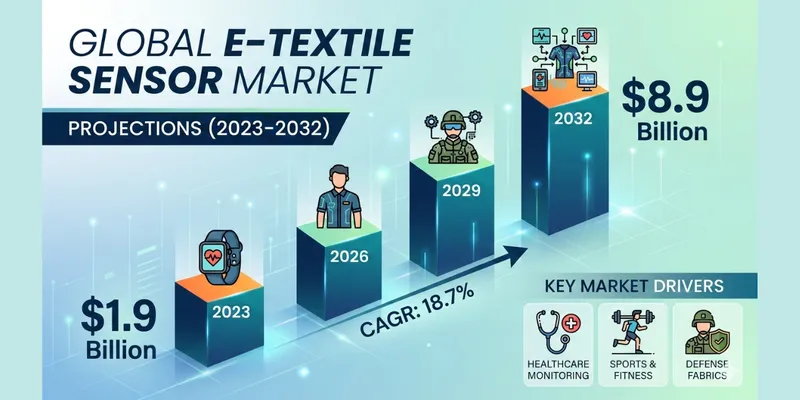
The global E Textile Sensor market is witnessing exponential growth, driven by the rapid adoption of smart wearables, healthcare monitoring systems, and defense-grade smart fabrics. According to Marketintelo, the market was valued at approximately $1.9 billion in 2023 and is projected to reach $8.9 billion by 2032, expanding at a robust CAGR of 18.7% during 2024–2032.
In 2024 alone, the market recorded a year-over-year (YoY) growth of 16.2%, compared to 14.8% in 2023 and 13.5% in 2022, indicating accelerating adoption. Increasing investments in IoT-integrated textiles and rising healthcare applications are key contributors to this growth trajectory.
Historical Market Performance (2016–2023)
The E Textile Sensor market has evolved rapidly over the past decade, supported by advancements in nanotechnology, conductive fibers, and flexible electronics.
• 2016 Market Value: $620 million
• 2018 Market Value: $910 million (CAGR: 21.1% from 2016)
• 2020 Market Value: $1.2 billion (YoY growth: 12.4%)
• 2021 Market Value: $1.4 billion (YoY growth: 16.7%)
• 2022 Market Value: $1.65 billion (YoY growth: 17.8%)
• 2023 Market Value: $1.9 billion (YoY growth: 15.1%)
Between 2016 and 2023, the market expanded at an average CAGR of 17.2%, with healthcare and sports applications accounting for over 48% of total demand.
Key Numerical Highlights
• Global market expected to reach $8.9 billion by 2032
• CAGR (2024–2032): 18.7%
• Healthcare segment share (2023): 32.5%
• Asia-Pacific market share: 38.7%
• Smart clothing production volume: ~72 million units in 2023
• IoT-enabled textile adoption rate: +22% YoY
• R&D investment in smart textiles exceeded $1.3 billion globally in 2023
Market Drivers with Quantitative Insights
1. Rising Healthcare Applications
The healthcare segment dominates the E Textile Sensor market, contributing $620 million in 2023, expected to exceed $3.1 billion by 2032.
• Wearable biosensors adoption increased by 27% YoY in 2024
• Remote patient monitoring systems grew by 31.4% in 2023
• Over 68% of hospitals in developed economies are integrating smart textile sensors 2. Growth in Sports and Fitness Industry
Sports applications accounted for $410 million in 2023, with projected CAGR of 17.9%. • Smart fitness apparel usage increased by 24% globally
• Athlete performance monitoring solutions saw 29% growth in demand • Over 45 million smart sports garments were sold in 2023
3. Defense and Military Investments
Governments are allocating substantial budgets toward smart uniforms: • U.S. and NATO combined spending exceeded $780 million in 2023 • Smart soldier systems adoption grew by 19.6% YoY
• Military segment projected to reach $1.4 billion by 2030
Market Restraints with Data
Despite strong growth, several challenges persist:
• High production costs: conductive fibers increase costs by 25–40% • Limited durability: sensor efficiency drops by 12–18% after 50 washes • Lack of standardization affecting ~30% of manufacturers globally
Additionally, only 42% of textile manufacturers have fully integrated electronic sensor capabilities, limiting scalability.
Regional Market Breakdown
Asia-Pacific (APAC)
• Market share: 38.7% in 2023
• Market value: $735 million
• CAGR: 20.3% (2024–2032)
China, Japan, and South Korea collectively account for 72% of APAC demand. Textile production hubs and electronics manufacturing ecosystems are driving growth.
North America
• Market share: 27.4%
• Market value: $520 million (2023)
• Healthcare adoption rate: +28% YoY
The U.S. leads with over 65% regional revenue share, supported by strong R&D investments of $620 million annually.
Europe
• Market share: 21.6%
• Market value: $410 million
• CAGR: 17.1%
Germany, France, and the UK contribute 68% of European demand, with sustainability focused smart textiles gaining traction.
Rest of the World (RoW)
• Market share: 12.3%
• Market value: $235 million
• Growth rate: 15.4% CAGR
Industry Trends and Investment Data
The E Textile Sensor market is witnessing significant technological advancements and funding:
• Global investment in smart textiles reached $2.4 billion (2022–2024 cumulative) • Startups in wearable textile sensors increased by 34%
• Patent filings grew by 18.6% YoY, reaching over 3,200 patents in 2023
Major industry players are allocating 8–12% of annual revenue toward R&D, focusing on flexible sensors, washable electronics, and AI integration.
Market Segmentation Data
By Sensor Type
• Pressure Sensors: 28% market share
• Temperature Sensors: 22%
• Motion Sensors: 19%
• Biosensors: 31% (fastest-growing, CAGR 20.5%)
By Application
• Healthcare: 32.5%
• Sports & Fitness: 21.6%
• Military & Defense: 18.9%
• Fashion & Lifestyle: 14.3%
• Others: 12.7%
E Textile Sensor Market Snapshot
Metric | Value (2023) | Forecast (2032) |
Market Size | $1.9 Billion | $8.9 Billion |
CAGR | 15.1% (historical) | 18.7% (forecast) |
APAC Share | 38.7% | 41.5% |
Healthcare Revenue | $620 Million | $3.1 Billion |
Smart Garments Production | 72 Million Units | 210 Million Units |
R&D Investment | $1.3 Billion | $3.8 Billion |
Year-over-Year Growth Analysis
The E Textile Sensor market has shown consistent acceleration:
• 2021–2022 Growth: +17.8%
• 2022–2023 Growth: +15.1%
• 2023–2024 Growth: +16.2%
• 2024–2025 (Projected): +18.4%
• 2025–2026 (Projected): +19.1%
This upward trend reflects increasing commercialization and adoption across industries.
Future Outlook and Projections (2024–2032)
The future of the E Textile Sensor market is highly promising, driven by technological integration and expanding use cases:
• Smart healthcare textiles expected to grow at 20.8% CAGR
• AI-integrated textile sensors projected to account for 35% of market by 2030 • Global production volume forecast to exceed 210 million units by 2032 • Emerging markets expected to contribute ~46% of incremental growth
Additionally, government initiatives supporting smart manufacturing and wearable tech are expected to exceed $5.2 billion in funding globally by 2030.
Conclusion: Strong Data-Backed Growth Trajectory
The E Textile Sensor market is on a high-growth path, expanding from $1.9 billion in 2023 to $8.9 billion by 2032, with a strong 18.7% CAGR. Historical growth trends, rising investments, and increasing adoption across healthcare, sports, and defense sectors reinforce this outlook.
Asia-Pacific leads with 38.7% market share, while healthcare remains the dominant application segment at 32.5%. With production volumes expected to triple and R&D investments set to exceed $3.8 billion, the market is entering a phase of rapid commercialization.
Overall, the E Textile Sensor market is positioned for sustained, data-driven expansion, supported by technological innovation, increasing global demand, and strong financial backing across regions.
Read A Full Report: https://marketintelo.com/report/e-textile-sensor-market