E-Textile Sensor Market Accelerates with 18.7% CAGR Through 2033 Amid Rising Demand for Smart Wearables
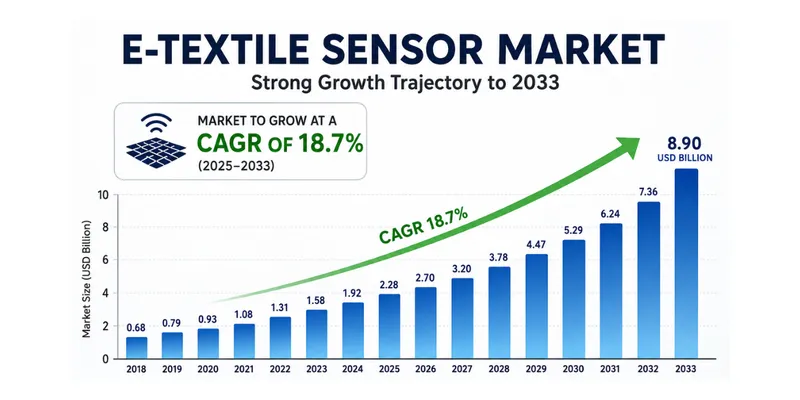
The global E-Textile Sensor industry is witnessing rapid expansion as smart fabrics become integral to healthcare, sports, military, and industrial applications. According to insights published by Marketintelo, the global E-Textile Sensor market was valued at approximately USD 1.92 billion in 2024 and is projected to reach USD 8.9 billion by 2033, expanding at a robust CAGR of 18.7% during the forecast period.
The increasing adoption of wearable technologies has significantly boosted market demand. More than 1.3 billion wearable devices were in use globally in 2025, representing a 14.2% year-over-year increase compared to 2024. E-Textile Sensor technology enables fabrics to monitor physiological parameters such as heart rate, respiration, temperature, pressure, and motion in real time.
Key Numerical Highlights
• Global market value reached USD 1.92 billion in 2024
• Market expected to hit USD 2.28 billion in 2025
• Forecast value projected at USD 8.9 billion by 2033
• CAGR estimated at 18.7% (2025–2033)
• Healthcare applications account for 34.8% market share
• Sports and fitness segment contributes 27.5% of total revenue
• Smart clothing adoption increased 22% YoY in 2025
• Asia-Pacific accounts for 39.4% of global demand
• North America contributes 31.2% market share
• Over USD 4.5 billion invested globally in smart textile R&D since 2020
Historical Growth Analysis (2018–2025)
The E-Textile Sensor market has demonstrated consistent growth over the past seven years.
Year | Market Value (USD Billion) |
2018 | 0.68 |
2019 | 0.79 |
2020 | 0.93 |
2021 | 1.08 |
2022 | 1.31 |
2023 | 1.58 |
2024 | 1.92 |
2025 | 2.28 |
Between 2018 and 2025, the market expanded by nearly 235%, highlighting strong commercialization of E-Textile Sensor technologies across multiple industries.
Healthcare Sector Dominates Market Demand
Healthcare remains the largest application segment for E-Textile Sensor products. Smart garments embedded with biosensors are increasingly used for remote patient monitoring.
In 2025:
• Healthcare generated approximately USD 790 million in revenue
• Smart patient-monitoring garments recorded 24% annual growth
• More than 48 million patients globally utilized wearable health-monitoring solutions • Hospital adoption of sensor-enabled textiles increased 17% YoY
The aging population is another key driver. By 2030, people aged over 60 will represent nearly 16% of the global population, creating strong demand for continuous health monitoring solutions.
Regional Market Breakdown
Asia-Pacific
Asia-Pacific leads the global E-Textile Sensor market with approximately 39.4% share in 2025. • China contributes nearly 38% of regional revenue
• Japan accounts for 19%
• South Korea contributes 14%
• Regional market value exceeded USD 900 million in 2025
North America
North America represents 31.2% of global revenue.
• United States accounts for nearly 84% of regional demand
• Defense-related smart textile projects exceeded USD 650 million in cumulative funding
• Smart apparel sales grew 16.8% year-over-year
Europe
Europe holds approximately 23.6% market share.
• Germany contributes 28% of European revenue
• United Kingdom accounts for 19%
• France represents 15%
• EU-funded smart textile initiatives surpassed USD 420 million between 2021 and 2025
Technology and Investment Trends
Investment activity in E-Textile Sensor innovation continues to accelerate.
Global smart textile patent filings increased from approximately 3,100 filings in 2019 to more than 7,800 filings in 2025, representing a 151% increase.
Key technology segments include:
• Pressure sensors: 29% market share
• Temperature sensors: 24%
• Motion sensors: 21%
• Biometric sensors: 18%
• Chemical sensors: 8%
Manufacturing costs for conductive textile materials have declined nearly 31% since 2020, improving commercial viability and supporting large-scale production.
Future Outlook Through 2033
The future of the E-Textile Sensor market remains highly promising. Global smart clothing shipments are expected to exceed 185 million units annually by 2033, compared with approximately 62 million units in 2025.
Revenue from military and defense applications is forecast to surpass USD 1.4 billion by 2033, while healthcare applications could exceed USD 3 billion. Continuous innovation in flexible electronics, conductive fibers, and AI-powered wearables is expected to sustain double-digit growth.
In conclusion, the E-Textile Sensor market is evolving into a multi-billion-dollar industry, growing from USD 1.92 billion in 2024 to an estimated USD 8.9 billion by 2033. Supported by an 18.7% CAGR, increasing wearable adoption, rising healthcare digitization, and expanding investments in smart textiles, the E-Textile Sensor sector is positioned as one of the fastest growing segments within the advanced materials and wearable technology ecosystem.
Read A Full Report: https://marketintelo.com/report/e-textile-sensor-market