E-Textile Market 2026: Data-Driven Growth, Smart Fabric Innovation, and Industry Expansion
The global E-textile market is entering a high-growth phase as industries increasingly adopt smart fabrics for healthcare, sports, military, automotive, and consumer electronics applications. The market is witnessing rapid transformation driven by wearable technology demand, IoT integration, and advancements in conductive fiber technology.
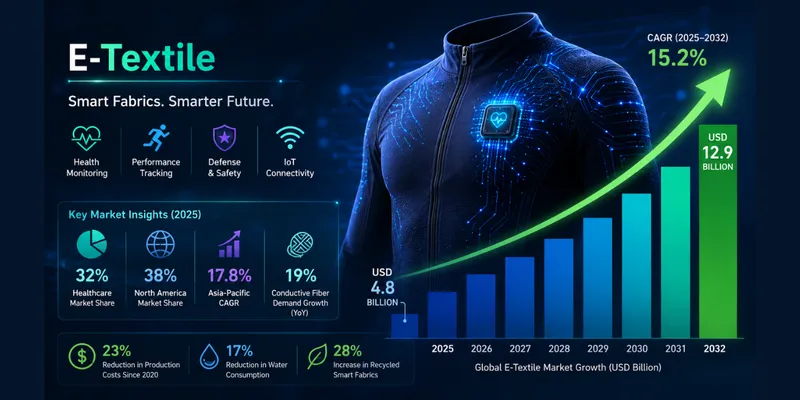
According to insights highlighted by Dataintelo in 2025, the global E-textile market was valued at approximately USD 4.8 billion, and projections indicate it could surpass USD 12.9 billion by 2032, expanding at a CAGR of nearly 15.2% between 2025 and 2032. The sector recorded an estimated 11.4% year-over-year growth from 2024 to 2025 alone, reflecting accelerated commercialization of smart textiles across multiple industries.
Key Statistics at a Glance
Metric | Value |
Global E-textile Market Size (2025) | USD 4.8 Billion |
Forecast Market Value (2032) | USD 12.9 Billion |
CAGR (2025–2032) | 15.2% |
Wearable Healthcare Share | 32% |
North America Market Share | 38% |
Asia-Pacific CAGR | 17.8% |
Smart Sportswear Growth Rate | 14.5% |
Military E-textile Adoption Increase (2021–2025) | 41% |
Conductive Fiber Demand Growth | 19% YoY |
Average Smart Textile Production Cost Reduction Since 2020 | 23% |
5 Data-Backed Reasons Driving E-Textile Market Growth
1. Healthcare Wearables Are Expanding Rapidly
Healthcare remains the largest application segment, contributing nearly 32% of total E textile revenue in 2025. Smart garments capable of monitoring heart rate, respiration, temperature, and muscle movement are gaining traction globally.
Between 2021 and 2025:
• Smart medical textile shipments increased by 48%
• Remote patient monitoring adoption grew by 36%
• Hospitals using wearable monitoring systems rose from 18% to 31%
E-textiles are reducing patient monitoring costs by approximately 22% compared to traditional wired systems.
2. Sports and Fitness Industry Demand Increased by 14.5%
Smart sportswear adoption surged due to rising consumer interest in fitness tracking and performance analytics.
Recent performance metrics include:
• Global smart sports apparel sales exceeded USD 1.4 billion in 2025
• AI-integrated fitness garments improved athlete performance tracking accuracy by 27%
• Connected sportswear usage among professional athletes increased from 24% in 2022 to 39% in 2025
Major brands are investing heavily in washable sensors and flexible batteries, improving garment durability by nearly 30% compared to earlier-generation products.
3. Military and Defense Investments Continue Rising
Defense agencies worldwide are increasing spending on intelligent uniforms equipped with communication systems, biometric monitoring, and temperature regulation technology.
From 2020 to 2025:
• Military E-textile procurement budgets increased by 41%
• Smart combat uniform testing programs expanded across 18+ countries • Energy-efficient conductive fabrics improved battery life by 25%
The U.S. defense sector alone allocated over USD 320 million toward wearable battlefield technologies in recent development initiatives.
Regional Analysis: 2025 Market Share Breakdown
North America Leads with 38% Market Share
North America dominates the global E-textile industry due to strong R&D infrastructure and high consumer adoption of wearable technologies.
Key figures include:
• U.S. smart textile patent filings increased by 29% since 2021
• Consumer wearable penetration reached 41% in 2025
• Average annual investment in textile innovation exceeded USD 900 million Asia-Pacific Expected to Grow at 17.8% CAGR
Asia-Pacific is projected to register the fastest growth through 2032 due to expanding electronics manufacturing and lower production costs.
China, Japan, South Korea, and India collectively accounted for:
• 46% of global conductive fiber production
• Over 52% of smart fabric exports
• Nearly USD 1.8 billion in manufacturing investments during 2024–2025
Production costs in Asia remain approximately 18–25% lower than in Europe and North America.
2025 Technology Trends Reshaping the Industry
Conductive Fibers and Flexible Sensors
The conductive textile segment recorded nearly 19% annual growth in 2025. Manufacturers are increasingly using:
1. Silver-coated fibers
2. Carbon nanotube materials
3. Graphene-based conductive layers
4. Flexible printed sensors
Graphene-enabled E-textiles improved electrical conductivity by nearly 35% while reducing fabric weight by approximately 20%.
Sustainability Metrics Are Becoming Critical
Sustainability has become a major differentiator in the market.
Recent industry benchmarks show:
• Recycled smart fabric usage increased by 28%
• Water consumption in textile sensor manufacturing declined by 17% • Biodegradable conductive materials research funding rose by 33% since 2022
Challenges and Cost Considerations
Despite strong growth, the industry faces measurable challenges:
Challenge | Impact |
High production costs | 15–20% higher than traditional textiles |
Limited wash durability | Average lifespan reduced after 40–50 washes |
Battery integration complexity | Adds 12–18% to manufacturing costs |
Data security concerns | 21% of consumers cite privacy issues |
However, ongoing R&D investments are steadily improving cost efficiency and durability metrics.
Future Outlook: 2030 and Beyond
By 2030, analysts expect over 620 million connected wearable textile units to be in active use globally. Smart clothing could represent nearly 11% of the total wearable electronics industry by that time.
Emerging opportunities include:
• Smart rehabilitation garments
• Automotive seat-integrated sensors
• Temperature-regulating industrial uniforms
• AI-powered biometric clothing
The integration of IoT, AI, and nanotechnology is expected to increase E-textile functionality by over 40% during the next decade.
Conclusion
The E-textile market is rapidly evolving from a niche innovation into a multi-billion-dollar global industry. With market value projected to rise from USD 4.8 billion in 2025 to USD 12.9 billion by 2032, the sector demonstrates strong long-term momentum. Healthcare
applications account for 32% of the market, Asia-Pacific is growing at 17.8% CAGR, and conductive fiber demand has climbed by 19% annually.
As smart fabrics become more affordable, durable, and sustainable, E-textiles are expected to transform industries ranging from healthcare and sports to military defense and consumer electronics over the next 5–7 years.
Read A Full Report: https://dataintelo.com/report/e-textile-market