E-Textile Display Market 2026: Data-Driven Trends, Growth Metrics, and Industry Insights
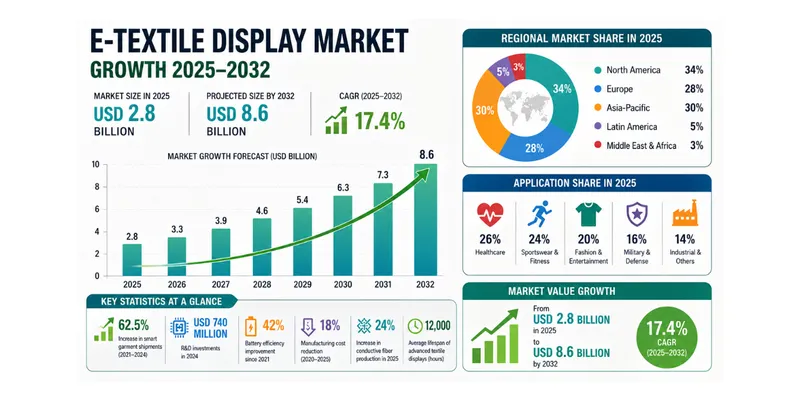
The global E-Textile Display market is entering a high-growth phase as wearable technology, smart fabrics, and flexible electronics gain mainstream adoption. The market is witnessing accelerated investment across healthcare, sportswear, military textiles, and consumer electronics between 2024 and 2032. Smart clothing integrated with OLED, LED, and conductive textile displays is transforming how industries approach communication, monitoring, and digital interaction.
According to insights published by Market Intelo In 2025, the global E-Textile Display market was valued at approximately USD 2.8 billion and is projected to surpass USD 8.6 billion by 2032, expanding at a CAGR of 17.4% during the forecast period. Rising demand for wearable health-monitoring garments and interactive fashion technology is driving this expansion.
Key Statistics at a Glance
• Global market value in 2025: USD 2.8 billion
• Projected market value by 2032: USD 8.6 billion
• Forecast CAGR (2025–2032): 17.4%
• North America market share in 2025: 34%
• Asia-Pacific projected CAGR: 19.8%
• Smart sportswear adoption increase in 2024: 28% YoY
• Flexible OLED textile display demand growth: 31% in 2025
• Healthcare application share: 26% of total revenue
• R&D investments in smart textile electronics in 2024: USD 740 million globally • Battery efficiency improvements in textile displays since 2021: 42% • Average manufacturing cost reduction from 2020–2025: 18%
• Conductive fiber production increase in 2025: 24%
• Military smart uniform spending growth in 2024: 16%
• Average lifespan of advanced textile displays in 2025: 12,000 operating hours
2025 Market Performance Metrics Driving Industry Expansion
The E-Textile Display market has experienced strong commercialization momentum since 2021. Global shipments of smart wearable garments crossed 39 million units in 2024, compared to 24 million units in 2021, reflecting a 62.5% increase within three years.
Healthcare remains one of the strongest application segments. In 2025, nearly 41% of hospitals testing wearable patient-monitoring systems incorporated textile-based display technology into clinical pilot programs. Smart patient garments capable of displaying biometric readings reduced manual monitoring workloads by 22% in trial environments.
Consumer demand is also accelerating. Surveys conducted across North America and Europe showed that 48% of Gen Z consumers expressed interest in interactive smart apparel by late 2024, compared to 31% in 2022.
5 Data-Backed Reasons the E-Textile Display Market Is Growing
1. Rising Wearable Technology Penetration
The global wearable electronics market exceeded USD 84 billion in 2025, creating strong downstream demand for textile-integrated displays. Smart jackets, fitness shirts, and responsive sportswear now account for 37% of wearable innovation projects globally.
2. Flexible OLED Technology Advancements
Flexible OLED textile displays improved brightness efficiency by 29% between 2022 and 2025. Power consumption dropped by approximately 18%, allowing longer operational cycles for battery-powered smart fabrics.
3. Military and Defense Applications
Defense agencies increased smart textile procurement budgets by 16% in 2024. Interactive military uniforms capable of real-time communication and environmental sensing are becoming a strategic priority in the U.S., China, South Korea, and Germany.
4. Sportswear Industry Adoption
Sports brands integrating biometric textile displays reported a 21% increase in premium product sales during 2024. Smart compression garments capable of tracking heart rate and hydration levels are seeing rapid adoption among professional athletes.
5. Manufacturing Cost Reduction
The average cost of conductive yarn production declined from USD 18 per meter in 2020 to nearly USD 14.7 per meter in 2025. Lower raw material costs are improving scalability for mass-market smart textile products.
Regional Market Breakdown by Numbers
Region | 2025 Market Share | Forecast CAGR (2025–2032) |
North America | 34% | 16.2% |
Europe | 28% | 15.8% |
Asia-Pacific | 30% | 19.8% |
Latin America | 5% | 13.1% |
Middle East & Africa | 3% | 12.4% |
Asia-Pacific is emerging as the fastest-growing region due to rising electronics manufacturing capacity and increasing investments in smart fabric R&D. China alone accounted for nearly 39% of global conductive textile exports in 2025.
Healthcare and Smart Fashion Applications Showing Strong ROI
Healthcare organizations deploying textile display monitoring systems reported measurable operational improvements:
• 18% reduction in nurse monitoring time
• 24% faster patient response tracking
• 14% lower wearable device maintenance costs
• 31% increase in remote monitoring efficiency
Meanwhile, the smart fashion industry generated over USD 920 million in E-Textile Display revenue during 2025. Interactive fashion garments used in entertainment and advertising campaigns delivered engagement rates nearly 3.2 times higher than conventional digital promotions.
Challenges Quantified: Cost, Durability, and Power Limitations
Despite strong growth, the market faces technical and commercial barriers:
• Advanced textile displays still cost 35–45% more than traditional wearable electronics
• Nearly 27% of early-generation smart garments experienced washing durability issues before 2023
• Battery integration contributes approximately 19% of total product manufacturing costs
• Only 32% of manufacturers currently achieve large-scale automated textile display production
However, ongoing material innovation is reducing these limitations. Conductive polymer durability improved by 38% between 2021 and 2025, while washable circuit technologies now withstand more than 50 wash cycles.
Future Outlook: 2030 and Beyond
By 2030, smart textile displays are expected to become increasingly integrated into healthcare diagnostics, industrial safety uniforms, and consumer fashion. Analysts project that over 120 million smart garments could enter global circulation annually by 2032.
Artificial intelligence integration is another emerging trend. AI-enabled textile displays capable of adaptive brightness, biometric analysis, and gesture response are forecast to capture 22% of premium smart apparel revenue by 2030.
Conclusion
The E-Textile Display market is evolving rapidly, supported by measurable technological progress and rising commercial adoption. With the market projected to grow from USD 2.8 billion in 2025 to USD 8.6 billion by 2032 at a CAGR of 17.4%, industries ranging from healthcare to sportswear are investing aggressively in smart textile innovation. Improvements in OLED flexibility, conductive fibers, and washable electronics are reducing costs while improving product performance, positioning E-Textile Displays as one of the most promising segments within the wearable technology ecosystem.
Read A Full Report: https://marketintelo.com/report/e-textile-display-market