Digital Trust: Building Confidence in a Connected World
Why digital trust matters more than ever in a rapidly evolving online landscape.
As digital services expand across every sector, trust has emerged as the foundation of secure adoption, smooth experiences, and meaningful innovation.
The digital world evolves at breathtaking speed. New platforms, tools, and services appear each day, making online engagement almost instinctive—one tap to buy, one click to share, one swipe to connect. Yet beneath this convenience lies a quiet, persistent question: Can we trust the systems we rely on?
That is where the concept of digital trust becomes indispensable.
What Is Digital Trust?
Digital trust refers to the confidence individuals place in the people, technologies, and processes they engage with online. It encompasses privacy protection, strong security measures, system reliability, and transparent communication.
When trust is high, people readily adopt digital services. When trust is compromised, hesitation follows—users avoid sharing personal details, making payments, or embracing new tools.
Building digital trust isn’t an overnight achievement. It develops gradually through responsible data practices, clear communication, and consistent, user-first behaviour.
Why Digital Trust Matters
As services across banking, healthcare, education, entertainment, and commerce move online, trust becomes the glue that keeps digital ecosystems functioning smoothly.
Where confidence is strong, new technologies scale rapidly. Secure digital payment systems encourage wider adoption. Remote working thrives when employees believe collaboration tools protect their data. Smart home devices enter households only when people trust them not to misuse personal information.
Digital trust also fuels innovation. Companies with strong reputations can introduce new offerings more easily, and users feel comfortable trying them. But when doubt clouds a brand’s intentions, even sophisticated solutions struggle to gain traction.
What’s Driving Growth in the Digital Trust Market?
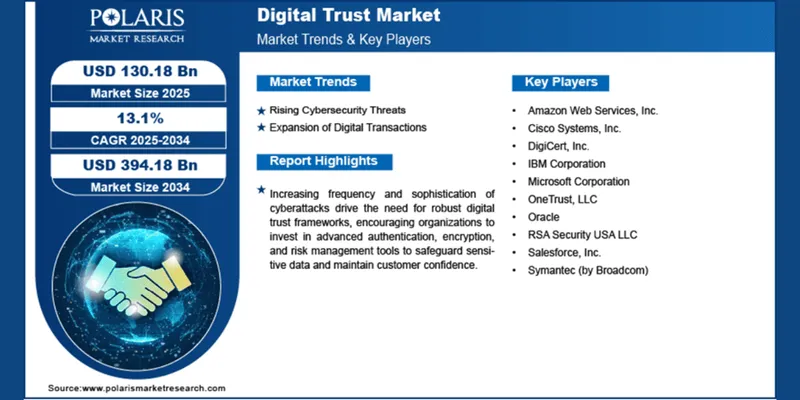
According to Polaris Market Research, the global digital trust market reached USD 115.25 billion in 2024 and is expected to grow at a 13.1% CAGR between 2025 and 2034. Several powerful forces are propelling this expansion:
- Increasing frequency and complexity of cyber-attacks, pushing organizations to adopt stronger trust and security systems.
- Rising dependence on cloud computing, remote work, and digital identity platforms, creating demand for secure authentication and data protection.
- Advances in AI and blockchain, enhancing verification accuracy and strengthening trust in digital transactions.
- Expanding privacy regulations, driving businesses to seek compliance-focused solutions.
Five Core Pillars of Digital Trust
Privacy
Privacy allows users to maintain control over their data. People want clarity on what is collected, how it is used, and who has access. Transparent policies—and simple language—build lasting confidence.
Security
Strong security shields systems from cyber threats through encryption, multi-factor authentication, and regular updates. A single breach can damage a brand’s credibility for years, making robust security a non-negotiable element of trust.
Transparency
Users value honesty in how digital services function. Transparency includes explaining algorithms, revealing data practices, and communicating promptly during issues. Silence creates mistrust; openness builds credibility.
Reliability
Reliable platforms work when users need them—fast-loading sites, stable apps, consistent service. Even minor, repeated failures can slowly erode confidence.
Accountability
Organizations must own their digital actions. Mistakes are inevitable, but swift solutions and sincere communication reinforce respect and help prevent further issues.
The Future of Digital Trust
As AI, connected devices, and smart infrastructure reshape everyday life, digital trust will become even more critical. From digital identities to virtual work environments, every emerging technology depends on user confidence.
Companies that invest in transparent, secure, and responsible digital practices will gain a decisive competitive edge. Those that disregard trust may struggle to survive in an increasingly connected economy.
Conclusion
Digital trust has become the backbone of modern life. In a world where more interactions shift online each day, trust determines what people adopt, rely on, and recommend. The winners of the digital era will be the companies that treat trust not as an optional advantage—but as a fundamental requirement.