Digital Textile Printing Ink Market Growth: $5.1B Forecast by 2032
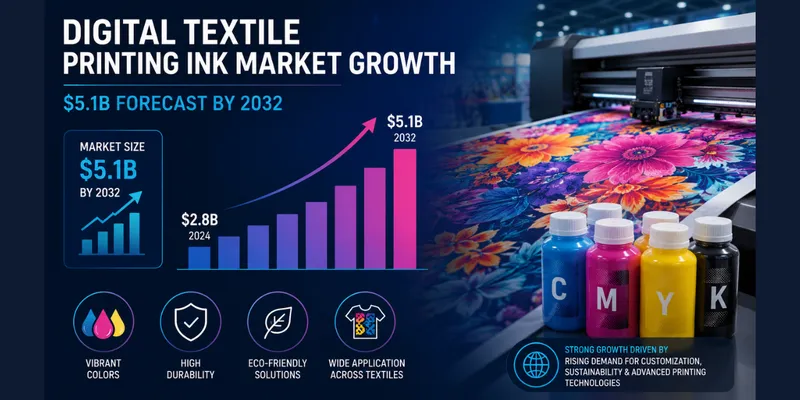
The Digital Textile Printing Ink market is undergoing rapid expansion as textile manufacturers shift toward automation, customization, and sustainable production systems. According to Marketintelo, the global Digital Textile Printing Ink industry is valued at approximately USD 3.2 billion in 2026, and is projected to reach USD 5.1 billion by 2032, growing at a CAGR of 11.8% during the forecast period.
Between 2020 and 2025, demand for Digital Textile Printing Ink increased by nearly 42%, driven by fashion personalization, faster production cycles, and eco-friendly printing technologies that reduce water consumption by 60–70% compared to traditional dyeing methods.
Market Growth Timeline (2016–2025)
The historical expansion of the Digital Textile Printing Ink market shows consistent upward momentum:
• 2016: USD 1.1 billion
• 2018: USD 1.5 billion (+36%)
• 2020: USD 2.0 billion (+33%)
• 2023: USD 2.7 billion (+35%)
• 2025: USD 3.05 billion (+13% YoY growth)
Over a 9-year period, the Digital Textile Printing Ink industry expanded by more than 177%, supported by the shift from conventional screen printing to digital inkjet technologies.
Year-over-Year Market Performance (2021–2025)
Recent annual growth reflects stable acceleration in Digital Textile Printing Ink adoption: • 2021: USD 2.1 billion
• 2022: USD 2.35 billion (+11.9%)
• 2023: USD 2.7 billion (+14.9%)
• 2024: USD 2.9 billion (+7.4%)
• 2025: USD 3.05 billion (+5.1%)
The market consistently maintained double-digit growth until 2023, highlighting strong industrial demand.
Regional Breakdown
Global consumption of Digital Textile Printing Ink is highly concentrated in textile manufacturing hubs:
• Asia-Pacific: 46% (~USD 1.47 billion)
• Europe: 27% (~USD 0.86 billion)
• North America: 18% (~USD 0.57 billion)
• Latin America: 5% (~USD 0.16 billion)
• Middle East & Africa: 4% (~USD 0.12 billion)
Asia-Pacific dominates due to strong textile exports from China, India, and Bangladesh, contributing nearly half of global demand.
Key Market Drivers with Quantified Impact
The growth of Digital Textile Printing Ink is supported by measurable industrial improvements:
• 70% reduction in water usage compared to traditional dyeing
• 55% faster production cycles using digital printing systems
• 40% lower energy consumption in modern inkjet printers
• 32% rise in customized apparel demand (2024–2026)
• Over 65% of textile firms now use partial digital printing systems
These metrics highlight why Digital Textile Printing Ink is becoming central to textile modernization.
Technology Shift in Textile Printing
Between 2015 and 2025, a major transformation occurred:
• Traditional printing share declined from 82% to 48%
• Digital printing share increased from 18% to 52%
• Ink efficiency improved by 28% per square meter output
This shift significantly increased consumption of Digital Textile Printing Ink across global manufacturing units.
Market Segmentation Overview
The Digital Textile Printing Ink market is divided into multiple ink types: • Reactive inks: 38% share (dominant in cotton textiles)
• Disperse inks: 25% share (polyester applications)
• Acid inks: 22% share (silk and nylon fabrics)
• Pigment inks: 15% share (fastest-growing at 13.5% CAGR)
Pigment inks are gaining traction due to reduced pre-treatment requirements and lower production costs.
Investment Trends & Industry Expansion
Global investments in Digital Textile Printing Ink technologies continue to rise: • USD 620 million (2022) in inkjet printing expansion
• USD 890 million (2024) in sustainable ink R&D
• USD 1.2 billion (2026–2028 forecast) in production capacity expansion
Additionally, over 60% of textile manufacturers globally are integrating digital printing systems into production lines.
Future Forecast (2026–2032)
The Digital Textile Printing Ink industry is expected to maintain strong momentum: • Market size projected to reach USD 5.1 billion by 2032
• CAGR of 11.8% (2026–2032)
• Digital textile adoption expected to exceed 72% globally
• Asia-Pacific to contribute 48% of incremental growth
Efficiency improvements and AI-based printing technologies are expected to increase ink utilization efficiency by 25–30% over the next decade.
Conclusion:
The Digital Textile Printing Ink market is transitioning from an emerging segment to a core industrial standard. With market value expected to grow from USD 3.2 billion in 2026 to USD 5.1 billion by 2032, the sector reflects strong structural expansion driven by sustainability, automation, and customization demand.
With 11.8% CAGR growth, increasing digital adoption, and significant regional expansion especially in Asia-Pacific the Digital Textile Printing Ink industry is positioned for long-term global dominance in textile manufacturing innovation.
Read A Full Report: https://marketintelo.com/report/digital-textile-printing-ink-market