DGFT Calls on Industry to Convert FTAs and Export Schemes into Actual Exports
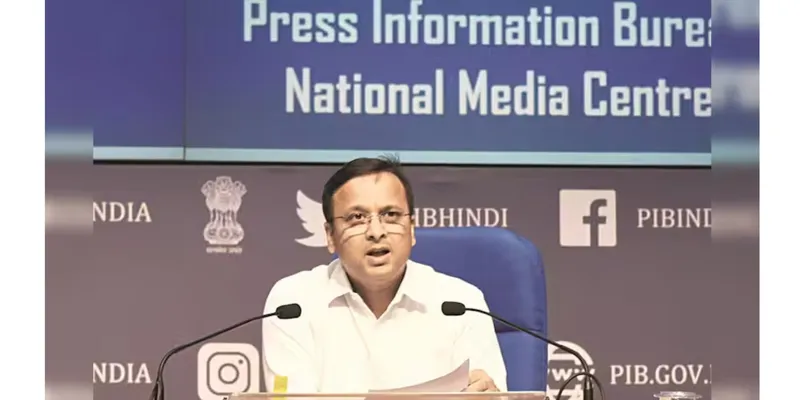
Lav Agarwal urges industry associations to mentor exporters at district and cluster levels and strengthen India’s participation in global value chains
Director General of Foreign Trade (DGFT) Lav Agarwal has called on Indian industry associations to move beyond awareness programmes around free trade agreements (FTAs) and government export schemes and focus on converting these opportunities into actual exports. He also urged industry bodies to work with the government on mentoring and hand-holding potential exporters at the district and cluster levels.
“Through the trade agreements, India has opened up markets across the globe and created opportunities that can make Indian industry more competitive. The challenge now is to translate these FTAs into action on the ground,” Agarwal said at the Confederation of Indian Industry’s National Manufacturing Conclave.
Focus on Using FTA Market Access
Agarwal’s comments come as India has brought two FTAs with the UK and Oman into force during the current financial year and remains on track to implement another FTA with New Zealand next month.
Referring to the India-UK agreement, Agarwal said Indian industry had not shown the same level of interest in understanding the market access available under the agreement as UK industry.
According to Agarwal, the UK government and industry representatives held several meetings with the DGFT to understand the market access available following the agreement, while comparatively fewer Indian industry representatives approached the DGFT for similar discussions.
“We are here to work with all of you. We want to create a framework so that whatever market access an agreement offers does not only remain on paper,” he said.
He urged manufacturers to include trade considerations in their expansion plans and seek greater integration into global value chains.
“Industrial development ultimately needs to translate into trade, either domestically or globally,” Agarwal said.
Export Promotion Mission to Reach the Grassroots
Agarwal also called on industry associations to take the 11 components of the government’s Export Promotion Mission to the grassroots.
Approved by the Union Cabinet last November, the mission covers areas including export finance, market intelligence, logistics efficiency, inland export support and compliance with international trade agreements.
“Government policy alone cannot lead to the required results. What we need is a true partnership, and a true measure of success would be how those initiatives are adopted by the industry at large,” Agarwal said.
He added that the DGFT had funds available under the Export Promotion Mission.
Linking Export Promotion Mission with Districts as Export Hubs
Agarwal suggested combining the Export Promotion Mission with the Districts as Export Hubs initiative to develop a more effective export ecosystem.
The Districts as Export Hubs initiative seeks to turn every Indian district into a centre for global trade. Agarwal pointed to the current concentration of exports across a limited number of states and districts as an indication of the potential for wider participation.
He said 10 states currently account for around 85 per cent of India’s total exports, while 15 states account for around 95 per cent.
At the district level, 10 districts contribute around 35 per cent of total exports. Jamnagar alone accounts for around 8.29 per cent, while Kanchipuram and Pune contribute around 5.98 per cent and 6.57 per cent, respectively.
Industry Bodies Asked to Mentor Potential Exporters
Agarwal said every district with export potential could become a district as an export hub. He called on industry associations to mentor prospective exporters, including micro, small and medium enterprises (MSMEs) and start-ups.
He also urged industry bodies to help translate more than 500 district export action plans into actual exports.
“Every district which has the potential to actually become a district as an export hub,” Agarwal said.
According to the DGFT, awareness workshops and seminars alone would not be sufficient to create exporters. Industry associations need to work with the government on an end-to-end framework covering mentoring and hand-holding of potential exporters.
The focus, therefore, is on moving from awareness of trade agreements and export support programmes towards practical assistance that enables more businesses and districts to participate in international trade.