Denim Sustainability by the Numbers: Industry Progress and Remaining Challenges
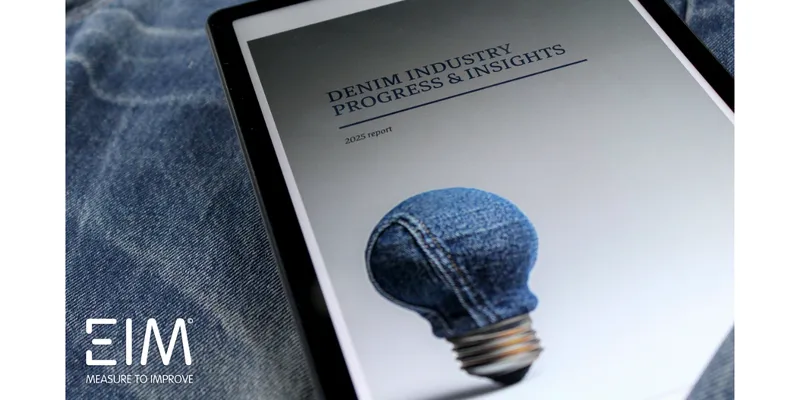
The global denim industry continues to make progress in reducing its environmental footprint, according to the latest Denim Industry Progress & Insights 2025 report published by EIM (Environmental Impact Measurement). The report provides an overview of sustainability performance across denim finishing processes, highlighting improvements in water and energy efficiency while identifying chemical impact as the sector's most significant remaining challenge.
Developed in Spain, EIM has become a widely used methodology for measuring the environmental impact of textile finishing processes. Its latest findings indicate that 66% of denim finishing processes are now classified as low environmental impact, reflecting ongoing efforts by manufacturers to adopt more efficient technologies and production practices.
KEY FIGURES
66%
of processes are now classified as low environmental impact.
30 liters
Average water consumption per garment, reflecting a stabilization of the industry after years of continuous improvement.
85%
of processes are classified as low impact in terms of energy consumption, driven by equipment modernization and automation.
27%
of processes are still classified as high chemical impact, making it the industry's main remaining challenge.
68%
of processes show low impact on worker health, thanks to the growing adoption of more responsible and automated technologies.
Sustainability is improving, but progress remains uneven
The data points to steady progress driven by process optimization and the gradual adoption of more efficient technologies. However, improvements are not consistent across all environmental indicators.
Water and energy continue to improve
The industry continues to make progress in reducing resource consumption. Water use remains stable at around 30 liters per garment, reflecting a plateau after years of continuous improvement. Energy delivers the strongest results, with 85% of processes now classified as low impact thanks to equipment modernization and automation.
Chemical impact remains the industry's biggest challenge
Despite progress in other areas, 27% of processes are still classified as high chemical impact. The use of generic chemicals, limited transparency around certain formulations and the persistence of traditional practices such as pumice stones and potassium permanganate continue to slow progress across the industry.
The challenge is adoption
The report highlights a gap between the solutions already available and their implementation at scale. Technologies capable of significantly reducing the environmental impact of finishing processes already exist, yet adoption remains uneven across parts of the industry.
Automation is improving worker health
The replacement of more aggressive manual techniques with automated technologies is helping improve working conditions and reduce impacts on worker health.
WHY IT MATTERS
• It is estimated that around 5 billion pairs of jeans are produced every year.
• The fashion industry faces growing pressure to reduce its environmental footprint and improve transparency across its supply chains.
• EIM provides an objective way to measure the industry's environmental progress and compare performance using common benchmarks.
• Measuring environmental performance helps brands, manufacturers and suppliers identify opportunities for improvement and make more informed, data-driven decisions.
Full Denim Industry Progress & Insights 2025 report