De Beers Collaborates with Mabeo Studio and Botswana Basket Weaver at Homo Faber 2026
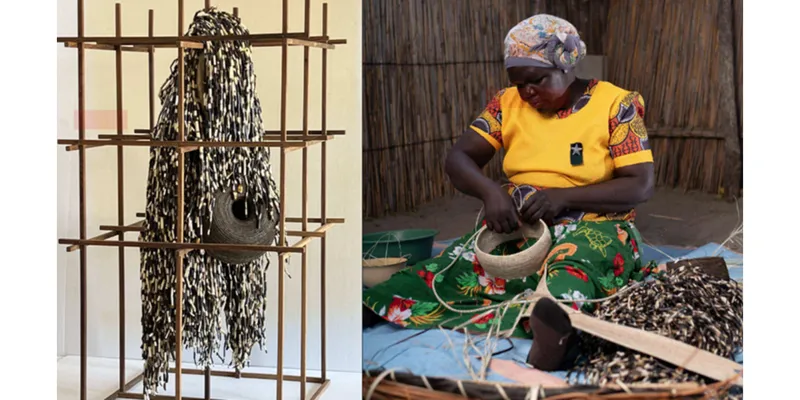
Shakunona Parata presents live weaving and a new sculptural work created with Mabeo Studio during the craft exhibition
De Beers is continuing its participation in Homo Faber 2026 by supporting Botswana-based master basket weaver Shakunona Parata, who will demonstrate her weaving practice and present Diware, a new sculptural work created in collaboration with Beullah Serema and Peter Mabeo of Mabeo Studio.
Based in Botswana, Mabeo Studio works at the intersection of craft, design and culture, collaborating with artisans to develop contemporary works using local materials, cultural heritage and traditional craftsmanship.
Live Weaving at Homo Faber
Curated by Artistic Director Es Devlin, Homo Faber 2026 explores the theme “An Island of Light,” examining the relationship between light, materials and creativity while highlighting craft practitioners from around the world.
In the A Rooted Ascent room, Parata will demonstrate her basket-weaving practice live alongside the presentation of Diware. The exhibition focuses on the makers, their materials, tools and processes.
Parata is a member of the Ngamiland Basket Weavers, based in the north-western region of Botswana. Her practice uses locally gathered materials and techniques passed down through generations. She learned basket weaving from her mother and grandmother and continues to explore variations in technique, pattern and colour.
Her work is influenced by her connection to the Okavango River, its seasonal movements and the materials found in its surrounding landscape. The project highlights both Parata’s individual practice and the wider community and traditions of making associated with her work.
Diware Combines Natural Materials from Botswana
Alongside the live weaving presentation, Parata and Mabeo Studio have created Diware, a sculptural work incorporating natural materials from Botswana, including woven palm leaves, naturally gathered porcupine quills, carved wood and semi-precious stones.
The sculpture draws on Manyevora, a traditional Mbukushu attire associated with Diware, a historic healing ceremony that is now more commonly represented through dance.
Manyevora forms the most prominent element of the sculpture and is made using materials foraged from nature. The different natural and crafted materials have been deliberately combined while retaining their individual characteristics.
The work explores convergence between maker and material, individual and community, and people and place.
Craft Traditions and the Diamond Landscape
Through its Homo Faber participation, De Beers is exploring craft skills and organic materials originating from the same landscape as natural diamonds.
Parata’s presentation follows the participation of South African artist Abongile Sidzumo in August. De Beers’ collaboration with Mabeo Studio will continue at Frieze Masters in London in October, where the studio is working with basket weavers from the Ngamiland Basket Weavers collective, as well as potters and wood carvers from across Botswana, on a new commission titled Voyage Through the Diamond Realm, Chapter Two.
Lynn Serfaty, General Manager – Natural Diamonds, De Beers, said: “Shakunona Parata’s work at Homo Faber reflects the skill, dedication and heritage that shape the relationship between natural materials and craft. We are pleased to support her collaboration with Beullah Serema and Peter Mabeo of Mabeo Studio as part of this year’s Homo Faber.”
Shakunona Parata said: “My life and that of the river are connected. The flood plains of the Okavango river guides my activities and rituals. My basket weaving practice is an extension of nature, of the river through the materials it yields, the movement of the seasons and my hands, seeing through my eyes with conscientiousness of all that is around me and within me, through my work.”
Mabeo Studio said: “Homo Faber presents an opportunity to consider relationship. While it is helpful to recognise the highly valued and respected individual maker, in our studio, we also see it as worthwhile to be aware of how any practice is but a small expression of a whole. To see the indivisible wholeness of life and living, intangibly in approach and physically with how natural materials are related with, across cultures, through simple and dedicated craft acts.”