Daniel Bikas’ Persian Rug Explores How Societies Define Role Models
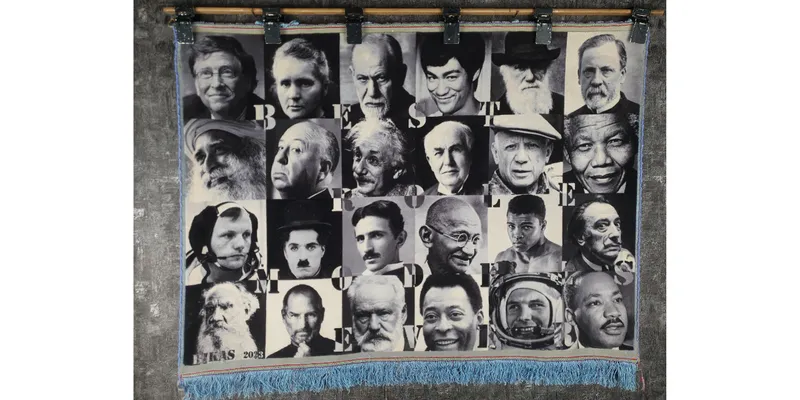
“Best Role Models Ever” brings 24 internationally recognised figures together through Persian carpet-making, connecting traditional craft with ideas of cultural memory and human achievement
Daniel Bikas’ Persian wall rug “Best Role Models Ever” examines how societies select, remember and celebrate individuals regarded as examples of human achievement. The artwork brings together portraits of 24 internationally recognised figures from different fields, using the traditional Persian rug as a medium for exploring influence, memory and the changing meaning of a role model.
Rather than presenting the figures simply as famous personalities, the work raises questions about why particular individuals become symbols of courage, creativity, intelligence, perseverance, leadership, discovery or other qualities.
How Role Models Are Created
The idea of a role model extends beyond professional success. Wealth, awards, records, discoveries and public recognition can establish a person's achievements, but societies often associate exemplary status with qualities that appear to have a wider cultural meaning.
Scientists, athletes, artists and writers, for example, may be remembered not only for their individual accomplishments but also for the influence their work has had on how people understand knowledge, creativity, perseverance or human potential.
Over time, individual biographies can become cultural narratives representing what a society believes people can achieve.
The concept also changes between cultures and historical periods. Ancient societies often placed rulers, warriors and religious figures at the centre of collective memory, while later periods increasingly celebrated philosophers, scientists, writers and explorers. Modern culture has expanded this group further to include figures from sport, cinema, technology and popular culture.
The selection of role models therefore also reflects the values and aspirations of the society making that selection.
The Complexity Behind the Icon
The artwork also considers the gap between a historical individual and the simplified image that may remain in collective memory.
People regarded as role models are rarely without contradictions or imperfections. When an individual becomes an icon, certain characteristics may receive greater attention while other parts of their life disappear from public memory.
Portraiture can reinforce this process. A portrait captures one face and one visual moment, while leaving out the complexity of the life behind it. In this sense, creating a portrait is also an act of interpretation.
By placing 24 portraits together, “Best Role Models Ever” asks viewers to consider what connects people from different professions, cultures and historical circumstances.
The common element is not necessarily fame or occupation, but influence.
A Persian Rug as Cultural Memory
The artwork brings together contemporary portraiture with the longstanding tradition of Persian carpet-making.
Persian rugs have historically incorporated intricate patterns, symbols, narratives and cultural references. In Bikas’ work, the traditional textile surface becomes a medium for preserving images of influential individuals.
The rug can therefore be viewed not only as a craft object but also as a form of cultural memory, placing portraits within a textile tradition that has carried visual information across generations.
The work creates a connection between craft and memory, tradition and contemporary culture, and individual achievement and collective identity.
Why 24 Figures?
The inclusion of 24 individuals from different fields broadens the idea of human excellence beyond any single discipline.
Scientific discovery, athletic achievement, literature, art, cinema, technology, exploration and spiritual or intellectual thought can all represent different forms of human contribution.
The collection consequently presents multiple possibilities rather than one definition of excellence. One person may expand scientific knowledge, another may challenge physical limitations, while another may influence society through art, writing, ideas or exploration.
The diversity of the portraits is therefore central to the concept of the work.
Who Decides Who Is a Role Model?
The title “Best Role Models Ever” appears definitive, but the artwork can also be read as an invitation to question its own premise.
Viewers may agree with all the selections, question some of them or think of individuals who are absent. Such differences raise broader questions about how societies assign importance to particular lives.
Should a role model be someone who changed history, helped others, demonstrated courage, expanded knowledge, inspired millions or overcame adversity?
There is no universally fixed answer.
The discussion also highlights the fact that collective memory is selective. Museums, books, monuments, photographs, films and artworks all contribute to determining which individuals remain visible to later generations.
Black-and-White Portraits on a Woven Surface
The black-and-white treatment of the portraits gives the composition an archival character. The tonal contrast places emphasis on faces, expressions and identities rather than spectacle.
At the same time, the portraits remain part of a woven surface, creating a contrast between the photographic character of the imagery and the traditional process associated with Persian rugs.
The words “Best Role Models Ever” also form part of the visual environment, reinforcing the central question behind the work: who deserves to be described as a role model, and who has the authority to make that judgment?
Beyond Fame
At its core, “Best Role Models Ever” is not only a collection of portraits of well-known individuals. It examines humanity's continuing search for examples of what people can achieve.
Every generation develops its own figures of admiration, while societies preserve particular names and stories because they represent qualities that people want future generations to remember.
The artwork suggests that role models do not necessarily need to be perfect. Their significance can instead come from what their lives demonstrate — that knowledge can expand, obstacles can be challenged, creativity can cross boundaries and an individual can influence the imagination of others.
By transforming 24 portraits into a Persian wall rug, Daniel Bikas uses textile craft as a surface for reflecting on collective memory and human aspiration.
The result leaves viewers with a question that extends beyond the artwork itself: What kind of human being do we want the next generation to remember?