Could Textile-Based Implants Provide Long-Term Drug Release Inside the Human Body?
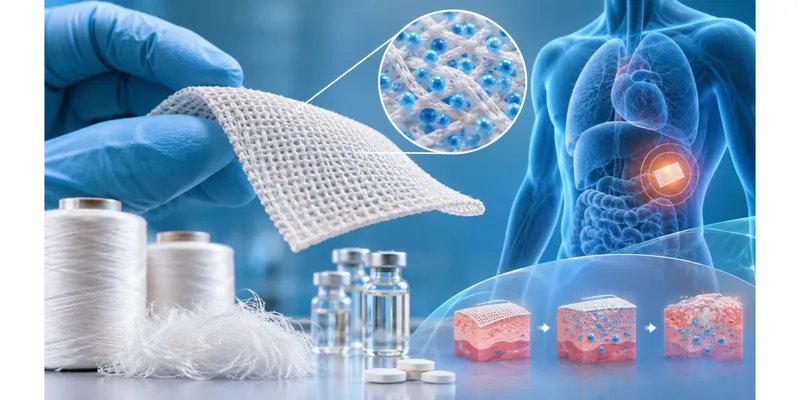
The next generation of implantable drug-delivery systems could combine textile engineering with pharmaceutical science. Instead of relying only on conventional tablets, injections or rigid implants, researchers are investigating how engineered fibres and textile structures can store medicines and release them gradually inside the body.
This approach could create new possibilities for cancer treatment, tissue regeneration, surgical implants and long-term disease management.
Why Are Researchers Exploring Textile-Based Drug Delivery?
Many medicines require repeated administration to maintain effective concentrations in the body. Patients may need daily tablets, frequent injections or repeated hospital visits, depending on the treatment.
However, conventional drug delivery can create several challenges:
- Drug concentrations may fluctuate between doses.
- Frequent administration can affect patient convenience and treatment adherence.
- Some medicines may cause unwanted effects when they circulate throughout the body.
- Maintaining a therapeutic concentration near a specific treatment site can be difficult.
Implantable drug-delivery systems offer another approach. They can be placed near the target tissue and designed to release a medicine over a controlled period.
Textile engineering adds another dimension to this technology. Researchers can manufacture polymer fibres, nanofibres, yarns and woven structures that hold therapeutic compounds within their architecture.
These materials can potentially function as small drug reservoirs inside the body.
How Do Textile-Based Implants Work?
A textile-based implant is not simply a conventional fabric placed inside the body. It is an engineered structure made from selected medical-grade materials and designed for a specific biological application.
Researchers can incorporate medicines into the fibres during manufacturing or attach them to the fibre surface after production.
Once implanted, the material controls how the medicine moves into the surrounding tissue.
Three important mechanisms determine drug release:
1. Diffusion-controlled release
Drug molecules gradually move from the fibre structure into surrounding body fluids. Fibre diameter, porosity, polymer composition and drug concentration can influence the release rate.
2. Polymer degradation
Some biodegradable polymers gradually break down inside the body. As the material degrades, the incorporated medicine becomes available for release.
3. Surface-controlled release
Medicines attached to or coated onto the fibre surface can be released through dissolution, diffusion or changes in the surrounding environment.
Researchers can combine these mechanisms to develop different release profiles, from an initial dose followed by sustained delivery to a slower, more continuous release.
Which Textile Technologies Can Support Implantable Drug Delivery?
Several manufacturing techniques can create fibrous structures suitable for drug delivery.
Electrospinning
Electrospinning uses an electric field to produce extremely fine polymer fibres. These fibres can form porous structures with a large surface area, making them useful for incorporating therapeutic compounds.
Researchers can also create core-shell fibres, where the drug is placed inside a central core and surrounded by a protective polymer layer.
This structure can help regulate how quickly the drug moves out of the fibre.
Woven Nanotextiles
Woven nanotextiles combine fine polymer fibres into yarns and then arrange those yarns into a textile structure.
The density of the weave, yarn arrangement and fibre composition can influence how much medicine the implant holds and how quickly it releases it.
A particularly relevant 2019 research study developed paclitaxel-loaded woven nanotextiles using electrospun polydioxanone (PDS) nanoyarns. Researchers investigated their potential as implantable drug reservoirs for cancer treatment.
The study reported sustained paclitaxel release for up to 60 days in mice after the implant was attached to the peritoneal wall. The researchers also demonstrated drug-release tuning through changes in textile packing density.
This is an important proof of concept, but it is preclinical research, not evidence of an established human cancer treatment.
Multilayer and Core-Shell Fibres
Multilayer structures can separate different medicines or control when each compound becomes available.
For example, one layer could release an initial dose while another provides slower delivery. Core-shell structures can also protect sensitive therapeutic compounds during implantation and regulate their exposure to surrounding fluids.
These approaches may be useful when treatment requires multiple therapeutic agents or different release stages.
Where Could These Implants Find Medical Applications?
Textile-based implants could support several areas of healthcare, although the level of research and clinical maturity differs across applications.
1. Cancer Treatment
Cancer treatment is one of the most interesting potential applications.
An implantable textile structure could be positioned near a tumour or surgical treatment site to release anticancer medicines locally. This may help maintain drug exposure around the target area while reducing reliance on repeated systemic administration.
The paclitaxel-loaded woven nanotextile research provides an example of this approach. Its sustained release and retention in the peritoneal cavity were investigated in animal models.
Future research could explore other anticancer compounds, drug combinations and implant geometries.
2. Post-Surgical Infection Prevention
Implantable materials can create opportunities for delivering antibiotics near surgical sites.
Drug-loaded fibres could potentially release antimicrobial agents around selected implants, surgical repairs or reconstructed tissues.
The objective is to maintain local drug availability during the period when infection risk is clinically important.
However, researchers must carefully evaluate drug stability, release duration, local tissue compatibility and the risk of antimicrobial resistance.
3. Tissue Engineering and Regenerative Medicine
Some medical implants need to do more than provide structural support. They may also need to encourage tissue growth and repair.
Electrospun scaffolds can be designed to resemble aspects of the extracellular matrix, the natural environment surrounding cells.
By incorporating growth factors or other bioactive compounds, researchers can investigate whether these scaffolds can support tissue regeneration while gradually releasing therapeutic substances.
Potential research applications include bone repair, vascular tissue engineering, nerve regeneration and periodontal reconstruction.
4. Cardiovascular and Vascular Applications
Textile engineering already has an established role in certain vascular grafts and cardiovascular medical devices.
Drug-releasing fibrous structures could provide another layer of functionality. Researchers are exploring how therapeutic compounds incorporated into implantable materials might support healing and influence the tissue response around an implant.
These applications require strict evaluation of blood compatibility, clotting risk, mechanical strength and long-term performance.
5. Postoperative Adhesion Prevention
After surgery, internal tissues can sometimes develop unwanted adhesions as they heal.
Researchers are investigating multilayer electrospun membranes that can combine physical separation with the controlled release of therapeutic compounds.
Such systems may help address postoperative adhesion formation while supporting the surrounding tissue during recovery.
Important Materials Used in Drug-Releasing Textile Implants
Material selection determines whether an implant can maintain its structure, release the medicine appropriately and interact safely with the surrounding tissue.
Material | Potential role in implantable systems | Important consideration |
Polydioxanone (PDS) | Biodegradable sutures and drug-loaded fibrous structures | Degradation and mechanical strength |
Polycaprolactone (PCL) | Long-term biodegradable fibre matrices | Relatively slow degradation |
Polylactic acid (PLA) | Drug-loaded fibres and tissue scaffolds | Degradation behaviour and drug compatibility |
Polylactic-co-glycolic acid (PLGA) | Biodegradable controlled-release systems | Release kinetics and acidic degradation products |
Chitosan | Bioactive fibrous structures and drug carriers | Biological compatibility and processing |
Alginate | Drug loading and bioactive fibrous systems | Swelling, stability and release control |
The suitability of each material depends on the intended implant location, medicine, required release duration and mechanical demands.
What Determines How Long an Implant Can Release a Drug?
Long-term delivery is not achieved simply by increasing the amount of medicine inside a fibre. Researchers must balance several material and pharmaceutical properties.
Fibre diameter: Smaller fibres provide a larger surface area, which can influence drug loading and release.
Textile density: Closely packed fibres may change fluid movement and drug diffusion through the implant.
Polymer degradation: The speed at which a biodegradable material breaks down can influence how long it remains functional.
Drug-polymer compatibility: The medicine must remain stable during manufacturing, storage and implantation.
Implant location: Body fluids, tissue conditions, local pH and biological activity can affect drug release.
Mechanical properties: The implant must maintain sufficient structural integrity during the required treatment period.
The challenge is to develop an implant that delivers the correct medicine, at the correct rate, for the required duration without creating unwanted tissue reactions.
The Major Challenges Before Commercial Adoption
Despite promising research, several barriers must be addressed before textile-based drug implants can become widely used medical products.
1. Reproducible manufacturing
Small changes in fibre diameter, polymer concentration, drug distribution and textile density can alter release behaviour. Manufacturers need consistent production processes and reliable quality-control systems.
2. Long-term biocompatibility
Implants must be evaluated for inflammation, toxicity, tissue reactions and degradation-related effects. A material that performs well in laboratory testing may behave differently inside a living body.
3. Drug stability
Some biological compounds, proteins and sensitive medicines can lose their activity during fibre manufacturing or storage. Production methods must protect the therapeutic agent.
4. Predictable release kinetics
An initial burst of medicine may create unwanted exposure, while excessively slow release may fail to provide an effective therapeutic concentration. Researchers must establish reliable release profiles for each application.
5. Clinical validation and regulatory approval
Preclinical studies are only an early stage of development. Human clinical studies must demonstrate safety, performance and meaningful therapeutic benefits.
Combination products that integrate a drug with an implantable medical device may also require more complex regulatory evaluation.
What Opportunities Could This Create for the Medical Textile Industry?
The development of implantable drug-delivery systems could expand the role of textile manufacturers beyond conventional hospital clothing, surgical fabrics and protective materials.
It could create opportunities across several parts of the healthcare supply chain.
- Advanced fibre producers: Develop medical-grade polymers and specialised fibres suitable for drug incorporation.
- Technical textile manufacturers: Produce engineered yarns, woven structures and multilayer fibrous implants.
- Pharmaceutical companies: Collaborate on drug loading, formulation development and release-profile optimisation.
- Medical device manufacturers: Integrate drug-releasing textiles into surgical implants and therapeutic devices.
- Biotechnology companies: Explore fibre-based platforms for growth factors, proteins and other biological compounds.
- Contract manufacturers: Develop specialised production capabilities for medical-grade fibrous products.
For manufacturers, the opportunity is not limited to supplying raw materials. Expertise in fibre architecture, polymer processing, textile construction and quality control could become important capabilities in developing advanced medical products.
What Comes Next for Textile-Based Drug Delivery?
Future development will likely focus on more precise control over drug release, biodegradable implant structures and multifunctional materials.
Researchers may combine textile architectures with responsive polymers that release therapeutic compounds when exposed to particular conditions, such as changes in pH or other local biological signals.
Multidrug-loaded structures could also support treatments that require different compounds to be released at separate stages.
However, commercial progress will depend on more than laboratory performance. Manufacturers and healthcare companies will need to establish reliable production methods, demonstrate long-term safety and generate clinical evidence.
Sources:
About Us
Towards Healthcare Research and Consulting provides comprehensive research and strategic consulting across the global healthcare industry, covering pharmaceuticals, biotechnology, medical devices, clinical trials, vaccines, healthcare IT, AI in healthcare, dental care, medical imaging, laboratory equipment, cosmeceuticals, consumer healthcare, and cell and gene therapy. We help industry stakeholders identify emerging opportunities, understand competitive dynamics, and make informed business decisions through reliable data intelligence and specialized industry expertise.