Could Digital Twins Help Manufacturers Predict Medical Garment Performance?
Medical garments must meet several requirements at once. They need to provide appropriate protection, withstand repeated use when designed for reuse, support comfortable movement, and perform consistently under specific clinical conditions. For manufacturers, balancing these requirements before production can be difficult and expensive.
Digital twin technology offers a new way to address this challenge. By creating a virtual representation of a medical garment, manufacturers can simulate how its materials, construction and design may behave under different conditions before committing to physical prototypes.
The technology is gaining attention across advanced manufacturing because it connects engineering data with product performance. In medical textiles, it could help manufacturers make more informed decisions about fabric selection, garment design, quality and production costs.
What Is a Digital Twin in Medical Garment Manufacturing?
A digital twin is a virtual representation of a physical product, process or system. It uses engineering specifications, material properties, simulation models and, where available, real-world sensor data to represent how its physical counterpart behaves.
For medical garment manufacturers, a digital twin could represent a surgical gown, protective coverall, isolation gown or another specialized healthcare garment.
The model may include information about fiber composition, fabric thickness, layer arrangement, seam construction, coating properties and garment dimensions. Engineers can then use simulations to study how these variables influence performance.
For example, a manufacturer developing a fluid-resistant surgical gown could model different fabric layers and seam designs to assess how they may affect fluid penetration, flexibility and air permeability.
However, a digital twin does not automatically prove that a garment is safe or compliant. Its predictions depend on the quality of the underlying data, the accuracy of the simulation and validation against physical testing.
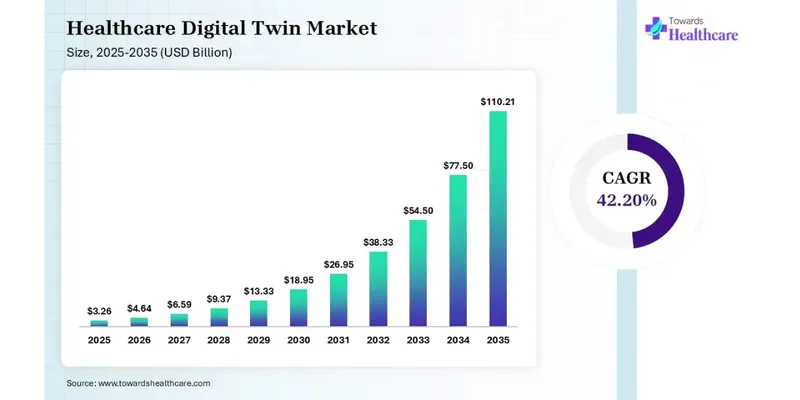
The healthcare digital twin market size stood at USD 3.26 billion in 2025, grew to USD 4.64 billion in 2026, and is forecast to reach USD 110.21 billion by 2035, expanding at a CAGR of 42.2% from 2026 to 2035. Researched by Towards Healthcare
How Digital Twins Can Predict Medical Garment Performance
Digital twins can support several stages of medical garment development, from early material selection to manufacturing and quality evaluation.
1. Simulating Fabric and Material Behavior
The performance of a medical garment depends on more than the type of fiber used. Fabric structure, pore distribution, thickness, surface treatment and the interaction between layers can also affect its behavior.
A digital model can compare candidate materials under defined conditions. Engineers may examine how changes in fabric structure influence airflow, mechanical strength, stretch or resistance to liquid penetration.
For example, a manufacturer designing protective clothing for long clinical procedures could compare alternative material combinations to identify promising options for balancing barrier performance and comfort.
These simulations help narrow the choices before physical samples are produced. Laboratory testing remains necessary to confirm whether the selected materials meet the intended performance requirements.
2. Predicting Stress, Stretch and Seam Failure
Medical garments experience mechanical stress during donning, removal, movement and clinical procedures. Areas around seams, sleeves, shoulders and closures may experience different loads from the main fabric.
Digital twins can incorporate structural simulation methods to estimate how a garment responds to stretching, bending, pulling and repeated movement.
This information can help manufacturers identify potential weak points and adjust seam placement, garment patterns or material combinations before full-scale production.
For instance, if a protective coverall is likely to experience high stress around the underarm during movement, engineers can evaluate alternative panel shapes or seam configurations.
The objective is not simply to make the garment stronger. It is to achieve suitable strength, flexibility and fit for its intended use.
3. Evaluating Fluid and Barrier Performance
Fluid resistance is an important requirement for many medical garments, particularly those used during surgical procedures and other situations involving exposure to biological fluids.
Simulation tools can help engineers investigate how fluid may interact with fabric surfaces, pores, coatings and multilayer structures. Computational fluid dynamics and other modeling approaches may support the evaluation of airflow or fluid movement, depending on the material and model.
A digital twin could help compare design alternatives and identify areas that require closer physical testing.
However, predicting liquid penetration through porous and coated textiles can be complex. Surface chemistry, pressure, fluid properties and manufacturing variation can influence the results. Simulation alone cannot establish compliance with applicable protective-garment standards.
4. Studying Heat and Moisture Inside Medical Clothing
Protective garments can restrict heat and moisture transfer, particularly during physically demanding procedures or long working hours.
Digital models that combine garment geometry, thermal properties and airflow assumptions can help researchers study heat transfer and moisture-related conditions around the body.
Manufacturers could compare fabric weights, ventilation zones and garment constructions to understand potential thermal trade-offs.
This is especially relevant when designing garments that must provide a specified level of protection without creating unnecessary discomfort.
Nevertheless, actual wearer comfort depends on several factors, including the individual, activity level, room conditions and duration of use. Physical wear trials and appropriate human-factors assessments are still important.
Where Digital Twins Could Create the Most Value
The practical value of digital twins depends on the type of garment, the manufacturer's technical capabilities and the decisions the model is intended to support.
Medical garment design: Engineers can compare fabric structures, dimensions, seams and closures before producing multiple physical prototypes.
Manufacturing process optimization: Models linked with production data may help investigate how changes in process settings affect garment consistency, material use or defect rates.
Quality investigation: When a recurring defect appears, manufacturers can compare production records and model assumptions to identify possible contributing factors. Physical inspection and testing are needed to confirm the cause.
Product customization: Digital models may help evaluate different garment sizes, body shapes and movement requirements while maintaining specified design constraints.
Lifecycle performance: For reusable garments, models could incorporate data from laundering, sterilization and inspection cycles to investigate changes in properties such as strength or dimensional stability. Predictions must be validated against actual repeated-cycle testing.
These applications show how digital twins could support both product development and operational decisions rather than functioning only as a visualization tool.
Digital Twins and Physical Testing: Why Both Matter
One of the main advantages of digital twins is the ability to explore design alternatives without manufacturing a physical sample for every option. However, their effectiveness depends on how well their predictions match real-world performance.
A practical development process combines simulation with laboratory testing and product validation.
Material selection: Digital twins compare modeled material properties, while physical testing evaluates actual fabric samples.
Garment design: Simulations evaluate fit, movement and stress points, while physical wear and mechanical tests assess real-world performance.
Barrier development: Models investigate fluid and airflow behavior, while applicable barrier and penetration tests assess actual protection.
Manufacturing: Simulations analyze process parameters and variation, while production samples and finished garments undergo inspection.
Reusable garment evaluation: Models estimate changes across use cycles, while testing after defined laundering or sterilization cycles checks actual performance.
The specific tests depend on the garment's intended use, claims and applicable regulations or standards. A simulation should not replace required testing, certification or conformity assessment.
Manufacturers also need to consider model uncertainty. If the input data do not accurately represent the production material, the resulting prediction may be misleading.
The Data Challenge Behind Digital Twins
Building a useful digital twin requires reliable information from several parts of the manufacturing process.
Material suppliers may hold data on fiber composition, coatings and fabric performance. Garment manufacturers may hold design specifications, seam details and production parameters. Testing laboratories may provide results for mechanical strength, fluid resistance and other performance characteristics.
In practice, these records may be stored in different systems, collected using different methods or available at inconsistent levels of detail.
This creates several challenges.
Data consistency: Material specifications and test results must use comparable definitions and measurement conditions.
Model validation: Simulation outputs need to be compared with physical results across relevant materials and garment designs.
Production variability: Differences between material batches, equipment settings and manufacturing conditions can affect actual performance.
Integration costs: Connecting design software, manufacturing systems and quality databases may require technical investment and staff training.
Evidence and compliance: Manufacturers need documented methods for determining whether model outputs are suitable for the decisions they support.
A digital twin should therefore be developed around a defined business or engineering problem. Building a complex model without reliable data or a clear use case may create additional costs without delivering meaningful improvements.
What Manufacturers Should Consider Before Investing
Digital twin adoption does not need to begin with an entire garment portfolio. A focused pilot can help manufacturers determine whether simulation provides useful results.
A practical approach includes five steps.
- Select a specific problem. Identify an issue such as repeated seam failures, excessive prototyping, inconsistent fabric performance or difficulty balancing protection and comfort.
- Collect relevant data. Bring together material specifications, garment designs, laboratory results and available production records.
- Build a focused model. Start with the material, component or garment feature most closely connected to the problem.
- Validate the predictions. Compare simulation results with physical tests and investigate any meaningful differences.
- Measure business value. Evaluate whether the approach reduces unnecessary prototypes, shortens development time, improves defect analysis or supports better material decisions.
This process gives manufacturers a way to assess technical feasibility and commercial value before expanding the technology across multiple product lines.
The Business Implications for Medical Textile Companies
Digital twins could change how manufacturers approach product development, technical differentiation and investment decisions.
Companies that can combine reliable material data with validated simulation methods may be better positioned to evaluate design alternatives and explain the performance trade-offs behind their products.
For material suppliers, this creates an opportunity to provide more detailed technical data to garment manufacturers. For garment producers, it may support more systematic product development and closer collaboration with textile engineers, testing laboratories and healthcare buyers.
The technology also introduces competitive considerations. Companies must evaluate software costs, data ownership, intellectual property, staff capabilities and the time required to validate models.
The strongest business case will depend on measurable improvements rather than the technology itself. Manufacturers should assess whether digital twins address a costly, recurring problem and whether the resulting decisions justify the investment.
How Towards Healthcare Supports Strategic Decisions in Medical Textiles
For organizations considering digital twins, the challenge extends beyond selecting simulation software. Leaders also need to understand where the technology fits within the medical textile value chain, which applications offer practical opportunities and what capabilities may be required to commercialize them.
Towards Healthcare provides strategic consulting and research support for organizations and industry leaders in medical textiles and related healthcare sectors.
Its work can help decision-makers evaluate industry developments, assess competitive positioning, identify emerging technology opportunities and examine the business implications of material and manufacturing innovation.
For companies exploring digital twins, this strategic perspective can support questions such as:
- Which medical garment applications may benefit most from simulation-led development?
- Where are manufacturers facing recurring product performance or production challenges?
- What capabilities, partnerships and data resources may be needed to implement digital twin systems?
- How could simulation-based development influence product differentiation and manufacturing strategy?
- Which emerging technologies deserve further assessment before organizations commit resources?
By combining industry research with strategic consulting, Towards Healthcare helps leaders assess technology opportunities in the context of business objectives, competitive conditions and changing healthcare requirements.