Corporate Performance Report: Ghushine Fintrade Ocean Limited (FY 2023–2025)

1. Introduction
The Indian textile and diamond trading landscape is a study in fragmentation, where micro-cap entities often operate in the shadows of giants until a sudden surge in activity demands closer scrutiny. Ghushine Fintrade Ocean Limited (GFOL) presents a compelling, if polarizing, case study for the 2024-2025 period. Listed on the BSE SME platform, the company is currently attempting a high-stakes pivot from operational dormancy to aggressive scale. This analysis explores the fundamental tension at the heart of GFOL: a business that is finally finding its top-line footing while simultaneously drowning in a backlog of regulatory and compliance failures. For the sophisticated observer, GFOL represents the "growing pains" of a family-run enterprise attempting to professionalize under the harsh glare of public market standards.
The intent of this report is to evaluate whether GFOL’s recent 212% revenue jump is a sustainable growth story or merely a temporary spike overshadowed by deep-seated governance risks. To understand this trajectory, we must first look under the hood of their foundational operations in Gujarat.
2. Company Overview
In equity research, a company’s business model is its DNA; if the foundation is poorly understood, the financial ratios that follow are often misinterpreted. Ghushine Fintrade Ocean Limited, incorporated in 1995, is a veteran of the Surat textile hub. Based in the Vesu-Abhava area near Aagam Crossroad, the company operates in the heart of India's fabric capital. While it maintains a dual-sector focus on textiles and diamonds, its current strategic weight is firmly behind its role as a "Domestic Textile Supplier."
GFOL has carved out a specialized niche in 100% organic fabrics, offering a catalog that includes sarees, curtains, and sofa fabrics. This focus on "green" textiles is a clear attempt to capture modern consumer sentiment, yet the company’s physical footprint remains that of a traditional SME. Its registered office at Aagam AC Market serves as the nerve center for a business that is trying to bridge the gap between legacy trading and modern sustainable apparel.
While the operational roots are deep, the path forward is dictated by a leadership team that maintains an iron grip on the company’s strategy and capital.
3. Promoter / Founder Introduction
In the SME ecosystem, "Promoter Skin in the Game" is a double-edged sword. On one hand, it ensures resilience; on the other, it can lead to governance blind spots. GFOL is steered by Mr. Alok Bhopal Singh Jain (Chairman, MD, and CFO) and Mrs. Kapilaben Alokbhai Jain, who bring 30 and 29 years of experience, respectively. Together, they hold over 51% of the company, providing a stable ownership structure as the firm enters its third decade.
However, a closer look at the governance framework reveals a significant "concentration of power," with Mr. Jain holding three critical executive roles. Furthermore, disclosures in the AOC-2 filings reveal several "at-will" loans to promoter family members, including Samyak and Akansha Jain. From a strategy consultant’s perspective, these related-party transactions suggest that the company treasury is being managed with the informality of a private family office, creating potential liquidity risks for minority shareholders despite the promoters' long tenure.
The experience at the top is undeniable, but the true measure of their management lies in the audited numbers, which tell a story of massive growth on a razor-thin edge.
4. Financial Statement Analysis
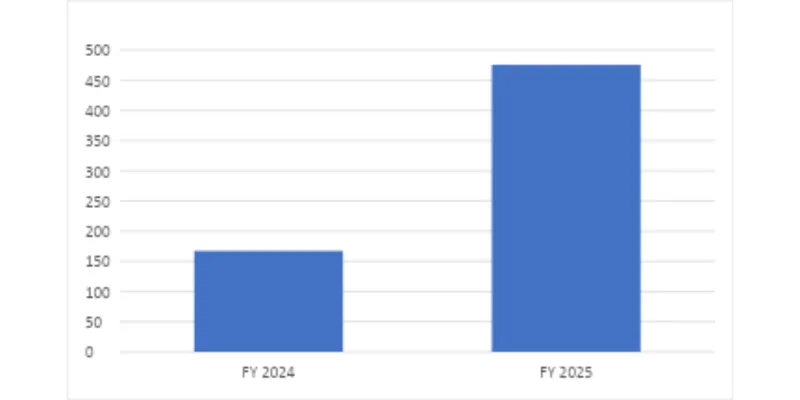
The 2024-2025 financial year has emerged as a major pivot point for GFOL’s top-line revenue. After years of negligible activity, the sales engine has finally ignited.
Fiscal Year Performance (INR Lacs)
Particulars | FY 2025 | FY 2024 | FY 2023 |
Total Income | 475.54 | 167.27 | ~0.22 |
Total Expenditure | 474.29 | 166.92 | ~0.22 |
Net Profit | 0.34 | 0.02 | 0.00 |
Analysis: Growth vs. Leakage
The "So What?" behind these numbers is a study in extremes. On the positive side, GFOL achieved a 212% TTM Sales Growth and successfully reduced its Debtor Days from a sluggish 262 days to a more manageable 142 days. This improvement likely stems from a strategic shift toward cash-based trading in the organic niche, or perhaps the sheer volume of new revenue is diluting older, slower receivables.
However, the profitability gap is staggering. The company generated 475.54 lacs in income but saw 474.29 lacs vanish into expenditures. This suggests almost zero pricing power or significant overhead leakage. One bright spot on the balance sheet is a 20 lac investment in Mercury Ventures Private Limited, acquired via loan-to-equity conversion—a rare strategic asset for a company of this size.
5. Key Insights & Interpretation
To understand GFOL, one must look past the sales growth and confront a regulatory landscape that threatens the very "Going Concern" status of the firm.
Strengths and Strategic Moves: The primary strength is the operational re-awakening in the organic fabric sector. Notably, the company has recently appointed Mr. Jitendra Bhagat as a Secretarial Auditor for a five-year term. While not strictly mandatory for all SMEs, this move is a rare "pro" in their governance column, signaling an attempt to fix their compliance culture.
The Compliance Crisis: The weaknesses, however, are systemic. The company’s website—a basic requirement for a modern textile trader—remains non-functional. More critically, GFOL faces a combined SEBI and BSE penalty of over 11.5 lacs for various defaults. To put this in perspective, the penalty is roughly 34 times the company’s annual profit. If these "crystallized liabilities" are fully enforced, the financial position would be decimated. Furthermore, the company is embroiled in a legal battle with the ROC regarding its registered office, a matter currently being appealed in the Honorable High Court of Gujarat.
6. Conclusion
Ghushine Fintrade Ocean Limited is currently a paradox. Its operational core is vibrating with new life, evidenced by triple-digit sales growth and a tightening credit cycle. Yet, the administrative and regulatory framework is in a state of near-collapse. The contrast between a 0.34 lac profit and an 11.5 lac regulatory fine creates a precarious investment thesis.
While the appointment of a professional Secretarial Auditor suggests a desire to reform, the non-functional website and the ongoing High Court battles signal a fundamental breakdown in the "SME to Scalable Entity" transition. Until the company can resolve its standing with the BSE and stop the "leakage" that keeps profits at near-zero levels, it remains a high-risk regulatory red flag rather than a pure growth story.
Data Source: Audited Annual Report 2024-25 and Screener.in Financial Database.