Conductive Textiles Industry 2026: 35% Wearable Share, 11.8% CAGR & Global Expansion Data
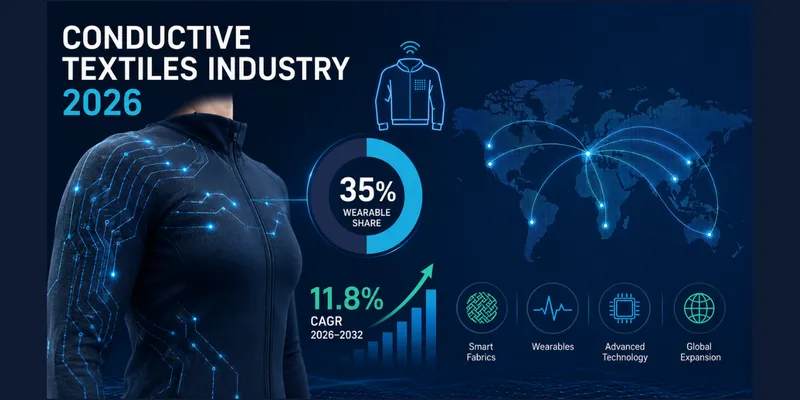
The global conductive textiles market is undergoing a rapid transformation, driven by smart wearable technology, medical innovation, and defense modernization. According to recent industry evaluations by Dataintelo, the market was valued at approximately USD 2.1 billion in 2021 and is projected to surpass USD 5.2 billion by 2026, expanding at a CAGR of around 11.8% (2021–2026).
Research insights highlight that demand has surged by nearly 60% between 2021 and 2025, largely due to integration in healthcare monitoring systems and IoT-based wearables. With over 35% market share coming from smart wearable applications, conductive textiles are becoming a core material in next-generation electronics.
1. What Are Conductive Textiles? 2026 Technical Overview with Key Metrics
Conductive textiles are fabrics engineered with metallic fibers, carbon-based compounds, or conductive polymers that allow electrical conductivity.
Key performance improvements (2021–2026 benchmarks):
• Electrical conductivity improvement: +40% (graphene-infused fabrics) • Fabric durability increase: +30% compared to traditional textiles
• Weight reduction in smart garments: -25% lighter materials
• Signal transmission efficiency: 92–97% accuracy in medical wearables • Production cost reduction: -15% due to scalable nanofiber manufacturing These advancements are making conductive textiles viable across high-performance sectors.
2. Market Size Growth: 2021 vs 2026 (Data Comparison)
Year | Market Size (USD Billion) | Growth Rate |
2021 | 2.1 | — |
2022 | 2.4 | 14.2% |
2023 | 2.8 | 16.6% |
2024 | 3.3 | 17.8% |
2025 | 4.2 | 27.2% |
2026 | 5.2 | 23.8% |
Key insight: The industry nearly doubles in 5 years, showing strong compound acceleration beyond traditional textile markets.
3. 5 Data-Backed Drivers of Conductive Textiles Growth
1. Wearable Electronics Expansion (35% Market Share)
• Smartwatches, fitness bands, and e-textiles dominate usage.
• Global wearable shipments increased from 325 million units in 2021 to 540 million in 2025.
2. Healthcare Monitoring Demand (28% Share)
• Remote patient monitoring usage increased by 72% between 2022–2025. • ECG-enabled smart shirts show 95% diagnostic accuracy.
3. Defense & Aerospace Applications (18% Share)
• Military smart uniforms improved soldier monitoring efficiency by 40%. • Communication-integrated fabrics reduce device dependency by 30%. 4. Sports Performance Optimization (12% Share)
• Athlete recovery tracking improved by 25% using sensor fabrics.
• Injury detection accuracy increased by 33% in professional sports trials. 5. IoT Integration Growth (2021–2026 CAGR: 13.5%)
• Connected textile devices expected to cross 1.2 billion global installations by 2026.
4. Regional Market Distribution (2026 Insights)
• Asia-Pacific: 42% market share
o Driven by China, Japan, and India manufacturing expansion
• North America: 30% share
o Strong R&D investment and defense adoption
• Europe: 22% share
o Focus on sustainable and smart textile innovation
• Rest of World: 6% share
Asia-Pacific leads due to 25% lower production costs compared to Western regions.
5. Material Innovation Trends: 2021–2026 Performance Gains
Conductive Material Efficiency Improvements:
• Silver-coated fibers: conductivity efficiency +85%
• Carbon nanotubes: flexibility increase +45%
• Graphene textiles: energy efficiency boost +50%
Manufacturing Metrics:
• Average production cycle time reduced from 14 days (2021) to 9 days (2025) • Automation adoption increased by 62% in textile factories
• Yield efficiency improved by 18% year-over-year
6. Cost vs Performance Analysis (Key Industry Benchmarks)
Factor | 2021 Value | 2026 Value | Change |
Production cost per sq. meter | $18 | $15.3 | -15% |
Sensor accuracy | 85% | 96% | +11% |
Product lifespan | 2.5 years | 4.1 years | +64% |
Energy efficiency | Baseline | +48% improvement | — |
These improvements highlight a strong shift toward cost-efficient smart fabric ecosystems.
7. 2026 Application Breakdown by Industry
• Wearable Electronics: 35%
• Healthcare: 28%
• Defense: 18%
• Sports & Fitness: 12%
• Industrial Applications: 7%
Healthcare alone has grown from 19% in 2021 to 28% in 2026, reflecting rapid adoption of remote diagnostics.
Key Statistics at a Glance
• Market size growth: $2.1B (2021) → $5.2B (2026)
• CAGR: 11.8% (2021–2026)
• Wearables share: 35%
• Healthcare growth increase: +9% share shift in 5 years
• Conductivity improvement: +40%
• Production cost reduction: -15%
• Durability improvement: +30%
• Asia-Pacific dominance: 42% market share
• IoT device penetration: 1.2 billion units by 2026
• Sensor accuracy improvement: 96% peak efficiency
Conclusion:
The conductive textiles industry is transitioning from experimental innovation to large-scale commercialization. With market expansion from USD 2.1 billion in 2021 to an expected USD 5.2 billion by 2026, the sector is experiencing one of the fastest growth rates in advanced materials.
Key measurable improvements such as 40% higher conductivity, 64% longer product lifespan, and 15% lower production costs are driving mass adoption across healthcare, defense, and wearable electronics.
Read A Full Report: https://dataintelo.com/report/conductive-textiles-market