Comprehensive Corporate & Financial Analysis: Oswal Yarns Limited (FY 2024-25)

1. Introduction
The Indian Textiles & Apparel (T&A) industry is a foundational pillar of the national economy, contributing significantly to GDP and serving as a massive employment engine across the value chain. However, as global markets shift toward sustainable practices and technological integration, legacy players are finding themselves at a strategic crossroads. This report evaluates Oswal Yarns Limited (OYL), a Ludhiana-based entity incorporated in 1982, as it navigates a high-stakes transition. Once a traditional manufacturer, OYL is currently pivoting its operational identity in response to sector-wide headwinds, including skilled labor shortages and rising production costs. For the strategic analyst, OYL represents a critical case study in asset monetization and corporate survival, as the company effectively functions as a real estate holding vehicle disguised as a textile trader during this 2024-25 fiscal period.
2. Company Overview
In financial valuation, a company’s history and business model provide the "why" behind the numbers. Without this context, an auditor sees figures; with it, a consultant sees a narrative of resilience or stagnation.
Background & History Oswal Yarns Limited has maintained a 43-year presence in Ludhiana’s Industrial Area A (Link Road). As an established member of the Oswal Group, the company’s identity is deeply intertwined with the industrial heritage of Punjab. However, legacy alone is no longer sufficient to sustain its historical manufacturing footprint.
Business Model Transformation The most striking development in FY 2024-25 is the total cessation of production; the source context explicitly confirms that "during the year there was no manufacturing activity." OYL has transitioned into a pure-play trading entity, but even this appears to be a transitory phase. The company’s focus has shifted toward unlocking the value of its primary asset—its land. By obtaining "Change of Land Use" (CLU) from industrial to commercial and registering as a real estate promoter with GLADA (Greater Ludhiana Area Development Authority), the company is signaling a terminal exit from the textile production sector.
Core Portfolio While manufacturing is dormant, the company continues to trade in a diverse yarn and cloth portfolio:
- Knitted Cloth: Apparel-related textile products.
- Cotton Yarns: Carded, Combed, Organic, BCI, and SUPIMA varieties.
- Value-Added Blends: Cotton-Polyester and Grey yarns.
Listed on the BSE (Scrip Code: 514460), OYL is a micro-cap entity with a market capitalization of approximately ₹6.16 Crore. While it carries the Oswal name, its current operational scale is that of a "skeleton crew" operation.
This strategic downsizing is a deliberate move steered by a leadership team focused on cost-containment and asset-based value creation.
3. Promoter & Founder Introduction
In small-cap entities, the role of Key Managerial Personnel (KMP) is definitive. In the absence of institutional layers, the personal strategy of the promoters dictates the company's ultimate trajectory.
Leadership Profiles
- Sh. Tej Paul Oswal (Managing Director): A primary promoter holding 22.10% (886,100 shares), Sh. Oswal is the strategic architect of the current pivot.
- Sh. Bharatt Oswall (Whole-time Director/Executive Director): Holding 8.69% of equity, he manages the lean executive functions.
- Sh. Kulwant Rai Dhawan: Serves as a Director, bringing consistent board oversight to the transition process.
Strategic Role and Cost-Containment The leadership has navigated "difficult times" by drastically reducing overhead. A pragmatic audit of the 2025 remuneration reveals a "skeleton crew" approach: the Whole-time Director (Sh. Bharatt Oswall) and the CFO (Sh. Bansi Lal Bhat) took annual salaries of just ₹158k and ₹160k respectively. This indicates that the KMPs are prioritizing corporate liquidity and the real estate pivot over personal short-term compensation. Their primary objective is the monetization of the Link Road land, a move that requires navigating the complex GLADA registration process to transition from a manufacturer to a developer.
4. Financial Statement Analysis (2023-2025)
A three-year trend analysis reveals that OYL is in a state of technical stagnation, where revenue "growth" is overshadowed by the inefficiency of the trading model.
Income Statement Analysis
- Revenue Trends: Revenue rose to ₹19,939.20k (2025) from ₹19,404.10k (2024) and ₹12,500k (2023). While the upward curve looks positive, the scale is insufficient for a listed entity.
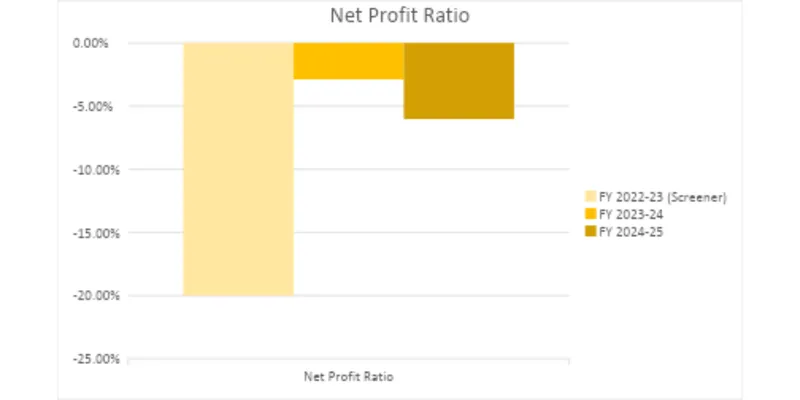
- The Profitability Trap: Net losses have deepened from ₹561k (2024) to ₹1,201k (2025). Pedagogically, this is a dangerous signal: it indicates that the incremental cost of trading and maintaining a listed shell is higher than the margins earned. Despite higher sales, the business is losing money more rapidly than in the previous year.
Balance Sheet Analysis
- The Asset Base: The company holds Property, Plant and Equipment (PPE) of ₹11,754.89k.
- Equity Erosion: While Share Capital is stable at ₹40,100k, "Other Equity" is a concern -₹9,184k. The negative Debt-Equity ratio (0.52) is not a sign of low debt, but a symptom of eroded equity and technical insolvency; the accumulated losses are eating the company’s book value.
Cash Flow Statement Analysis
OYL reported Net Cash from Operating Activities of ₹2,711k in 2025. This cash was not generated by profit, but by the liquidation of inventory (₹3,732k reduction). This is a finite strategy—once the remaining inventory is sold, the company has no recurring cash engine to cover operational losses.
Financial Ratios Table
Ratio | FY 2024-25 | FY 2023-24 | FY 2022-23 (Screener) |
Debt-Equity Ratio | (0.52) | (0.57) | N/A |
Inventory Turnover | 0.93 | 0.00 | 0.90 |
Net Profit Ratio | -6.02% | -2.89% | -20.00% |
5. Key Insights & Interpretation
The "Current Ratio" Paradox
While a Current Ratio of 52.36 typically suggests extreme liquidity, here it is a red flag of capital inefficiency. In a healthy trading business, capital should circulate. At OYL, capital is "rotting" in stagnant inventory (over ₹19 million), suggesting the company is unable to move stock efficiently, even as it tries to pivot.
Strengths & Weaknesses
- Strength: The company is effectively debt-free regarding external bank limits (utilizing zero of its sanctioned ₹5 crore limit).
- Weakness: Five-year sales growth is a dismal -8.87%, and the interest coverage ratio is critically low.
Risk Factor Correction
While the broader industry faces Foreign Exchange Risks, OYL is currently insulated. The 2025 report explicitly states there was "zero foreign exchange earning and outgo." The primary operational risk is the depletion of the inventory cash-cushion before the land sale is finalized.
The Strategic Pivot: Real Estate Transition
The "smoking gun" for OYL's future is found in Note 31. The company has provided a bank guarantee to GLADA for registration as a real estate promoter. Combined with the CLU approval for the Link Road land, it is clear that OYL is no longer a textile company; it is a real estate development vehicle.
6. Conclusion
From an investment perspective, Oswal Yarns Limited is a company in a state of controlled hibernation. It has stripped its manufacturing operations to the bone, maintained a skeleton crew with minimal salaries, and is liquidating inventory to pay the bills while it pursues its true goal: asset monetization.
Financial Health Evaluation The company’s bloated liquidity (Current Ratio 52.36) masks an underlying state of technical insolvency caused by years of eroded equity. The current trading model is not self-sustaining, as evidenced by the widening net loss despite increased revenue.
Final Verdict OYL is a "pivot play." Its value is no longer tied to the volatile textile market but to the successful execution of the land disposal and its transition into real estate. Stakeholders should view the company as a property-holding entity whose primary mission is the conversion of legacy industrial land into commercial capital.
Data Source: Oswal Yarns Limited Annual Report 2024-25 & Screener.in Financial Records.