Colour from the Earth: Exploring Mineral Dyes and Pigments

Dr. N. N. Mahapatra
Business Head (Dyes),
Shree Pushkar Chemicals & Fertilisers Ltd
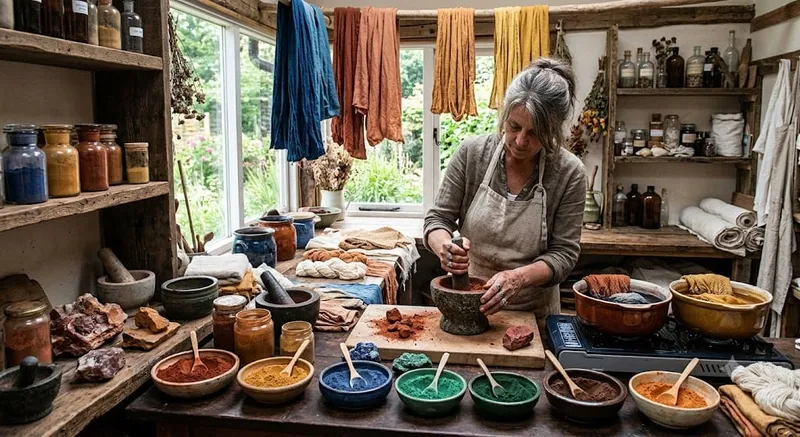
Using minerals to dye yarn is not a new invention and is used to some extent in carpet manufacturing. By combining these, a lot of different nuances can be used when colouring the yarn. Minerals are inorganic compounds abundantly given to us by Mother Earth. They are rich sources of metallic ions, mineral salts, and metal oxides and are sometimes used for the extraction of certain pigments to dye yarn. Minerals are drawn out by mining and exploration techniques. To obtain a mineral dye, the pigments present in a mineral are drawn out. The extracted pigment is suspended in a medium, and the medium bonds with the cloth. These mineral pigments work best with natural fabrics like cotton, linen, hemp, wool, and silk. Mineral-based pigments are a classic example of sustainable alternatives for synthetic chemical dyes. Earth pigments are known for their light-fastness (how resistant to fading it is when exposed to light) and fast drying.
These include various metal salts and metal oxides. Minerals provide such dyes as Prussian blue, chrome yellow, and iron buff. Tribes and nations in different parts of the world have found out the art of colouring and staining textiles with mineral compounds.
Iron buff: iron springs, containing iron salts in solution, are found in many countries, with colour sediments left when the water stands exposed to the air. Dipping clothes in these springs and then exposing them to the air dyed them in iron rust colour commonly called "iron buff”. Mineral khaki, a mineral colouring matter, has been used to dye military uniforms. Today, instead of iron scrap, ferrous sulphate is being used.
A natural dyestuff made from minerals; examples are ochre, chrome yellow, and Prussian blue.
Mineral dyes are produced by the metallic ions in the mordant salts. This gives a yellow from chrome, brown from the iron salts, and blue from copper. These are the most used minerals for dyeing: Ochre, a kind of iron ore, also called limonite, which is an earth mineral oxide. It is used for yellow, brown, and red nuances. Malachite, an intense green mineral, is actually copper carbonate mixed with copper hydroxide.
These are the most used minerals for dyeing:
1. BROWN OCHRE
The brown color covers a wide range of the visible spectrum and is a combination of yellow, orange, or red. Its shades are named reddish brown, yellowish brown, dark brown, light brown, and so on. As a mineral-based alternative, Brown ochre is a major source for obtaining brown pigment. It is basically a limonitic rock which is a mixture of several minerals, predominantly goethite. The pigment is absolutely stable and works best with Acrylics, Lime / Fresco, Ceramic, Oil, Tempera, Watercolor / Gouache, Cement.
Brown ochre is well documented in the ancient cave paintings which are still in excellent condition, showing their color stability. It is compatible with all other pigments and is often used in mixture with other pigments.
For textile use, the pigment is powdered to a fine paste. Brown ochres can also be prepared artificially by a variety of procedures. The two main production methods:
- Precipitation of iron oxides
- Thermal decomposition of iron compounds.
It is a kind of iron ore, also called limonite, which is an earth mineral oxide. It is used for yellow, brown, and red nuances. It is a kind of iron ore, also called limonite, which is an earth mineral oxide.
2. SIENNA
Sienna is a yellowish-brown earth pigment with oxides of iron and manganese. It was first mined near Tuscany and named terra rossa (red earth), terra gialla, or terra di Siena.
Along with ochre and umber, it was one of the first pigments to be used by humans and is found in many cave paintings.
Sienna is used in two of its popular forms:
- Raw Sienna: The naturally occurring sienna is yellow in color. This pigment is known as terra gialla.
- Burnt Sienna: The raw sienna, when exposed to heat it turned out reddish brown and is known as burnt sienna, producing brown pigment. The pigment is also known as terra rossa. This pigment shows a various color range, including Burnt sienna pigment (Maerz and Paul), Dark sienna (ISCC-NBS), Sienna (X11 colour).
Since the Renaissance, it has been one of the brown pigments most widely used by artists. In the 20th century, pigments began to be produced using synthetic iron oxide rather than the natural earth.
3. UMBER
Another mineral alternative for brown dye is Umber. It is a natural brown or reddish-brown mineral which is darker than sienna and ochre. The name comes from terra d’ombra, or earth of Umbria, a mountainous region where the pigment was first extracted.
Likewise, sienna, or raw umber, is light in color, but when exposed to heat, it turns darker and more intense and is thus called burnt umber, suitable for both oil and watercolor paint.
In the 20th century, natural umber pigments were gradually replaced by synthetic pigments made with iron oxide and manganese oxide. Natural umber pigments are still being made, with Cyprus as a prominent source.
4. MALACHITE
Malachite, an intense green mineral, is actually copper carbonate mixed with copper hydroxide. Breaks from time to time as copper ore. Used for green nuances
5. MANGANESE
Manganese, a metallic element. Used for black nuances. Manganese Black is the pigment obtained from the silver-grey colored chemical element, which is often found in minerals along with iron. The pigment shows stability in acids and alkalies and also at high temperatures. It shows excellent lightfastness and is compatible with all other pigments. Several colorful oxides of manganese used as pigments are:
- Manganese dioxide – Abundantly found in nature and has been used as a pigment since the Stone Age. The cave paintings in Gargas that are 30,000 to 24,000 years old contain black manganese pigments.
- Pyrolusite – Often called Mineral Brown Black is the most common manganese mineral. The pigment is dark brown or brownish black, used as a coloring material in calico printing and dyeing. It imparts violet, amber, and black colors to glass, pottery, and bricks, and is used in the manufacture of green and violet paints.
Manganese compounds have been used as pigments and for the coloring of ceramics and glass. The brown color of ceramic is sometimes the result of manganese compounds. A metallic element. Used for black nuances
It was used by Egyptian and Roman glassmakers, either to add to or remove colour from glass.
6. CINNABAR
Cinnabar, a heavy reddish mineral, with a metallic adamantine lustre. It is made from quicksilver sulphide. Used for red nuances.
7. AZURITE
Azurite, a blue/darkblue copper mineral. It is crystallized and often found together with the green mineral malachite. Both are products of erosion and oxidation of copper minerals. Used for blue nuances.
8. LEAD
Lead, used for red nuances.
9. ARAGONITE
Aragonite, usually a colourless or white mineral. Used for white nuances.
10. LAPIS LAZULI
Lapis lazuli, also known as lapis, is a blue rock. Consists of a mixture of azurite and calcite, pyroxenite, and other silicate minerals, besides pyrite. Used for blue nuances.
11. MAGNETITE
One of the common rock minerals and an important ore of iron. Magnetite yields an excellent black color called Roman Black Pigment. This natural black oxide is dense, opaque, non-greasy, nontoxic, and imparts heavy, permanent color. India Black pigment is a Natural black Oxide from India that is suitable for all media, including Artists Paints, Home Decor Paints, limewash, plaster, mortar and grout, and more. The pigment has a cool, neutral tone and can be used with any medium.
Many mineral-yielding whites are used as pigments for white colors, tinting colors, and covering tones in paint, as inorganic pigments are comparatively easier to disperse in most paint vehicles than organic pigments. They undergo treatment to improve their dispersibility, lightfastness, and weather resistance.
12. ARAGONITE
Aragonite is a white to pale yellow mineral formed by biological and physical processes like precipitation from marine and freshwater environments, limestone caverns, near hot springs and geysers.
Aragonite is often found with gypsum, barite, malachite, calcite, quartz, clays, dolomite, and limonite among many other minerals.
Historically, Aragonite was used along with dolomite and chalk for creating backgrounds and motives with other pigments by Romans. The long-lasting fluorescent properties of this pigment add durability as well as luster and brilliance to color mixtures.
It is non-toxic and has good covering power as a white pigment in aqueous mediums, such as egg tempera, distemper, and casein. However, aragonite is not effective in oil mediums, because of its low refractive index. It exhibits excellent fluorescent properties.
13. ZINC SULFIDE
Zinc sulfide is an inorganic compound which mainly occurs as zinc in the mineral ore sphalerite. In its raw form, the mineral is usually black due to the presence of various impurities, but the pure pigment is white.
It is non-toxic to humans and has good lightfastness, but it is highly prone to weathering and therefore inadequate for outdoor paints. Ultraviolet radiation combined with humidity oxidizes zinc sulfide to the colorless zinc sulfate (ZnSO4) in paint.
Its uses as a pigment diminished during the past century due to its optical properties, which are inferior to those of titanium dioxide. Zinc sulfide is used in paint that requires pigments with low abrasion qualities. This is perhaps its only advantage in comparison to titanium dioxide.
Dying With Mineral Dyes
Examples of mineral dyes are chrome yellow, iron buff, Prussian blue, nankin yellow, and manganese brown, etc. They are very much insoluble in water and other solvents; therefore, the presence of a binder is necessary to attach to the fiber surface.
Iron buff is a fabric dye produced with the metal- IRON. In its simplest form, the clothes are dipped in iron springs, containing iron salts in solution. Dipping clothes in these springs and then exposing them to the air dyed them in an iron rust color commonly called " iron buff”.
In fact, ancient greys and blacks were almost all dyed with iron together with plant tannins. Examples of this technique can be seen in the textiles of the Swiss Lake Dwellers (approximately 3000 BC). Egyptians also dyed with iron liquor, and the sails of many Mediterranean fishing boats were dyed buff until quite recently.
Dyeing with iron produces buffs, dull yellows and oranges that are very fast to light and washing. To avoid shortening the life of the fibers too much, mostly cotton or linen are dyed using light shades. Fiber dyed with iron has already been mordanted and could be overdyed to unusual shades with weld, madder, and other natural dyes.
Many mineral-yielding whites are used as pigments for white colors, tinting colors and covering tones in paint, as inorganic pigments are comparatively easy to disperse in most paint vehicles than organic pigments. They undergo treatment to improve their dispersibility, lightfastness and weather resistance.
Properties Of Mineral Dyes
They are very much insoluble in water and other solvents; therefore, the presence of binder is necessary to attach to the fiber surface. The colours obtained on the fiber are extremely resistant to light and chemical agencies and are modified to deeper and richer shades by calcinations. Many mineral colourants have been found to be poisonous in nature; therefore, they have limited applications.
Mineral khaki is also called metallic khaki. Mineral khaki color is produced by the dyeing process of mixing iron buff and chrome green colors. It’s generally applied on cotton. This cannot be applied to silk or wool. Because this dyes decrease the flexibility and luster of silk and wool. Mineral khaki color is produced by a chemical reaction of metal salts. These classes of dyes are chrome yellow, chrome orange, chrome green, manganese brown, iron buff, khaki, Prussian blue, etc. Generally, military / police uniform are dyed with mineral khaki dyes. It has excellent water fastness because of the insolubility of the metal oxides in water. Involves a series of chemical reactions to make the process economical.
The Ultimate – Khaki Color
1. MINERAL KHAKI
Khaki is a color, a light shade of brown with a yellowish tinge. Mineral Khaki Color is produced by a chemical reaction of metal salt – Iron and chrome, more specifically (Iron buff and Chrome green color).
The color ranges from chrome yellow, chrome orange, chrome green to manganese brown, iron buff, khaki and Prussian blue.
Mineral Khaki Dye is:
- Generally used to dye cotton fabrics. It cannot be used on silk or wool as it decreases the luster and flexibility of silk and wool.
- It is lightfast.
- This color dye is resistant to alkalis.
- It is used for army or military clothes.
Mineral khaki was abandoned prior to the First World War due to the large production of synthetic sulfur colors producing khaki.
Mineral Khaki Dyes:
By mixing 50% Iron buff and 50% chrome alum solution, the military khaki color is produced; it’s called mineral khaki dye. Its other name is Military khaki dye.
Properties of Mineral Khaki Dyes:
- These dyes are generally applied to cotton fibers.
- Its light fastness and washing fastness are good.
- This color-dyed fabric is decreased by acid.
- It’s used for military dress dyeing.
But it is now very unknown in the market.
Application of Mineral Khaki Dye on Cotton:
The process of mineral khaki dyeing by impregnation with chrome alum and iron alum, followed by development with potassium chromate, deposits chromium and iron chromates on cotton. These compounds are hydrolysed and reduced by subsequent washing and drying of the dyed yarn, the ultimate pigment being a mixture of hydrated chromic and ferric oxides.
1st Method: Recipe
- Iron buff/ferrous sulphate — 3-5% o.w.m. [On the weight of materials]
- Sulphuric acid — 2-3% o.w.m.
- Potassium bichromate — 2-3% o.w.m.
- Temperature — 90-99°C.
- Time — 30-60 minutes
- M:L — 1:20
Process Sequence:
At room temp. Set the dye bath with some hot water and Iron buff /Ferrous sulphate. After sometimes Potassium bichromate and sulphuric acid to the bath, and add the rest of the water. Raise the temperature at 50oC. Add the fabric to the bath. Raise the temperature to 99 °C. Run the dye bath for about 60 minutes. After dyeing, wash the fabric to obtain khaki color.
2nd Method: Recipe
- Chrome alum — 5% o.w.m.
- Ferric chloride — 5% o.w.m.
- Soda — 10% o.w.m.
- Temperature — 90- 99 °C.
- Time — 30 minutes
- M:L — 1:20
Process Sequence:
- Set up the dye bath with the required water.
- Add Chrome alum and ferric chloride.
- Add fabric into the dye bath solution and raise the temperature at 90-99°C.
- The run time of the dye bath is 30 minutes.
- Cool down the dye bath and drain the bath.
- Soda solution is made in the other bath, and the dyed fabric is added to it to produce color.
- Raise the temp.at 99°C. For about 30 minutes.
- Soaping the goods at 90°C. And wash with cold water as after treatment.
Different khaki colors are also produced by mixing different % of chrome and Iron buff with manganese salt. It is used in textiles, but it is now very unknown in the market. It’s used only for military dress dyeing. Mineral khaki- dyed cloth is often overdyed (topped) with Vat Khaki. If the entire shade is built up with these vat dyes, the dyeing process becomes costly. In order to reduce the cost of dyeing, a major part of the shade is produced by the mineral khaki and topped with a small percentage of the vat dye.
A dye with less impact on the environment.
The dyeing process with mineral dyes has a lower impact on the environment for several reasons, namely the reduction of water and energy consumption. On the other hand, the products used in the process and the dyes themselves, of natural origin, are more environmentally friendly.
These dyes can be applied to almost any type of fibre used in confection, whether it be cotton, linen, viscose, polyamides, or polyester.
The available colours are extracted from natural elements; hence the colour palette is not too big, nor is it possible to make colours too strong. In general, this dyeing process has an irregular appearance and may have some small irregularities, such as stains or spots, which give the pieces an old and worn look.
They also have excellent resistance to washing, perspiration, and light. Being that, in stronger colours, the fastness to wet friction reveals values close to the Indigo dye of jeans.