Clothing Needs Its AQI Moment
We learnt to measure the air we breathe. Now the textile industry must make the invisible impact of clothing visible - from raw material to retail.
BY PARVINDER KADYAN Chairman, GATS | Founder, Aadi Sustainability Solutions
A decade ago, most of us could tell when the air felt polluted. Few of us could say whether it was an AQI of 80, 200 or 400. Once air quality started being measured and communicated every day, an invisible problem became visible - and people began to compare, question and act.
Clothing is still largely in its pre-AQI era. We can see a pair of jeans, judge the fit, finish and price, and read a fibre-composition label. But we usually cannot see where the cotton came from, whether the polyester is virgin or recycled, what happened in dyeing and washing, how much process water was used, where production waste went, or whether the sustainability claim can actually be proved.
Two garments can look the same on a retail shelf - and carry completely different material and environmental histories. |
That difference is becoming commercially important. Global fibre production reached a record 139 million tonnes in 2025. Polyester alone accounted for 59% of the total, and 88% of polyester was still virgin fossil-based. Yet textile-to-textile recycled fibre represented only 0.76% of global fibre production.
Those numbers expose the gap between the language of circularity and the material reality. A label may say “recycled polyester”, but Textile Exchange reports that 97% of recycled polyester in 2025 came from plastic bottles, not old textiles. “Cotton” can mean very different production systems. “Recycled” can describe very different feedstocks. Without traceability, the buyer - and eventually the consumer - cannot see the difference.
A garment’s composition label tells us what it is. Traceability should tell us what it means.
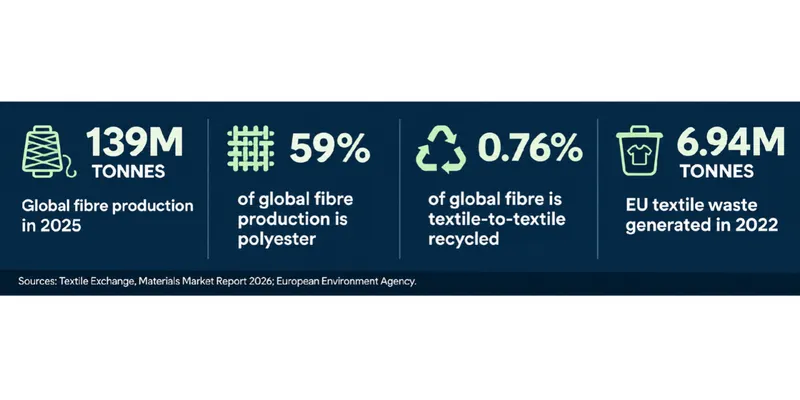
The EU generated about 6.94 million tonnes of textile waste in 2022 - 16 kg per person. The capture rate was just under 15%, meaning most household textile waste still entered mixed waste streams. A circular economy cannot work if the identity of the product disappears when it becomes waste.
TWO JEANS. SAME LOOK. DIFFERENT STORY.
Transparency matters because the environmental work done inside a supply chain is invisible at the point of sale unless information travels with the product.
WHAT TRACEABILITY CHANGES
Consider two commercially similar jeans. Both may pass quality tests and carry the same fibre composition. But one may have only a composition label; the other may carry evidence linking raw material, batches, processing, utilities, waste and product-level impact. The second product is not automatically “sustainable” because it has more data - but it is far easier to verify, improve and compare.
WHAT WE NEED TO KNOW | CONVENTIONAL JEANS | TRACEABLE JEANS |
Raw material | Composition only | Source / standard linked |
Polyester | Virgin/recycled not clear | Feedstock identified |
Processing water | Not product-linked | Measured / process-linked |
Production waste | Destination unclear | Output accounted for |
Chemicals | General compliance | Process evidence linked |
Impact claim | Marketing statement | Data + methodology |
Next life | No recovery data | Care / repair / take-back |
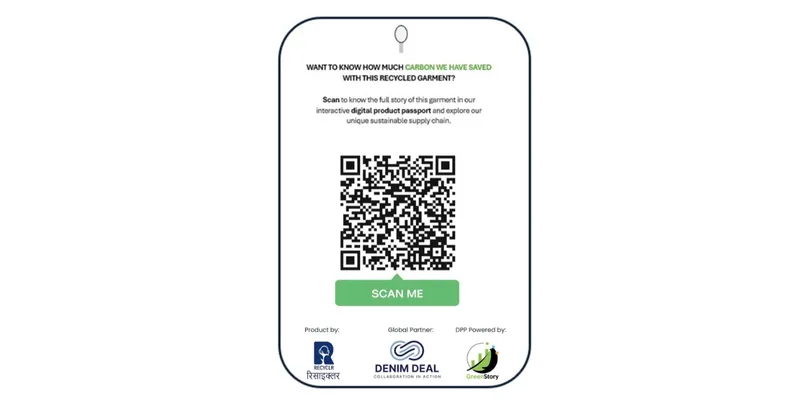
A DPP OF A DENIM PRODUCED BY AADI SUSTAINABILITY SOLUTIONS
If the market cannot distinguish the environmental investment behind one product from another, the manufacturer that invested more still gets pushed back into the same FOB negotiation.
FROM CLAIM TO EVIDENCE
A product tag or QR code is useful only when it opens a credible evidence chain: material source, recycled content, process data, LCA and traceability. The technology is the interface; the operating data is the proof.
200,000-500,000 tonnes Estimated textile microplastics entering the global marine environment each year. Synthetic textiles are estimated to account for 16-35% of microplastic releases to oceans globally. |
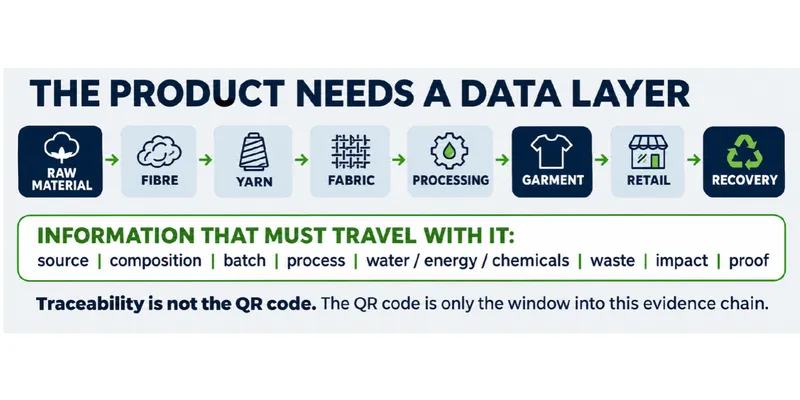
IF YOU CAN'T PROVE THE DIFFERENCE, YOU CAN'T SELL THE DIFFERENCE.
For Indian MSMEs, transparency should not become another department, another software subscription or another reporting cost. It should become a better way of running the business.
A buyer may ask for recycled-content proof, chemical compliance, water data, carbon data, social audits, traceability and, increasingly, product-level information - while still negotiating the same FOB. If every new requirement sits outside operations, the MSME sees transparency as compliance. That is understandable. The business case changes when the same data does more than one job. Material identity helps traceability, but it also improves inventory control. Batch linkage helps verify recycled content, but it also helps investigate quality variation. Water and energy data support LCA, but they also expose inefficient processes. Waste accounting strengthens a circularity claim, but it also identifies material loss. Operational data → Cost data → Impact data → Buyer evidence. One disciplined information system can support all four. WHAT OUR OWN FACTORY EXPERIENCE TAUGHT US At Aadi Sustainability Solutions, working across textile-waste recovery and garment manufacturing has made one lesson clear: physical circularity is easier than information circularity. Waste can become fibre, yarn, fabric and garment while the evidence behind it fragments at every commercial handover. Our approach has therefore been to connect zero-liquid-discharge operations, zero-solid-waste-to-landfill discipline, material traceability, manufacturing data, LCA and Digital Product Passport work. The lesson is not that every MSME needs an expensive digital platform. The lesson is that every claim must have an operating record behind it. | INDIA ALREADY HAS THE PHYSICAL CAPABILITY Collection, sorting, recycling, spinning, weaving, processing and garment manufacturing already exist at scale. Through GATS, the recurring gap we see is not absence of capability but fragmentation between those stages. THE BRAND OPPORTUNITY A traceability interface can become more than compliance. The same QR/DPP layer can support authenticity, care instructions, repair, resale, take-back and recovery - turning a disclosure tool into a post-purchase relationship channel.
|
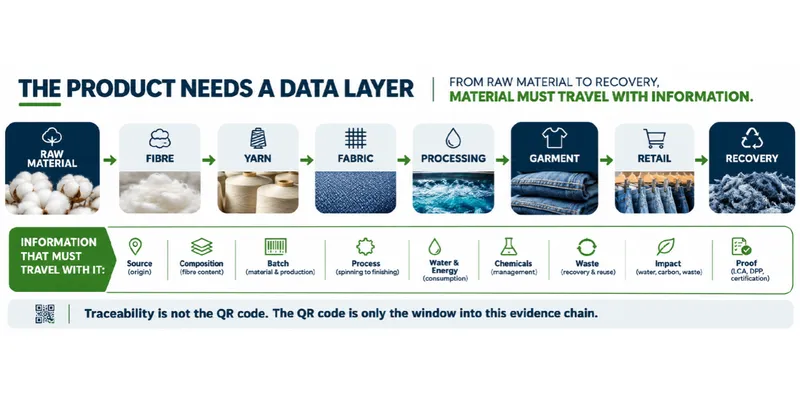
India should not remain the invisible manufacturing layer behind global sustainability claims. If we recover the material, manufacture the product, reduce the waste and create the impact, we should also own the evidence - and the commercial value attached to it.
As with air quality, awareness begins when the invisible becomes measurable. The next generation of textile businesses will not win by making more claims. They will win by making the difference visible.
WHAT GETS MEASURED CAN BE MANAGED. WHAT GETS PROVED CAN BE VALUED.
SOURCES: Textile Exchange, Materials Market Report 2026; European Environment Agency, EU textiles circularity and microplastics; European Commission, Sustainable and Circular Textiles Strategy and textile DPP timeline. ASSPL examples: company operating records.