Climate Asia Conference 2026 Emphasises Action, Skills and Resilience
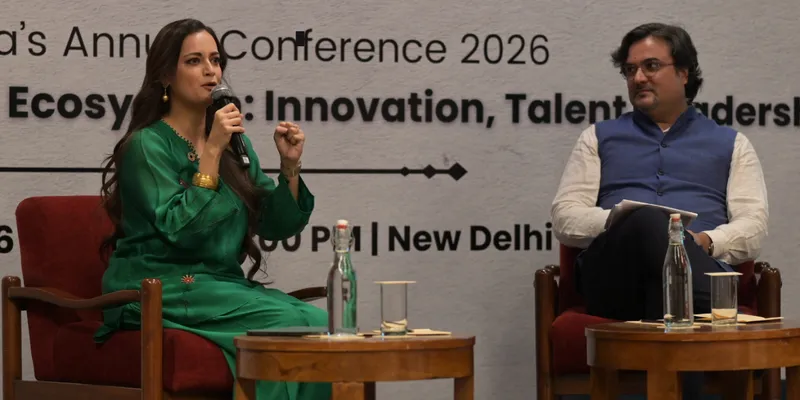
Climate Asia hosted its Annual Conference 2026 at India Habitat Centre, New Delhi, convening nearly 350 participants over two days. The event included 6 closed-door roundtables and 11 panel discussions, with close to 100 speakers, supported by 3 Anchor Partners and 15 Knowledge Partners. The conference theme, Building India’s Climate Ecosystem: Innovation, Talent, Leadership, focused on linking climate action with broader social and economic systems.
“When we talk about climate, we talk about data and degrees. But climate is really about a mother deciding whether to plant this season, a worker choosing between heat and income, a child breathing air that shouldn’t exist. Until we make that the centre of our work, we are solving the wrong problem.”
— Satyam Vyas, Climate Asia
Shrashtant Patara of Development Alternatives highlighted the importance of collaborative frameworks:
“At Development Alternatives, we have always believed in triads — people, planet and prosperity; sustainable livelihoods being at the intersection of work on job-creation, climate change and resource management. More important perhaps in terms of bringing these together in practice, is the urgent need to put together collaborative platforms that leverage the strengths of entrepreneurship, institutions and good old technology — to change systems, at scale.”
— Shrashtant Patara, Development Alternatives
The session “Building Resilient Livelihoods: Climate Vulnerabilities to Economic Security,” co-curated by Development Alternatives, addressed integrated approaches to strengthen livelihood systems. Sameer Shisodia of Rainmatter Foundation stated:
“We are not walking into a water-stressed place; we are walking into somebody’s home. Health, livelihoods, water, education, festivals—everything matters. Philanthropic and CSR capital may support the system, but the real engine is the people: their knowledge, resources, entrepreneurial energy, and the systems they shape in their communities.”
— Sameer Shisodia, Rainmatter Foundation
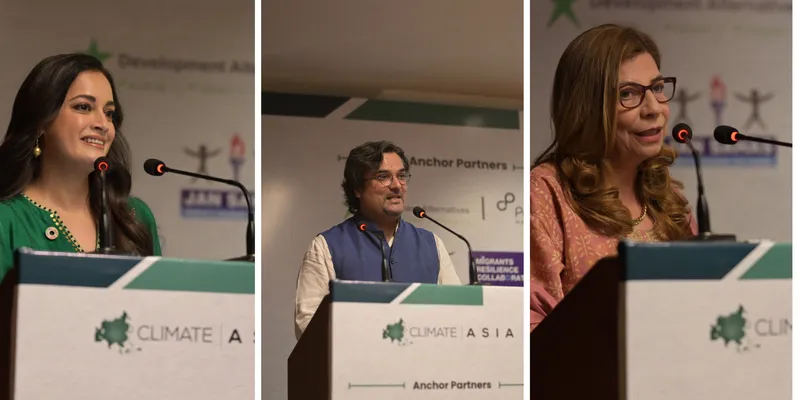
Keynote speaker Deepali Khanna of The Rockefeller Foundation discussed climate change as an economic and social issue, outlining the need for system-level alignment and scaling:
“The real question is not whether we act. It is whether we can move from urgency to execution fast enough, with faster decisions, better alignment, and a clear focus on scaling what works.”
— Deepali Khanna, The Rockefeller Foundation
Dia Mirza, Actor, UN Environment Goodwill Ambassador & United Nations Secretary-General's Advocate for Sustainable Development Goals, addressed climate impacts in relation to lived experiences and highlighted the role of storytelling and grassroots engagement:
“The earth is not speaking to us in predictions anymore. It is speaking to us now, through lived realities we can no longer ignore. The question before us is what we choose to do with what is already here.”
— Dia Mirza, Actor, UN Environment Goodwill Ambassador & United Nations Secretary-General’s Advocate for Sustainable Development Goals
A ‘Voices from the Ground’ segment included Sarika Santosh Pawar from Marwade village, Maharashtra, who described her experience with sustainable farming and clean energy:
“What started as a struggle for stability became a mission to promote sustainable farming, clean energy, and rural livelihoods. Today, my goal is bigger than myself—to empower 1,000+ women to become self-reliant and lead change in their communities.”
— Sarika Santosh Pawar, Rural Entrepreneur, Marwade Village, Mangalwedha Taluka, Maharashtra, SURE (Sakhi Unique Resource Enterprise)
The panel “Women-Led Climate Resilience: Scaling Local Solutions for Systemic Impact,” co-curated by PRADAN, examined institutional frameworks and participation. Deeksha Supyaal Bisht of the Ministry of Rural Development stated:
“Last year, 58% of workers under MGNREGA were women, reflecting the scale of participation. Research has shown how India’s rural employment guarantee programme has been instrumental in ensuring paid employment for women and bolstered their empowerment. The architecture exists and is being strengthened under VB-G RAM G, but communities and organisations must come forward to enhance the engagement of women and ensure their active participation in building Viksit Gram Panchayats.”
— Deeksha Supyaal Bisht, Rural Employment, Ministry of Rural Development
The session on “Leveraging Parametric Insurance to Strengthen Resilience of Informal Workers Against Climate Risks,” co-curated by Migrants Resilience Collaborative, an initiative of Jan Sahas, discussed financial tools for addressing climate risks among informal workers.
The panel “India’s Multi-Energy Future: From Fragmentation to Scale,” co-curated by Green Fuel Energy Solutions Pvt. Ltd., focused on energy systems and policy coordination. Speakers noted:
“Energy security is increasingly inseparable from climate policy. This directly relates with creating resilient systems for a sustainable reliable long-term energy supply. Stronger state-level implementation, and just transition built on skills, jobs, and social resilience will be at the heart of it.”
— Dr Divya Sharma, Climate Group
“Any large-scale project requires community concern and approval. That should not be seen as a disadvantage, but as an opportunity where the village becomes the unit of planning and proposal. We need to go back to the villages and scale it out through village packages and local solutions developed from the ground up.”
— Dr Albert Chiang, Meghalaya Basin Development Authority (MBDA) & Meghalaya Climate Change Centre, Government of Meghalaya
“India’s energy transition is no longer about choosing pathways—it is about governance and delivery. As cooling demand rises and climate costs grow, the real opportunity lies in energy-efficient buildings, integrated transport and land use planning, and stronger state-led implementation.”
— Madhav Pai, WRI India
The concluding session, “What Scale Misses: Climate Solutions from the First Mile to the System,” examined challenges in scaling local solutions. Sonya Fernandes of Ashraya Hastha Trust stated:
“Community consultations are essential, which require funders to engage with communities to understand their aspirations and needs. Sometimes a farm pond may serve small and marginal farmers well compared to recharging groundwater, which might seem sustainable, but do our programme models have the agility to respond? That is where the soul of a programme comes in.”
— Sonya Fernandes, Ashraya Hastha Trust
Across both days, discussions highlighted the need for coordination across systems, institutions and communities to address climate-related challenges.