CLC INDUSTRIES

- INTRODUCTION
- Introduction of the company
CLC Industries Limited is a Delhi based Company. It makes synthetic and cotton threads for fabric. The company historically operated multiple spinning units across India and expanded internationally, though it has faced severe operational headwinds in recent years, leading to the Corporate Insolvency Resolution Process (CIRP).
- Industry Overview
- About 2.3% of India’s economy comes from textiles, making it the biggest job provider next to farming.
- In recent months, cotton prices jumped close to 40%, yet buyers such as China haven’t increased orders, hitting small spinning units hard. CLC works in this part of production, where profits depend heavily on the gap between what they pay for raw material and what they earn selling yarn.
- Big companies with multiple operations can absorb shocks better; standalone spinners face consequences for every shift
- Purpose of the Analysis
- This report takes a look at how CLC Industries is doing financially, while also checking whether its assets hold solid value. It evaluates patterns in performance, trying to inspect how things have moved over time.
2. COMPANY OVERVIEW
- Background and History
Incorporated in 1991, the company grew rapidly through aggressive acquisitions, including the purchase of Indo Rama Synthetics' spinning division and units in the Czech Republic and Uzbekistan. This global expansion strategy, while ambitious, led to a heavy debt burden that eventually became unsustainable during the global textile downturn.
- Business Model
CLC operates on a B2B manufacturing model, converting raw cotton and man-made fibres into high-quality combed and carded yarns. Their revenue was traditionally export-heavy, supplying garment manufacturers in Europe and Southeast Asia.
- Key Products / Services
The key products offered by the company are as follows-
- Cotton Yarn: Combed and carded varieties for weaving and knitting.
- Polyester-Cotton Blends: Specialised yarns for durable apparel.
- Industrial Yarns: High-tenacity yarns used in technical textiles.
- Market Position
- Once dominant, CLC - operating then as Spentex - ranked among India's biggest spinning firms based on spindle count. Yet today, when measured against top performers, it holds far less influence.
- Now seen as a struggling company with deep roots, its strength abroad has faded due to limited funds for daily operations. Shutdowns across facilities have further weakened its standing over time.
3.PROMOTER /FOUNDER INFORMATION
Name of Promoter | Designation | Professional Background | Strategic Role |
|---|---|---|---|
Mr. Ajay Kumar Choudhary | Chairman & Managing Director | Extensive experience in the textile trade and industrial management. | Architect of the company’s domestic expansion and initial acquisition strategy. |
Mr. Kapil Choudhary | Executive Director | Background in business administration and export marketing. | Focused on international market penetration and global client relations. |
4. FINANCIAL STATEMENT ANALYSIS
- Income Statement Analysis
Particulars | FY 2025 | FY 2024 | FY 2023 |
|---|---|---|---|
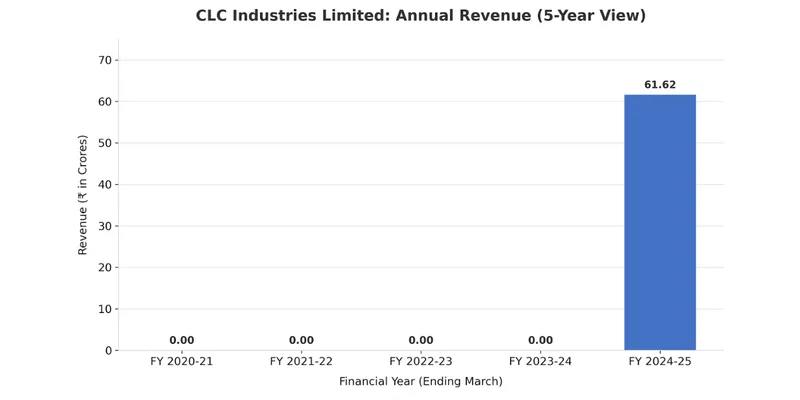
Total Revenue | 61.62 | 0.00 | 0.00 |
Total Expenditure | 111.25 | 27.34 | 1.95 |
Operating Profit/Loss | (49.63) | (27.34) | (1.95) |
Other Income | 6.95 | 0.34 | 0.45 |
Net Profit / (Loss) | (46.25) | (34.28) | (10.94) |
Key Observations of the Income Statement:
- Revenue Rise: A sudden climb to 61.62 crore rupees by 2025 hints at brief activity – it could be because of the short-term deals or contract tasks. Although, the spike didn’t last. Numbers plunged soon after. In December 2025, income had fallen down to about 31 crores.
- Operating Inefficiency: The company spent nearly Rs. 2 for every Rs. 1 earned, leading to a massive operating loss of Rs. 49.63 Cr.
- Deepening Deficit: Despite the revenue, the net loss widened by 35% YoY, showing that the "restart" actually accelerated cash burn rather than fixing the bottom line.
- Revenue Chart
- Balance Sheet Analysis:
Component | FY 2025 | FY 2024 |
|---|---|---|
Total Assets | 103.02 | 95.75 |
Total Debt | 54.61 | 34.93 |
Current Liabilities | 50.55 | 4.56 |
Total Equity (Net Worth) | 10.01 | 56.24 |
Interpretation:
- Equity Erosion: Net worth plummeted from Rs. 56 Cr to Rs. 10 Cr in a single year, a nearly 82% decline, as losses ate into the capital base.
- Debt Surge: Total debt rose by nearly 56% during FY 2025, likely due to fresh borrowings or interest capitalisation during the restart attempt.
- Asset Quality: While total assets appear higher, a significant portion is tied up in "Receivables" (Rs. 20.92 Cr) and "Inventory" (Rs. 20.77 Cr), which may be difficult to liquidate given the CIRP status.
- Cash Flow Statement Analysis (Rs. In crore)
Particulars | FY 2025 |
|---|---|
Net Cash from Operating Activities | (0.36) |
Net Cash from Investing Activities | 1.26 |
Net Cash from Financing Activities | (1.26) |
Interpretation:
- Negative Operations: The core business is still failing to generate cash, with an outflow of Rs. 36 lakhs despite the reported revenue.
- Zero Growth Capex: Investing activity shows a small inflow, likely from the sale of scrap or minor investments to fund daily administrative expenses of the insolvency process.
- Key Financial Ratios
Ratio Category | Ratio | Value | Interpretation |
|---|---|---|---|
Profitability | Net Profit Margin | (75.06%) | Losing 75 paise for every rupee of sales. |
Liquidity | Current Ratio | 1.09 | Barely covers short-term debt; heavily reliant on inventory value. |
Leverage | Debt-to-Equity | 5.45 | Debt is more than 5x the remaining equity. |
Efficiency | Inventory Turnover | 2.97x | Stock is moving very slowly through the system. |
- Year-on-Year Comparison (3 years)
Financial Metric | FY2023 | FY2024 | FY2025 | Year-on-Year Analysis (FY24 vs FY25) |
|---|---|---|---|---|
Revenue from Operations | 0.00 | 0.00 | 61.62 | Full Turnaround: Business activities resumed after a multi-year hiatus under new ownership. |
Operating Profit (EBITDA) | (1.92) | (19.44) | (39.45) | Negative Scale: Operating losses doubled as the company incurred high costs to restart plants and logistics. |
Net Profit (PAT) | (10.94) | (34.28) | (46.25) | Ongoing Stress: Higher losses driven by restructuring costs and initial working capital inefficiencies. |
Earnings Per Share (EPS) | (1.21) | (32.97) | (44.49) | Drastic Drop: Reflects the combined impact of higher losses and a much smaller post-restructuring share base. |
Total Assets | 203.05 | 95.74 | 103.03 | Asset Consolidation: Assets grew slightly as manufacturing restarted, despite previous massive write-downs. |
Total Equity | (548.29) | 56.23 | 10.00 | Clean Slate: Equity became positive in FY24 due to debt-to-equity conversion but eroded in FY25 due to losses. |
Debt-to-Equity Ratio | N/A | 0.62 | 1.35 | Borrowing: Debt levels are rising again to fund the revival of operations. |
- Strengths
The only strength is the physical land and plant assets, which may have "scrap" or "redevelopment" value for a potential resolution applicant.
- Weaknesses
Complete lack of working capital, broken supply chains, and loss of skilled labor during the prolonged insolvency period.
- Risk Factors
The primary risk is the total liquidation of the company if a viable buyer is not found. Legal risks associated with the massive defaults to banks are also paramount.
- Future Outlook
The company's future depends entirely on the NCLT (National Company Law Tribunal) outcome. There is no independent path to recovery without a total change in ownership and a massive capital infusion.
6. CONCLUSION
Final Evaluation of Financial Health
The 2025 data confirms that CLC Industries is in a terminal stage of financial distress. The brief attempt to scale revenue in 2025 resulted in even deeper losses and a massive erosion of shareholder equity.
Investment / Performance Perspective
The suggestion would be to avoid investing in this Company. The company’s stock has recently seen "speculative spikes" (reaching 52-week highs in early 2026), but this is disconnected from the fundamentals. With a Net Worth crashing toward zero and ongoing Committee of Creditors (CoC) meetings, the most likely outcome is a heavy haircut for creditors and total equity cancellation for shareholders.
Data Sources
https://www.screener.in/company/CLCIND/