Circ Partners with Xinxiang Bailu to Expand Recycled Fiber Production
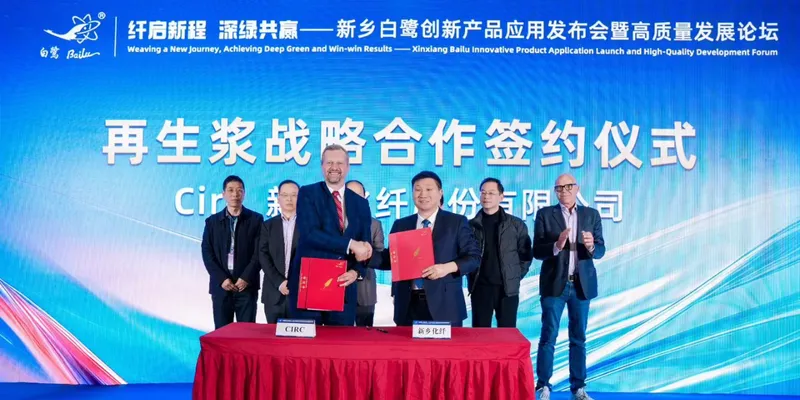
Circ announced a partnership agreement with Xinxiang Bailu Chemical Fiber Co., Ltd. to expand access to recycled textile fibers. The collaboration will support the production of recycled-content viscose filament using Circ pulp and strengthen manufacturing links within the textile supply chain.
Circ, a company focused on textile-to-textile recycling, has entered into a partnership with Xinxiang Bailu Chemical Fiber Co., Ltd., a Canopy Dark Green Shirt producer and manufacturer of viscose filament. Announced in Danville, Virginia on March 12, 2026, the agreement expands Circ’s operations in China and supports the development of recycled fiber production within the textile sector.

Under the partnership, Xinxiang Bailu Chemical Fiber Co., Ltd. will act as a commercial partner in China and manufacture viscose filament containing recycled content derived from Circ pulp. The recycled fibers will be supplied to mills and fashion brands.
Xinxiang Bailu Investment Group was founded in 1960, and its main subsidiary, Xinxiang Chemical Fiber Co., Ltd., was listed on the Shenzhen Stock Exchange on October 21, 1999. The company produces more than ten product categories, including viscose filament and spandex. It is identified as a major participant in the global man-made cellulosic fiber market and operates the world’s largest viscose filament production capacity.
“This agreement marks an important step in deepening Circ’s presence in Asia and expanding the global network of manufacturing partners who share our vision for circularity,” said Peter Majeranowski, CEO of Circ. “By anchoring our technology within the world's leading fiber manufacturers, we’re accelerating the shift toward a truly circular textile economy and building the infrastructure required to scale it worldwide.”

Chairman Shao Changjin of Bailu Group added, “Xinxiang Chemical Fiber and Circ join hands in innovation to provide leading solutions for the recycling of textile waste, and jointly promote the green, low-carbon, circular, and sustainable development of the textile and apparel industry. “
The companies stated that validating Circ’s pulp for viscose filament production supports the development of a closed-loop recycling model in China, the world’s largest textile manufacturing hub. The partnership also aims to expand the availability of recycled fiber alternatives for brands seeking materials aligned with climate and circularity goals.
