Cil Nova Petrochemicals Ltd
1. Introduction
Company Overview
CIL Nova Petrochemicals Limited has changed its name to True Green Bio Energy , effective in December 2024, to reflect its shift towards renewable energy and biofuels . Out of India comes CIL Nova Petrochemicals Ltd., making polyester alongside petrochemical derivatives since 2007. Based in Ahmedabad, Gujarat, it finds its space within synthetic textile raw materials. Though new on the timeline, its footprint grows quietly across the sector. Operations center firmly on chemical-based fabric foundations, not drifting far from core work.
Industry Overview
Fuel-based materials take up most of its work, tied tightly to fabric production. Yet it’s the chemical side that drives output, feeding into threads and fibers through steady industrial loops.
Polyester Segment – Making Polyester Staple Fibre, a material found in clothes, fabrics, yet common in household items too. While often seen in apparel, it shows up across bedding and upholstery just the same.
Out of oil comes fabric basics - cracked molecules become threads through chemical tweaks. A refinery's leftover gases twist into fibers fit for weaving. These lab-made strands start life as soupy byproducts, then harden into spinnable resins. From pipeline to loom, gaseous scraps transform under heat and pressure. Molecules reshaped in reactors wind up as everyday cloth ingredients.
Fierce competition defines this sector, while swings in crude oil costs often shape its direction. Demand shifts play a big role, tied closely to how the world uses textiles. What happens globally tends to ripple through production patterns here.
Purpose of the Analysis
What matters most? Getting how the company makes money, what its numbers show, where it might go next.
2. Company Overview
Background and History
CIL Nova Petrochemicals Ltd. began under the Chiripal Group's vision. Driven by a need to move deeper into polyester production, it helped tighten the group’s hold across more parts of fabric making.
Business Model
The company earns revenue primarily from:
Fibres made from polyester are produced here. Their distribution follows once production ends. Selling happens alongside manufacturing activities. Production lines run while orders come through. The material moves out after quality checks finish
Supplying raw materials to textile manufacturers
Key Products and Services
- Polyester Staple Fibre (PSF)
- Synthetic textile raw materials
Market Position
Nowhere near the top, the business still manages to stay visible across India. Facing rivals both close to home and far overseas, it keeps moving without claiming control of the space.
3. Promoter or Founder Overview
Name of Promoters or Founders

- Mr Ved Prakash Chiripal (Chairman and Managing Director)

- Pradip Khandelwal(CEO)
Professional Background
Folks behind the project know their way around fabric production, chemicals processing, plus steering companies. They’ve spent years working where threads meet refineries, also handling how firms run day to day.
Role in company’s growth and strategic decisions
- Established manufacturing capabilities in polyester fibre
- Integrated operations within the textile value chain
- Expanded production capacity over time
4. Financial Statement Analysis
Income Statement Analysis
Particulars | FY2023 | FY2024 | FY2025 |
Revenue | ₹0 Cr | ₹0 Cr | ₹23.29 Cr |
Net Profit | ₹ -5.93 Cr | ₹ 0.81 Cr | ₹ -2.19 Cr |
Revenue Growth (YoY) | No growth | No growth | Strong increase (revival) |
Net Profit Growth (YoY) | Decline (higher loss) | Strong improvement (loss → profit) | Decline (profit → loss) |
Overall Trend | Continued losses | Temporary recovery | Revenue restart but loss continues |
Summary Insights
Aspect | Observation |
Revenue Trend | No operations for 3 years; revival seen only in FY2025 |
Profitability Trend | Continuous losses except FY2024 (one-time recovery) |
Growth Pattern | Highly inconsistent and volatile |
Business Status | Company appears to be in restructuring/turnaround phase |
Key Takeaways
- FY2022–FY2023: Completely inactive operations with continuous losses
- FY2024: Short-term profit likely due to non-core income
- FY2025: Business operations resumed, but profitability still negative
Revenue Trend Table
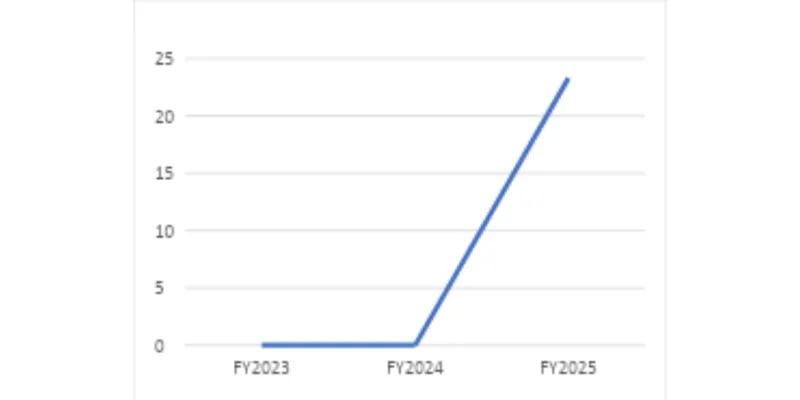
Year | Revenue (₹ Cr) | Growth Trend |
FY2023 | 0 | No operations |
FY2024 | 0 | No change |
FY2025 | 23.29 | Strong recovery |
Revenue Trend Chart
Balance Sheet Analysis
Moderate asset base with investment in manufacturing plants
Heavy borrowing happens because big spending on equipment is needed
A solid foundation exists, yet strength lags behind bigger rivals. Stability holds up, though power isn’t quite on par. While it stands firm, muscle remains modest next to major names. Resilience shows through, just without the heavy weight of top players. It doesn’t waver much, still lacks the punch seen elsewhere
Cash Flow Statement Analysis
- Operating cash flows can be inconsistent
- High capital expenditure affects investing cash flow
- Financing cash flows depend on debt restructuring
Key Financial Ratios
Ratio Type | Observation |
Profitability | Low margins |
Liquidity | Moderate |
Leverage | Relatively high debt |
Efficiency | Average |
Year-on-Year Comparison (3 years)
- Performance fluctuates with industry cycles
- No consistent long-term growth trend observed
5. Key Insights & Interpretation
Strengths
- Integrated position in textile value chain
- Growing demand for polyester products
- Backing of an established group
Weaknesses
- High dependence on petrochemical prices
- Low profit margins
- Limited brand recognition when measured against major competitors
Risk Factors
- Crude oil price volatility
- Cyclical textile demand
- High competition
Future Outlook
Success rides on rising polyester needs along with how well expenses are handled. Should fabric orders grow while raw material prices settle, results could get better. Growth ties closely to market appetite plus smart spending choices. When industry interest climbs and production costs level off, outcomes might strengthen. Progress links directly to wider usage of synthetic fibers together with tighter budget control. A boost in clothing materials demand combined with steady supply pricing may lift overall standing.
6. Conclusion
Final evaluation of financial health
CIL Nova Petrochemicals Ltd. runs steady, yet struggles as market swings hit profits hard. Its finances hold up fairly well though debt levels raise eyebrows now and then.
Investment or performance perspective
A rise in fabric demand might bring chances for the firm, yet shaky profits make it a less stable choice. Since swings in fashion spending can hit hard, watching market shifts matters more than chasing quick gains.
Data Sources: -
https://www.screener.in/company/533407/