China’s GDP Slows to 4.8% as Property Slump Deepens
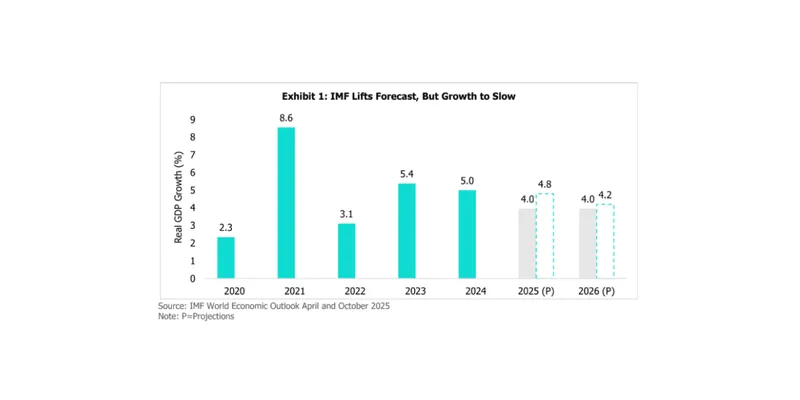
China’s Economic Growth Moderates Amid Property Woes, Weak Demand
China’s economy slowed to 4.8% in Q3 2025, marking its weakest growth in a year as property sector distress, soft consumer spending, and deflationary pressures weighed on recovery.
China’s GDP growth decelerated to 4.8% year-on-year in Q3 2025, the weakest pace in a year, as the country continued to grapple with a prolonged property downturn and fragile domestic demand. The slowdown followed stronger first-half growth — 5.4% in Q1 and 5.2% in Q2 — buoyed by early export gains and fiscal support measures like consumption subsidies.
The IMF raised its 2025 growth forecast for China to 4.8%, up 0.8 percentage points from its April projection, citing better-than-expected H1 performance. However, it expects growth to ease to 4.2% in 2026, with structural headwinds including weak household spending, high debt, and property sector stress. The upcoming Five-Year Plan (2026–2030) is expected to prioritize AI integration, high-end manufacturing, service sector growth, and demographic challenges.
Domestic Challenges: Property Weakness and Consumer Strain
China’s housing prices have been declining for over three years following restrictions on developer leverage. Although the pace of decline has stabilized, real estate investment fell 0.5% year-on-year during January–September 2025, dragging total fixed asset investment lower.
The labour market remains under strain — overall unemployment reached 5.2% in September, while urban youth unemployment hovered at 18.9%. Consumer sentiment has stayed subdued, and the effect of retail stimulus programs has waned. Retail sales growth slowed to 3% in September, its fourth consecutive monthly decline, while previously strong categories such as appliances and furniture saw sharp slowdowns.
Inflationary pressures remain muted. The Consumer Price Index (CPI) recorded –0.3% in September, while Producer Prices fell 2.3%, reflecting ongoing deflationary pressures. The government’s anti-involution campaign aims to curb price wars and overcapacity, though weak demand continues to limit price recovery.
Trade Resilience and Export Growth
Despite challenges, exports rose 6.1% year-on-year in the first nine months of 2025, bolstered by shipments to non-US markets and stronger performance in high-tech and mechanical goods. Exports to Africa (27.9%), Asia (10.9%), and Europe (5.7%) surged, while shipments to North America fell 15% due to trade tensions.
Labour-intensive exports, such as garments and toys, continued to contract, while high-value products saw significant growth, reinforcing China’s shift up the value chain.
Equities, Currency, and Policy Outlook
China’s CSI300 Index gained about 15% year-to-date, driven by optimism surrounding AI development and the “AI Plus” initiative, which outlines integration across key sectors through 2035.
The yuan appreciated 2.4% against the US dollar, supported by resilient equities and a weaker greenback. However, risks remain from renewed US-China trade tensions and potential tariffs. The People’s Bank of China is expected to maintain an accommodative stance, with gradual rate cuts aimed at balancing growth support with banking sector stability.
Looking Ahead: Policy and Geopolitics
China’s 15th Five-Year Plan, set for release in March 2026, will emphasize manufacturing innovation, AI integration, service sector expansion, and social safety reform to boost consumption.
Meanwhile, escalating US-China trade friction—including new US tech restrictions and China’s expanded rare earth export controls—could further test bilateral relations. President Trump’s proposed 100% tariff on Chinese goods and potential new restrictions threaten to intensify disinflationary pressures.
China, leveraging its dominance in rare earth exports and as a major soybean buyer, may use these as negotiation levers ahead of a possible Trump-Xi meeting at the APEC Summit.