Chhattisgarh Targets High-Value Manufacturing with Investment Proposals Near ₹8 Lakh Crore
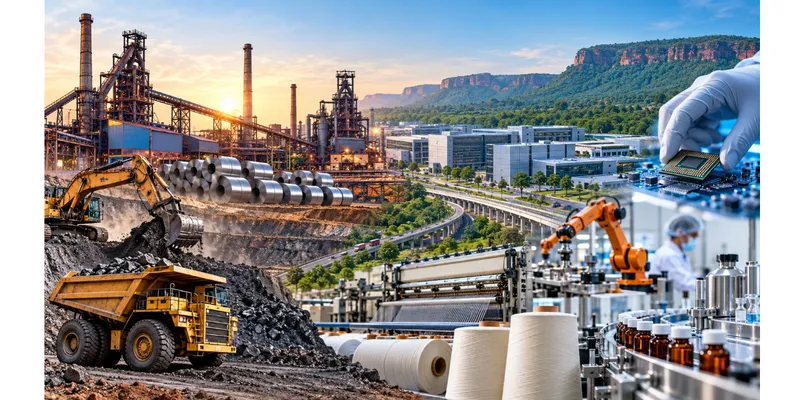
The state aims to move beyond primary production towards advanced manufacturing, with execution, employment generation and wider regional development emerging as key measures of success.
Chhattisgarh is seeking to transform its resource-driven economy into a diversified manufacturing hub, with investment proposals approaching ₹8 lakh crore over the past 18 months. The proposed investments span technology, pharmaceuticals, textiles, agro-processing and conventional industries, with the potential to generate more than 1.5 lakh jobs.
Industrial Policy 2024–30 Sets a New Direction
For decades, Chhattisgarh's economy has been shaped by its mineral wealth, energy resources and industrial base. Formerly known as the “Dhan Ka Katora” of undivided Madhya Pradesh, the state entered a new phase when it was formed in November 2000.
Successive state governments have sought to diversify the economy by moving beyond primary production and processing towards higher-value manufacturing.
The Industrial Development Policy 2024–30 focuses on finished products, advanced manufacturing and technology-led sectors. These include electronics, semiconductors, pharmaceuticals, engineering, robotics, artificial intelligence and green steel.
The strategy aims to encourage the production of specialised components, machinery and finished goods, potentially creating higher incomes, skilled employment, technological capabilities and opportunities for domestic enterprises.
Investment Proposals Need to Translate into Production
State Government figures indicate that investment proposals worth nearly ₹8 lakh crore have been received over the past 18 months, with the potential to generate more than 1.5 lakh jobs.
However, the conversion of proposals into operational projects remains a key challenge. Investment realisation will depend on access to finance, approvals, project execution and the creation of quality jobs. Greater participation by local businesses in industrial supply chains will also be important.
Naya Raipur is attracting interest in data centres and semiconductor manufacturing, with semiconductor proposals reportedly exceeding ₹18,000 crore.
An Electronics Manufacturing Cluster approved under the Centre's Electronics Manufacturing Cluster 2.0 programme in Rajnandgaon could further strengthen the state's manufacturing prospects.
For these investments to deliver lasting benefits, the state will need reliable power and water supplies, skilled workers, efficient logistics, technology partners and networks of suppliers and service enterprises.
Steel Sector Looks Towards Higher-Value Products
Steel is among the sectors where Chhattisgarh has an established industrial foundation, supported by mining, power generation and steel production.
The Bhilai Steel Plant, a major public-sector institution, has long been an important part of India's industrial landscape. The next stage of development involves moving beyond bulk steel production towards specialised products, advanced alloys and higher-value manufacturing.
The transition to greener steel is also becoming increasingly important, as lower-carbon production could influence competitiveness, investment decisions and market access.
According to reported state figures, the Chhattisgarh Green Steel Dialogue has secured investment commitments worth ₹13,840 crore. The actual impact will depend on project execution and the adoption of commercially viable, lower-emission technologies.
Pharmaceuticals and Technology Offer Diversification Opportunities
Pharmaceuticals represent another area of potential growth. Chhattisgarh has received investment proposals worth ₹992.53 crore in the sector over the past 18 months. Four projects valued at ₹216 crore are currently at different stages of implementation.
Although these figures are smaller than the state's overall investment pipeline, the projects could support skilled employment and create demand for quality-control laboratories, packaging, logistics and ancillary services.
Electronics, engineering and other technology-intensive industries will also require more than financial incentives. Investors need predictable regulations, dependable utilities, efficient transport infrastructure, skilled labour and consistent administration.
Regional Development and MSME Participation
Industrial growth will need to extend beyond established industrial corridors to create wider economic opportunities.
Regions such as Bastar and Sarguja have potential in forest produce, medicinal plants, food processing and small enterprises. These activities could support local value addition, improve producer returns and create non-farm employment.
Developing roads, storage facilities, processing infrastructure, digital connectivity and access to finance will be essential to support these activities.
Micro, small and medium enterprises (MSMEs) can play an important role by supplying larger manufacturers and generating employment. Their growth will depend on access to credit, technology, quality certification, markets and skilled workers.
Industry-linked training, apprenticeships and partnerships with educational institutions could help prepare local youth, including women, for emerging employment opportunities.
Execution and Sustainable Growth Will Determine Outcomes
Chhattisgarh's mineral resources, energy capacity, steel and power ecosystem, and central location provide a foundation for industrial expansion. However, development will also require careful infrastructure planning, environmental safeguards and responsible management of water and energy resources.
The success of the state's industrial strategy will need to be measured beyond announced investment figures. Key indicators include realised investments, commissioned factories, jobs created, local suppliers developed, export growth and improvements in incomes across regions.
The objective is not to move away from the minerals that have shaped Chhattisgarh's industrial identity, but to capture greater value from existing resources while developing new growth sectors.
The transition from a mineral-producing state to a manufacturing hub will ultimately depend on converting investment proposals into productive capacity, skilled employment, stronger enterprises and broader regional prosperity.