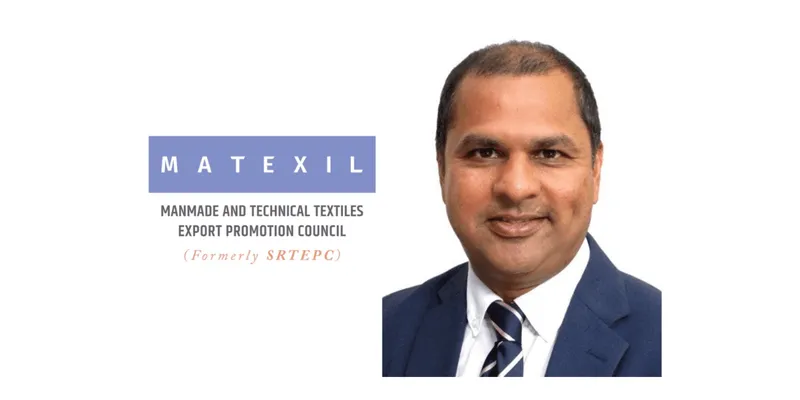
Chairman, Shri Shaleen Toshniwal’s Address Export Award Function – Technical Textiles (MATEXIL)
Shri Pabitra Margheritaji, Hon’ble Minister of State for Textiles & External Affairs,
Shri Anil Rajvanshi, Vice Chairman, MATEXIL Shri Bhadresh Dodhia, Immediate Past Chairman, MATEXIL, Shri Pramod Khosla, Convenor, Sub-Committee of Technical Textiles, MATEXIL
Distinguished Guests, Award Winners, Industry Leaders, Colleagues, Ladies and Gentlemen,
Good Evening.
It is my great pleasure to welcome you all to the Export Award Function for Technical Textiles.
This year, we celebrate the outstanding export performance for two consecutive years – 2023–24 and 2024–25.
I am truly grateful to Hon’ble Union Minister of State for Textiles, Shri Pabitra Margherita, for taking time out of his very busy schedule to join us this evening to present the awards and encourage the industry.
Sir, your leadership and guidance continue to inspire the transformation of India’s textile and apparel ecosystem. We are also deeply aware of all the arrangements you have made to be here today.
Thank you, Sir.
Celebrating Excellence
Today, we recognise and honour exporters who have excelled in the field of Technical Textiles.
I extend my heartfelt congratulations to all award winners and wish you continued success in the years ahead.
Your achievements inspire the entire industry. You are not merely exporting products — you are exporting Indian capability, reliability, innovation and trust.
Technical Textile Industry
Technical textiles do not walk the fashion ramp — yet, powered by research and technology, they are the superheroes of the textile world.
They strengthen infrastructure, save lives through medical products, improve mobility, support space missions, enhance sports performance, make vehicles lighter, and ensure cleaner air through filtration.
Technical textiles quietly support almost every aspect of modern life.
From life saving applications in medicine, to building roads and bridges, to building space crafts that reach the farthest reaches of space exploration. From making cars lighter and enhancing their functionalities, to improving the performance of athletes, and providing solutions for filtration for both air and dust. Technical Textiles help improve every facet of our everyday lives even without us realising it.
I would like to acknowledge the importance of technical textiles for our country. This industry has been growing at an encouraging double digit growth rate. I am pleased to share that in spite the global headwinds that we have now become so accustmed to. Technical textiles stands out like a bright light and grew its export’s by 12 percent last year and crossed 3 billion dollars.
Global Scenario
The global technical textiles market is undergoing major transformation. Demand is rising due to:
- Shifts in global supply chains
- A growing focus on sustainability and circularity
- Increased need for high-performance materials
- Segments such as medical textiles, geotextiles, filtration, protective wear, automotive textiles, agro-textiles, and composites are expanding rapidly.
Despite geopolitical uncertainties, regulatory shifts, and slow economic recovery, technical textiles continue to outperform traditional textile categories worldwide.
Global growth is being driven by:
- Infrastructure development
- Healthcare expansion
- Mobility transition
- Defence modernisation
- Environmental engineering
India is well-positioned to seize these opportunities — provided we continue to scale capacities, strengthen quality, enhance compliance, and build global competitiveness.
Export Performance – Technical Textiles
Despite global headwinds, India’s technical textiles sector continues to shine.
Glad to share with you some export data:
- Exports of Technical Textiles from India stood at US$ 1,431.2 Mn. during Apr – Aug 2025 as against exports of US$ 1,379.6 Mn. during Apr - Aug 2024, registering a growth of 3.7%.
- Technical Textiles Made-up articles such as FIBC bags, sling, ropes, gauze, wipes, etc. were the largest exported commodities from India during Apr - Aug 2025, representing 59.2% of the exports share, followed by Technical Fabrics (28.7%).
- FIBC bags were the largest exported products from India, representing 31% exports share in Apr - Aug 2025, followed by Coated & Laminated Fabrics (9%), Ropes & Cordages (5%) and Nonwovens (4%).
- USA was the largest market of Technical Textiles representing 27.9% share of the India’s exports, followed by Germany (6.1%) and UK (4.9%) during Apr – Aug 2025.
- Apart from top 10 markets, Canada, Saudi Arabia, Israel, Oman, Japan, Russia, Morocco, Tanzania, Peru, Switzerland, Argentina, Senegal, Togo and Afghanistan were emerging export destinations for Indian Technical Textiles during Apr - Aug 2025 as compared to Apr - Aug 2024.
Acknowledgements
The progress we are witnessing has been possible due to the strong support from the Ministry of Textiles.
We express our sincere gratitude to the Ministry for its consistent policy interventions and focus on industry growth. Some of the announcements made recently are really appropriate and the need of the hour:
- GST 2.0
GST 2.0 has brought long-awaited clarity and efficiency to the indirect tax structure.
The reduction of GST on MMF fibre (18% to 5%) and MMF yarn (12% to 5%) has finally resolved the long-standing issue of inverted duty structure.
- Amendments to the PLI Scheme
The recent amendments to the PLI Scheme for Textiles & Clothing have made it significantly more inclusive:
- More realistic investment & turnover criteria
- Inclusion of 8 new HSN codes for MMF Apparel and 9 new HSN codes for MMF Fabrics
- Reduced minimum investment:
₹150 crore for Part-1
₹50 crore for Part-2
- Relaxation from setting up new companies
These changes have generated strong interest among our members. We will shortly share further suggestions on additional HSN codes to the Government that merit inclusion.
- Export Promotion Mission
The new Export Promotion Mission (EPM) is a visionary initiative aimed at positioning India as a global textile export powerhouse.
Schemes under the Mission — Niryat Protsahan and Niryat Disha — provide:
- Interest Equalisation
- Market Access support
- Export factoring
- Collateral guarantees
- Collateral-free working capital
This will enhance competitiveness, diversify markets, and strengthen MSMEs and first-time exporters.
- Quality Control Orders (QCOs)
We thank the Ministry for the timely removal of QCOs on key raw materials like polyester and other fibres.
QCOs are essential for consumer-facing finished goods, but were a major challenge when applied to industrial inputs.
The removal of the QCO’s on polyester fibre and yarns, Viscose Staple Fiber has come as a big relief for the down stream industry particularly in the case of technical textiles. This will open up free access to key raw materials for both development and bulk production of various types of technical textiles.
This decision improves cost competitiveness and ensures smoother raw material access, especially for technical textiles.
Challenges Ahead
While progress is promising, challenges remain:
- Technical textiles require upgraded R&D, testing, and certification.
- Global norms on sustainability, carbon footprint, and traceability are becoming stricter.
- Several segments need expanded capacities and quality improvements.
- MSMEs must be better integrated into global value chains.
- Market diversification is essential — especially towards Latin America, Africa, Central Asia, Middle East, and the CIS region.
- Building specialised skilled manpower remains critical.
Addressing these challenges will enable India to capture a significantly larger share of global demand.
Opportunities
- India is at the cusp of a major growth phase in technical textiles.
- FTAs with UAE, Australia and EFTA will open significant opportunities.
- Russia is actively seeking reliable partners for technical textile solutions, Trade and Investments.
- New markets with potential like— Africa, Latin America, CIS, and the Gulf — require strategic focus.
- Infrastructure expansion is driving demand for geotextiles.
- Healthcare and hygiene needs are boosting medical textiles and nonwovens.
- Mobility transition is increasing demand for airbags, seatbelt webbings, composites, and filtration materials.
- Defence modernisation is creating new avenues for high-performance fibres and protective textiles.
- Sustainability and circularity are emerging as major export drivers.
- The growing MMF base strengthens our foundation for multiple technical textile applications.
- With the right policy support and strong industry–research collaboration, India can become a global centre for next-generation materials, solutions, and innovations.
Patna Event
We had a great collaboration between the research institutes and industry in Patna. This was in the presence of both union minister and state minister of textiles. I fondly recall the evening spent with Pabitraji where we had an enlightening discussion with all the participants in Patna. I urge the industry to take advantage of the various TRA’s and work on creating innovative solutions to the various problem statements that exist today.
RoDTEP Rates
Likewise we need proper look into the current RoDTEP rates that are currently being given to technical textiles. It is quite complex to classify all products here because of the sheer diversity of products. However based on fibre inputs at the very. least technical textiles needs to have rates that are at least equal to conventional textiles.
I believe that a look into this current anomaly and fixing the same will give the industry another shot in the arm to increase their competitiveness in global trade. We understand that the RoDTEP Committee is now reviewing the RoDTEP rates.
Since RoDTEP rates are data driven, I would request all those present here to furnish data to MATEXIL in the prescribed format to build up a strong case for an enhancement of RoDTEP rates for Technical Textiles.
I am sure with the support from the ministry and with a collaborative solution based approach the Technical Textiles industry will move from strength to strength.
Suggestions
- We see strong potential to double exports to the UK, following our recent engagement in Manchester. We propose the Government to please expedite the necessary process so that the India -UK Trade Agreement that has been already signed get implemented at the earliest.
- Industry–Research collaboration must be strengthened. Recent successful demonstrations at the Viksit Bharat National Summit, Patna show what can be achieved.
- Expansion of HS codes (200 existing, 150 proposed) will improve product classification. We urge the Government to notify more HSN Codes as Technical Textiles. MATEXIL has submitted a list of 200 HS Codes to the Government to notify them as Technical Textiles.
- Increase in RoDTEP rates for technical textiles require review to align with conventional textiles, especially given the 50% tariff barrier in the US.
Way Forward & Conclusion
Before concluding, I once again extend our deep gratitude to the Hon’ble Minister of State for Textiles & External Affair for gracing today’s function and for his continued guidance and support.
Let us work together — industry, government, and research institutions — to position India as a true global leader in Technical Textiles, driven by innovation, sustainability, and competitiveness.