Carboxymethyl Cellulose market projected to reach USD 5.04 billion by 2030
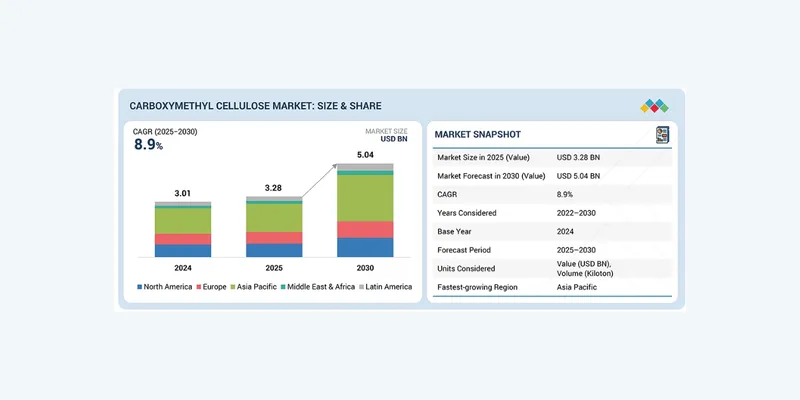
The global Carboxymethyl Cellulose market is forecast to expand from USD 3.28 billion in 2025 to USD 5.04 billion by 2030, registering a CAGR of 8.9% during the period. Growth is linked to rising demand across food & beverage, pharmaceutical, personal care, and industrial applications, particularly in Asia Pacific and other developing economies.
According to the report “Carboxymethyl Cellulose Market by Application (Industrial, Pharmaceutical, Personal Care, Food & Beverage, Other Applications) and Region – Global Forecast to 2030,” market expansion is supported by wider use of carboxymethyl cellulose in processed and convenience foods as a thickener, stabilizer, and emulsifier to improve texture and shelf life.
In pharmaceutical and personal care sectors, consumption is increasing due to its function as a binder, disintegrant, viscosity modifier, and film-former in tablets, topical formulations, cosmetics, and skincare products.
Key market participants identified in the report include AKKIM (Turkey), Ashland Global Holdings, Inc. (US), Nouryon Chemicals Holding B.V. (Netherlands), Shandong Head Co., Ltd. (China), Hebei Jiahua Cellulose Co., Ltd. (China), and Nippon Paper Industries Co., Ltd (Japan), among others.
The Middle East & Africa is projected to be the second-fastest growing regional market for carboxymethyl cellulose. Demand from the oil and gas industry is rising, as the material is used in drilling mud formulations. The region is also seeing investment in upstream and downstream energy projects in Saudi Arabia, the UAE, Qatar, and Kuwait.
Additional growth is being supported by expanding construction, mining, textile, and water treatment industries, which utilize the stabilizing, thickening, and binding properties of carboxymethyl cellulose. Rising disposable incomes, population growth, and urbanization in Africa and the Middle East are contributing to higher consumption of packaged foods, soft drinks, pharmaceutical products, toothpaste, and personal care goods.
Government initiatives aimed at promoting domestic manufacturing are reducing reliance on imports and encouraging the establishment of new processing facilities for food, detergents, pharmaceuticals, and industrial products.
Read Full Report: MarketsandMarkets