Carbon Capture, Utilization, and Storage Market Projected to Reach $17.75 Billion by 2030
CCUS market estimated to rise from USD 5.82 billion in 2025 to USD 17.75 billion by 2030 at a CAGR of 25.0%
The CCUS market is experiencing growth driven by the presence of small and large market participants and increasing research and development activities across key markets.
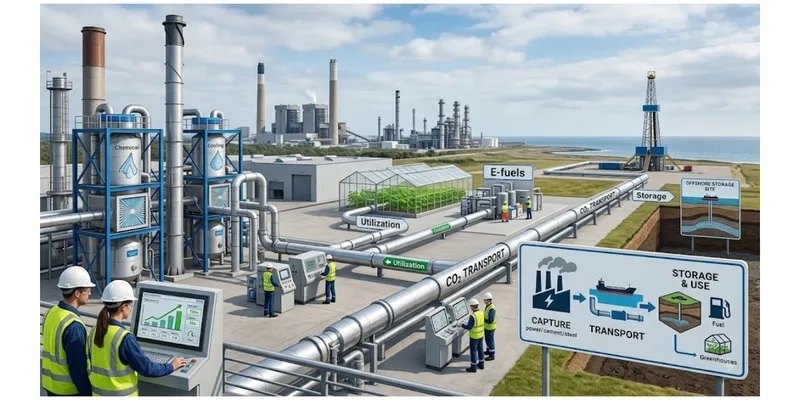
The market covers services including capture, utilization, storage and transportation, while the technologies covered in the report include chemical looping, solvents & sorbents, and membranes.
The study also analyses the market across end-use industries such as oil & gas, power generation, chemical & petrochemical, cement, and iron & steel.
Europe expected to be the fastest-growing region
Europe is anticipated to record the highest CAGR in the CCUS market during the forecast period. The growth outlook is linked to climate policies including the EU Green Deal and legally binding 2050 net-zero targets, which are driving carbon capture deployment across the power, cement, steel and chemical sectors.
The region is also supported by state initiatives, carbon pricing through the EU Emissions Trading System, and cross-border projects such as the Northern Lights and Porthos ventures. These projects combine carbon capture, transportation and storage infrastructure.
Europe's established industrial base, regulatory framework and focus on low-carbon innovation are identified as factors supporting the expansion of the CCUS market.
Recent developments in the CCUS market
April 2025: Calpine and Exxon Mobil signed a CO2 transportation and storage agreement under which Exxon Mobil will store up to 2 million tons (2.2 million tons) per year from Calpine’s Baytown Energy Center. The project will support the production of ~500 MW of low-carbon electricity, enough to power over 500,000 homes, while boosting US energy security and industrial competitiveness.
April 2025: Shell, along with partners Equinor and TotalEnergies, announced a USD 714 million investment to expand the Northern Lights CCS project. The investment will increase its CO2 storage capacity from 1.5 to 5 million tons (1.65 to 5.5 million tons) per year. The project is supported by a long-term agreement with Stockholm Exergi and funding from the EU and Norwegian funding, enabling cross-border CO2 transportation and offshore storage beneath the North Sea.
April 2025: Shell took Final Investment Decision (FID) on two CCS developments in Canada: the Polaris CCS project at its Scotford Energy and Chemicals Park, designed to capture 650,000 tons (716,502.35 tons) of CO2 annually, and the Atlas Carbon Storage Hub, developed with ATCO EnPower, which will provide permanent underground storage for captured CO2. The developments expand Shell’s CCS portfolio.