Carbon Black for Technical Textiles (2025–2030): Conductivity, UV Stability & Market Growth Analysis
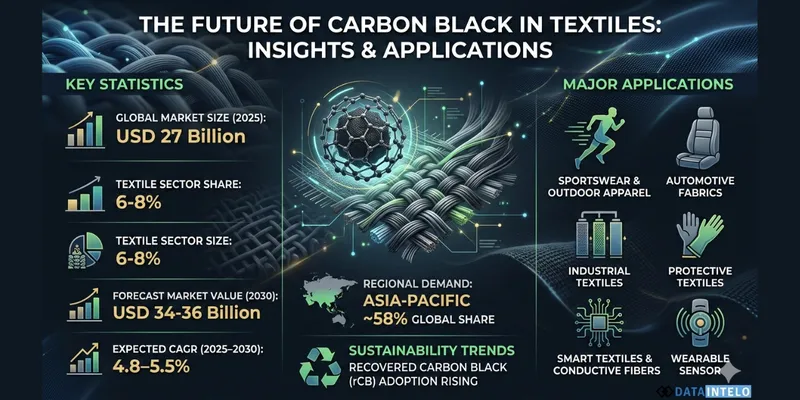
The Carbon Black Textile market has gained significant traction in recent years as textile manufacturers increasingly adopt advanced pigments and performance additives to enhance durability, UV resistance, and coloration quality. According to industry analysis highlighted by Dataintelo in 2025, the global carbon black market used across multiple industries is valued at approximately USD 26–28 billion, with textiles accounting for nearly 6–8% of total consumption.
Carbon black plays a crucial role in textile processing, particularly in synthetic fibers, technical fabrics, and performance textiles, where color stability and resistance to environmental factors are essential. Between 2020 and 2024, demand for carbon black in textile applications increased by nearly 4.7% annually, driven by growth in sportswear, automotive fabrics, industrial textiles, and protective clothing.
The textile sector alone consumed approximately 1.2–1.4 million metric tons of carbon black in 2024, representing a significant share of specialty pigment demand worldwide.
Key Statistics at a Glance
Metric | Value |
Global Carbon Black Market Size (2025) | USD 27 Billion |
Textile Sector Share | 6–8% of total demand |
Textile Carbon Black Consumption (2024) | 1.3 Million Metric Tons |
Forecast Market Value (2030) | USD 34–36 Billion |
Expected CAGR (2025–2030) | 4.8–5.5% |
Asia-Pacific Textile Carbon Black Demand | ~58% of global share |
Synthetic Fiber Usage Growth (2021–2024) | +11% |
UV Protection Improvement | Up to 40% higher durability |
Automotive Textile Segment Growth | 6.2% CAGR |
Industrial Textile Pigment Consumption Increase (2020–2024) | +18% |
These figures highlight how carbon black has become a critical additive in modern textile engineering.
1. Carbon Black Improves Textile Durability by Up to 40%
One of the most significant advantages of carbon black in textiles is its ability to enhance material strength and environmental resistance.
Research from textile chemistry studies conducted between 2021 and 2024 shows that fabrics treated with carbon black additives demonstrate:
• 30–40% higher UV resistance
• 25–32% improved color fastness
• 20% greater resistance to thermal degradation
This makes carbon black essential in high-performance textile applications such as: • Outdoor apparel
• Automotive seat fabrics
• Industrial filtration textiles
• Protective workwear
For example, polyester fibers infused with carbon black pigments can withstand UV exposure for over 1,500 hours, compared with 900–1,000 hours for untreated fibers.
2. Synthetic Fiber Production Driving 11% Demand Growth
The expansion of synthetic fiber manufacturing has directly boosted carbon black consumption in textile production.
Global synthetic fiber output increased from:
• 72 million tons in 2020
• 79 million tons in 2022
• Approximately 83 million tons in 2024
This represents a 15% increase over four years.
Carbon black is widely used in:
• Polyester fibers
• Nylon fabrics
• Polypropylene industrial textiles
Industry estimates suggest that nearly 18–22 kilograms of carbon black are used per ton of synthetic fiber in certain technical textile applications.
3. Asia-Pacific Accounts for 58% of Global Textile Carbon Black Consumption Regional manufacturing hubs strongly influence market demand.
In 2024, the global textile carbon black consumption was distributed as follows:
Region | Market Share |
Asia-Pacific | 58% |
Europe | 17% |
North America | 14% |
Latin America | 6% |
Middle East & Africa | 5% |
Countries such as China, India, Vietnam, and Bangladesh dominate textile manufacturing, collectively producing over 65% of global textile exports.
China alone accounted for nearly 720,000 tons of carbon black consumption in textile processing in 2024, making it the largest regional market.
4. Automotive Textile Applications Growing at 6.2% CAGR
The automotive textile industry has emerged as a major growth segment for carbon black usage.
Carbon black is widely used in:
• Seat fabrics
• Interior panels
• Carpet backings
• Thermal insulation textiles
Between 2023 and 2030, automotive textiles are projected to grow at approximately 6.2% CAGR, faster than the overall textile industry. Modern vehicles contain nearly 25–30 kg of textile materials, and approximately 8–12% of those fabrics incorporate carbon black additives for improved durability and color performance.
5. Industrial Textile Sector Increased Pigment Demand by 18% (2020–2024)
Industrial textiles including geotextiles, filtration fabrics, and conveyor belts have experienced strong growth over the past few years.
Carbon black improves:
• abrasion resistance
• electrical conductivity
• chemical stability
Between 2020 and 2024, carbon black usage in industrial textiles increased by nearly 18% globally.
For example:
• Filtration textiles now represent 14% of specialty textile applications • Carbon black conductive fibers can reduce static charge accumulation by up to 60%
This has made the material essential for mining, construction, and chemical processing industries.
6. Carbon Black Pigment Costs and Pricing Trends
Price stability is another important factor shaping the carbon black textile market. Average global carbon black prices have evolved as follows:
Year | Average Price (USD/ton) |
2020 | $1,100 |
2021 | $1,250 |
2022 | $1,480 |
2023 | $1,520 |
2024 | $1,450 |
2025 | $1,470 |
Price fluctuations are influenced by:
• crude oil feedstock costs
• energy prices
• supply chain disruptions
Despite volatility in 2022–2023, prices stabilized in 2024, helping textile manufacturers manage production costs.
7. Sustainability Trends: Recovered Carbon Black Adoption Rising Sustainability initiatives are transforming the carbon black supply chain.
Recovered carbon black (rCB) derived from recycled tires is gaining traction in textile pigment applications.
Key adoption metrics include:
• rCB production capacity reached 620,000 tons globally in 2024
• Expected to exceed 1 million tons by 2030
• Textile-grade rCB currently represents 7–9% of total textile carbon black supply
Using recovered carbon black can reduce CO₂ emissions by 60–70% compared with virgin carbon black production, making it attractive for sustainable fashion brands.
8. Smart Textile Innovation Expanding New Applications
Emerging smart textiles are also increasing carbon black demand.
Carbon black is used in conductive fibers that enable:
• wearable sensors
• flexible electronics
• heating textiles
Studies conducted in 2023–2024 show that carbon black conductive fabrics can achieve: • electrical conductivity of 10–50 S/cm
• temperature stability above 180°C
The smart textile sector is projected to grow from USD 6.5 billion in 2024 to nearly USD 16 billion by 2030, creating additional demand for conductive carbon-based additives.
9. Future Market Forecast: 5.5% CAGR Through 2030
Industry forecasts suggest steady growth for carbon black in textile applications. Key projections include:
• Global carbon black market expected to reach USD 34–36 billion by 2030 • Textile-specific demand likely to grow at 5–5.5% CAGR
• Total textile carbon black consumption may exceed 1.9 million metric tons by 2030 Growth will be driven by:
• expanding synthetic fiber production
• rising technical textile demand
• increasing automotive and industrial textile applications
Conclusion
The Carbon Black Textile market is evolving into a critical component of modern textile manufacturing, supported by strong data-driven trends. With the global carbon black market valued near USD 27 billion in 2025, textile applications already consume more than 1.3 million metric tons annually.
Demand is expanding across multiple sectors, including synthetic fibers, automotive fabrics, industrial textiles, and smart wearable materials. Key measurable advantages—such as 40% improved UV resistance, 30% better color stability, and 20% higher thermal durability—make carbon black an indispensable additive.
Regional dominance from Asia-Pacific with 58% market share, along with emerging sustainability solutions like recovered carbon black reducing emissions by up to 70%, further reinforces long-term growth potential.
Looking ahead to 2030, the market is projected to surpass USD 34 billion, with textile applications growing steadily at around 5% CAGR, highlighting a strong future for carbon black in advanced textile engineering.
Read A Full Report: https://dataintelo.com/report/carbon-black-textile-market