Canopy Report Highlights Wheat Straw as Alternative Fibre Source for Fashion Industry
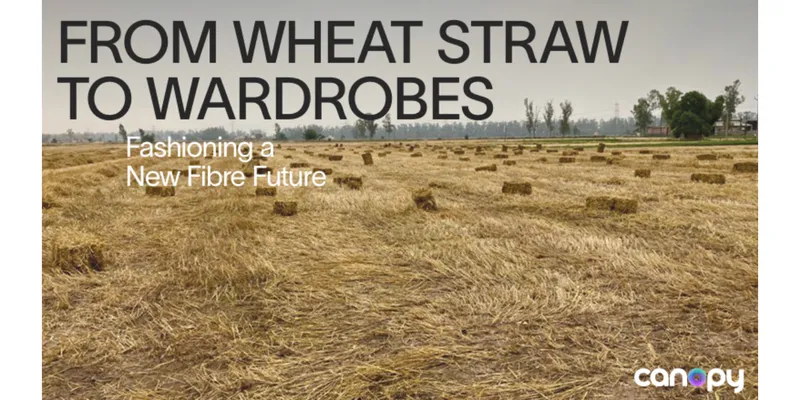
Canopy has published a report titled From Wheat Straw to Wardrobes: Fashioning a new fibre future, presenting findings from a pilot project that evaluated the use of Indian wheat straw pulp in the production of viscose and lyocell fibres.
According to the report, wheat straw pulp can directly replace conventional wood-derived pulp in Man-Made Cellulosic Fibre (MMCF) production while meeting technical and performance standards required across multiple textile applications.
The project, named Project Latvus, tested the feasibility of converting agricultural residue into textile fibre suitable for commercial use. The report noted that the resulting yarns and fabrics achieved performance standards required by participating brands and supply chain partners.
Wood-derived pulp is widely used in the production of MMCFs such as viscose and lyocell, which are often considered alternatives to synthetic fibres like polyester and to cotton. However, the report stated that more than 300 million trees are cut annually for MMCF production, including from climate-critical and biodiversity-rich forests.
Project Latvus brought together organisations and companies across the textile supply chain, including Canopy, Fashion for Good, C&A, H&M Group, Reformation, Chempolis, TITK, Inovafil, Yee Chain, Shahi, Filpucci, DBL, Textile Genesis, and A2P (Agri to Power) Energy.
The initiative was supported by Laudes Foundation and built upon the earlier Spinning Future Threads report, which examined the feasibility of using agricultural waste as a textile raw material.
The project aimed to integrate all stages of the supply chain — from sourcing agricultural residue to finished garments — to identify operational and technical challenges associated with scaling next-generation fibre production.
Representatives from Reformation and TITK stated that the fibre matched the appearance and feel of conventional lyocell while meeting commercial performance expectations. Other supply chain participants also indicated confidence in the scalability of the material.
The report identified alternative feedstocks as important for reducing dependence on forest-based fibres and improving supply chain resilience. It also highlighted the environmental implications of agricultural waste burning, particularly in India.
According to the report, more than 90 million tonnes of crop residue are burned annually in India. Canopy stated that redirecting agricultural waste into fibre production could support rural income generation, strengthen manufacturing systems and reduce air pollution linked to crop burning.
The report further noted that seasonal air pollution in Northern India is associated with high concentrations of PM2.5 particles, which exceed WHO safety guidelines in some periods.
Canopy called on fashion brands to support the expansion of Next Gen MMCFs produced from non-wood feedstocks, stating that increased industry demand could support faster commercialisation and improved cost competitiveness.
“Project Latvus shows that the future of fibre is already here. While continued scale-up is needed to optimize efficiency and close the price difference, the direction is clear - Next Gen MMCFs are ready for the next stage of commercial adoption,” said Nicole Rycroft, Founder and Executive Director of Canopy. “By diversifying feedstocks beyond forests, we have a real opportunity to build a more resilient, circular, and low-impact textile industry.”