BTMA Showcases Advanced Tech at ITMA Asia + CITME 2025
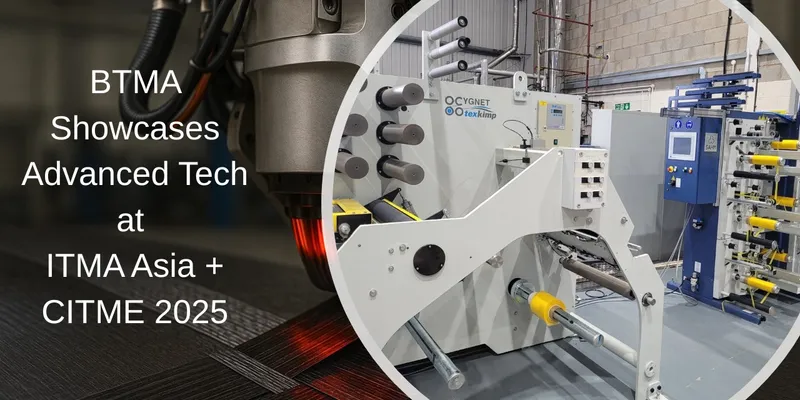
From Microsurgery to Aircraft Wings: BTMA at ITMA Asia + CITME 2025
At the upcoming ITMA Asia + CITME exhibition in Singapore, a delegation of 20 British Textile Machinery Association (BTMA) member companies will be present to engage with visitors and highlight their advanced contributions to a range of industries.
Medical Sutures:
Producing medical sutures is a highly specialised process, as these products are implanted directly into the human body. Each production stage is meticulously controlled to ensure sterility, safety, and consistent performance. Absorbable sutures are generally made from polymers such as polyglycolic acid, polylactic acid, or polydioxanone, while non-absorbable ones use durable, biocompatible materials like nylon, polypropylene, polyester, silk, or stainless steel.
The UK-based Fibre Extrusion Technology (FET) is a global leader in fibre selection and production technologies for the medical sector. At ITMA Asia + CITME, FET will showcase a groundbreaking new parallel technology based on supercritical CO2, along with developments in automation and control in advanced fibre production. Other BTMA members, including Autofoam, James Heal, Roaches, Strayfield, Verivide, and Wira Instrumentation, will also highlight their innovations.
Advanced Aerospace Composites:
Moving from micro-scale precision to large-scale engineering, BTMA members will also spotlight aerospace technologies such as automated fibre placement (AFP) and automated tape laying (ATL). AFP allows for complex, curved geometries—ideal for fuselage sections and wing skins—while ATL is used for larger, flatter surfaces like wing covers and stabilisers. Together, these processes improve material efficiency, reduce waste, and deliver superior structural integrity compared to traditional methods.
Cygnet Texkimp will unveil a new technology designed to significantly support this sector during the exhibition.
Collaboration and Innovation:
“High value industries such as aerospace, defence, renewable energy, automotive and the medical sector are areas of high growth and opportunity and an important factor underpinning the success of our companies here is the strong collaboration between industry and the many universities and institutes in the UK,” says BTMA CEO Jason Kent. “Machine builders can also be important in driving material developments as well as technologies.”
UHMWPE Development:
FET will also introduce a new flexible process for manufacturing ultra-high molecular weight polyethylene (UHMWPE). Known for being ten times stronger than steel by weight, UHMWPE is used in multiple industries, including medical implants. However, existing production systems are large-scale and complex, limiting innovation.
FET’s lab and small-scale gel spinning systems address this gap, enabling smaller, customised fibre quantities. “We have supplied many extrusion systems to the biomedical market and in exploring what else we could do for the same customers it became clear that there was a need for smaller quantities of UHMWPE fibres in bespoke sizes,” explains FET Managing Director Richard Slack. “We believe our introduction of a patented batch system for solvent extraction exploiting supercritical CO2 is a game changer.”
Early-Stage Testing with Cygnet Texkimp:
Cygnet Texkimp has also unveiled a next-generation, production-scale prepreg tape slitting machine at its UK Innovation Centre in Northwich. This technology allows organisations to test AFP and ATL processes under real-world conditions using their own materials or Cygnet’s in-house R&D prepregs. The machine is capable of slitting tapes at speeds of up to 60 metres per minute.
“We’re pleased to be able to offer partners the opportunity to engage with us at an early stage in process development, to test out their concepts, explore machine parameters, assess output quality and validate performance with support from our expert team,” says Graeme Jones, Wide Web Product Director at Cygnet Texkimp.
Splicing Solutions from Airbond:
Airbond will present its splicing technologies for carbon and aramid fibre processing. Pneumatic yarn splicing intermingles filaments to create stronger, flatter joins than traditional knots.
“We are continuing to find new partners in the wind turbine, hydrogen and aerospace industries and are doing a lot of developmental work with research institutes and universities,” says Technical Director Carwyn Webb. “This is leading to us expanding our portfolio and we are currently working on systems for carbon tape splicing, for example, as well as an automated system for full weaving beams.”
Other BTMA members—including Garnett Controls, Roaches International, Slack & Parr, and Tatham—will also display further innovations in technical textiles and composites.
Spirit of Openness:
“Many BTMA members are currently developing new technologies, either in-house or increasingly through joint projects, and we have much to reveal in Singapore,” concludes Jason Kent. “There’s a new spirit of openness and adventurous interaction in the UK right now – especially in the fields of advanced fibres and technical textiles – which is very encouraging for the future.”
BTMA’s exhibiting companies include Airbond, Autofoam, AVA CAD/CAM, Cygnet Texkimp, Fibre Extrusion Technology, James Heal, MCL, Roaches, Saurer Fibrevision, SDC Enterprises, Sellers, Shelton Vision, Slack & Parr, Society of Dyers and Colourists, Strayfield, Tatham, The Textile Institute, Verivide, Vickers Oils, and Wira Instrumentation.