Breathable Fabrics for Healthcare Workers: Balancing Protection, Comfort and Performance
Overview
Healthcare workers often spend long hours wearing gowns, masks, coveralls, and other protective clothing. While these products provide an important barrier against fluids and contaminants, wearing them for extended periods can create heat and moisture inside the garment.
This has increased interest in breathable healthcare fabrics and medical engineered materials that can improve comfort while maintaining the level of protection required for specific clinical applications.
Modern material engineering is helping manufacturers develop fabrics that manage airflow, moisture, temperature, and fluid resistance within the same textile system.
What Are Breathable Healthcare Fabrics?
Breathable fabrics are materials designed to allow water vapor and air to move through the fabric while limiting the passage of unwanted liquids or contaminants.
In healthcare clothing, breathability is not simply about making a fabric porous. The material must achieve a careful balance between air permeability, moisture management, fluid resistance, strength, and protection.
Nonwoven materials, membranes, microporous films, and advanced fiber structures can all be engineered to provide different levels of breathability.
Why Does Breathability Matter?
Healthcare workers may wear protective clothing for several hours during surgeries, emergency care, isolation procedures, or other demanding situations.
When heat and sweat become trapped inside protective clothing, workers may experience discomfort, moisture buildup, and reduced wearability.
A breathable material can help move water vapor away from the body and improve the overall wearing experience.
Comfort is therefore becoming an important consideration alongside protection when healthcare textiles are designed.
Protection vs Breathability
The key challenge is achieving the right balance.
Highly breathable materials may not provide sufficient barrier protection for certain applications, while highly impermeable materials can trap heat and moisture.
Medical engineered materials address this challenge by designing material structures around specific healthcare performance requirements.
How Are Breathable Materials Engineered?
Advanced Fiber Structures
Fiber diameter, density, bonding methods, and fabric structure can influence airflow, filtration, strength, and moisture movement.
Microporous Membranes
Microporous membranes can allow water vapor to pass while restricting larger liquid droplets, supporting both breathability and barrier performance.
Moisture Management
Engineered fabrics can move sweat away from the skin and distribute moisture across the surface for more efficient evaporation.
Moisture Management
Some fabrics are designed to move sweat away from the skin and distribute moisture across the fabric surface, where it can evaporate more efficiently.
This can be particularly valuable for healthcare workers operating in warm environments or wearing protective garments for extended periods.
Applications in Healthcare
Breathable fabrics can be used across several healthcare products, including:
- Surgical gowns
- Isolation gowns
- Protective coveralls
- Medical scrubs
- Patient clothing
- Face masks
- Protective headwear
- Healthcare uniforms
- Wound-care materials
The material requirements differ for each application. A surgical gown, for example, may prioritize fluid resistance and barrier performance, while a healthcare uniform may place greater emphasis on comfort and moisture management.
Benefits of Breathable Medical Textiles
Improved comfort:
Better airflow and moisture management can make protective clothing more comfortable during extended use.
Better wearability:
Comfortable garments may be easier for healthcare workers to wear for longer periods without excessive heat or moisture buildup.
Balanced performance:
Advanced fabrics can combine breathability with properties such as fluid resistance, strength, and filtration.
Application-specific design:
Engineered textiles can be developed around the requirements of different healthcare environments rather than using the same material for every application.
Challenges and Limitations
Developing breathable healthcare fabrics is not without challenges.
Protection trade-off: Increasing airflow can sometimes affect barrier performance, depending on the material structure and application.
Durability: Reusable protective garments must retain their performance after repeated washing, sterilization, and use.
Cost: Advanced membranes, coatings, and engineered fibers can increase manufacturing costs.
Testing requirements: Healthcare fabrics need appropriate testing for properties such as fluid resistance, filtration, strength, breathability, and biocompatibility where applicable.
Sustainability Considerations
The healthcare sector is also exploring reusable garments, recyclable materials, lightweight structures, and resource-efficient manufacturing.
For medical engineered materials, the challenge is to improve sustainability while maintaining the hygiene, safety, and performance required in healthcare settings.
The Role of Medical Engineered Materials
Breathable healthcare fabrics are part of a broader shift toward medical engineered materials.
Material developers are increasingly designing medical polymers, fibers, membranes, coatings, and composites for specific healthcare functions rather than relying only on conventional textile structures.
This approach can help combine several properties in one material, such as breathability, fluid resistance, antimicrobial performance, flexibility, and mechanical strength.
The result is a new generation of healthcare textiles designed around both human comfort and technical performance.
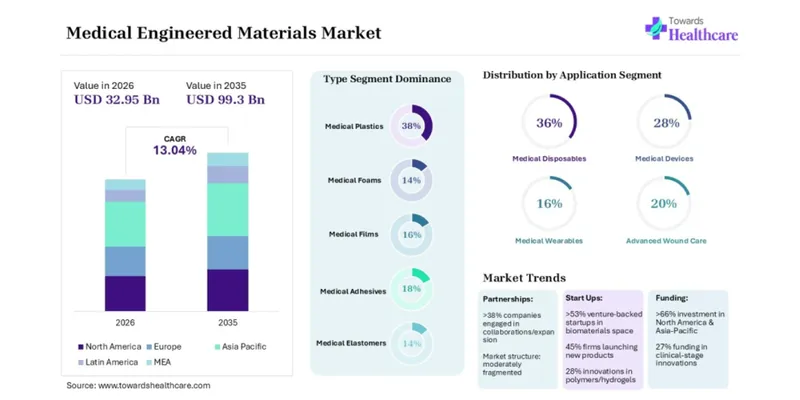
According to Towards Healthcare Research and Consulting, medical engineered materials market size was estimated at USD 29.15 billion in 2025 and is predicted to increase from USD 32.95 billion in 2026 to approximately USD 99.3 billion by 2035, expanding at a CAGR of 13.04% from 2026 to 2035.
Conclusion
Breathable fabrics are helping healthcare workers achieve a better balance between protection and comfort during extended use.
Advances in fibers, membranes, and moisture-management technologies are creating healthcare textiles that are lighter, more breathable, functional, and sustainable without compromising essential performance.
About Author

Payal Rabde is a Healthcare Market Research Analyst at Towards Healthcare Research & Consulting with over 4+ years of experience in pharmaceutical, biotechnology, medical device, and healthcare market research. She holds an MBA in Pharmaceutical-Biotechnology Management and a B.Pharm, specializing in market analysis, forecasting, competitive intelligence, and strategic healthcare insights.
About Us
Towards Healthcare Research & Consulting is a global strategy consulting firm with a presence in both Canada and India. We provide innovative solutions tailored to the healthcare sector, helping business leaders overcome challenges and accelerate growth. We specialize in delivering advanced technological solutions, clinical research services, and powerful data analytics. Our focus is on building meaningful partnerships that foster innovation and deliver actionable insights to drive success in healthcare.
Reference:
https://pmc.ncbi.nlm.nih.gov/articles/PMC7874299/
https://www.towardshealthcare.com/insights/medical-engineered-materials-market-sizing
https://www.towardshealthcare.com/insights/medical-clothing-market-sizing