Bonding Sensors To Fabric: The Adhesive Challenge Behind Smart Textiles
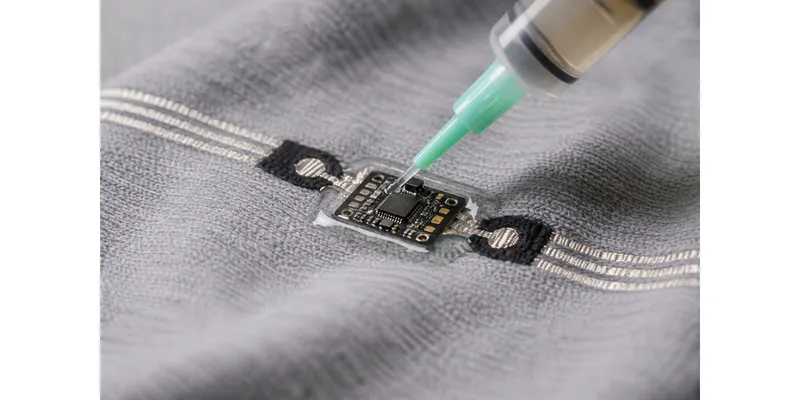
The smart textiles market is moving quickly. According to a report by Markets and Markets, the textile market is projected to grow from USD 2.41 billion in 2025 to USD 5.56 billion by 2030, at a CAGR of 18.2% during the forecast period. With the growth of electronics integration in clothing, one challenge remains. While the fabric is soft, flexible, stretchable, and washable, the sensors and electronic components are sensitive to moisture and are often rigid and brittle. This is why it is important to consider the adhesive connecting them. It is one of the most overlooked engineering decisions in smart textile design.
This brief article will study this challenge in detail and the trade-offs that are important to consider.
Why Bonding Sensors to Fabric Is Harder Than It Looks
A sensor bonded to fabric does not experience the same mechanical environment as a component mounted on a conventional PCB. Textile substrates bend, stretch, wrinkle, compress, and recover continuously, while rigid components resist those movements. That mismatch concentrates stress at the bond interface.
Three failure modes dominate:
- Delamination: Repeated flexing gradually weakens adhesion, eventually causing the sensor or trace to lift from the fabric surface.
- Moisture ingress: Water, sweat, and detergent can penetrate the bond during washing, compromising both adhesion and electronic reliability.
- Mechanical fatigue: Continuous strain cycling creates micro-cracks in the adhesive layer, reducing long-term bond integrity.
In high-motion zones such as elbows, knees, and shoulders, the challenge intensifies. Over its lifetime, a wearable joint may undergo 1–3 million bend cycles, pushing the bond to its mechanical limits. The adhesive must survive this repeated deformation without becoming brittle or separating from either substrate.
What the Adhesive Needs to Do
Here is how the adhesive should be:
Flexibility & Elongation
A flexible adhesive for fabric sensors must elongate with the textile rather than resist it. Overly rigid bonds may appear strong initially but often transfer stress directly into the sensor or conductive trace, accelerating failure. In many cases, controlled compliance is more critical than peak strength.
Wash Durability
Washability is non-negotiable in e-textile bonding. A wash-durable electronic adhesive must withstand repeated exposure to water, detergent chemistry, temperature swings, and mechanical agitation. It must also maintain barrier integrity to protect sensitive electronics from moisture ingress over multiple wash cycles.
Low-Temperature Cure
Manufacturing constraints are equally important. Many fabrics, especially synthetics, are heat-sensitive, making high-temperature curing impractical. Low-temperature curing systems simplify smart textile manufacturing and reduce risks such as fabric shrinkage, discoloration, or damage to embedded components.
Electrical & Thermal Function
In advanced designs, the adhesive becomes part of the circuit. A conductive adhesive for wearable electronics can form electrical pathways between sensors and traces, while thermally conductive formulations help dissipate localized heat from active components. At this level, adhesive chemistry is no longer just structural; it is functional device architecture. For deeper context, see conductive adhesives engineered for flexible substrates.
Where This Is Already Happening
These requirements are already shaping real-world products. Smart garments are being deployed in continuous health monitoring, sports performance tracking, rehabilitation systems, compression wear, and embedded haptic feedback applications. Research in this space increasingly focuses on fully integrated textile systems that combine sensing, actuation, and data processing within the fabric itself.
This evolution from Active Smart textiles (sensing and responding) to Ultra Smart textiles (sensing, reacting, and adapting) highlights a clear industry trajectory. As functionality increases, mechanical integration becomes just as critical as electronic design.
The Engineering Trade-Off Nobody Talks About
High-strength epoxies are not inherently unsuitable. In fact, rigid bonding systems are often necessary for anchoring sensor housings or maintaining precise alignment in localized regions.
The real challenge lies in zone-specific adhesive design. A single garment may require rigid bonding at the sensor interface, semi-flexible adhesion in transition areas, and highly compliant bonding in high-flex regions. This makes adhesive selection a formulation and system-level engineering problem rather than a material choice. For structural bonding considerations, see two-component epoxy adhesive: applications and characteristics.
Conclusion
As smart textiles scale from prototypes to mass production, adhesive performance will increasingly determine product reliability. The success of adhesives for smart textiles depends on balancing flexibility, wash durability, curing constraints, and, where required, electrical or thermal functionality. Ultimately, robust e-textile bonding requires treating the adhesive not as a supporting material, but as a core functional component of the system.