Block Printing
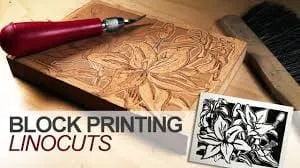
Block printing is the process of printing patterns by means of engraved wooden blocks.It is the earliest, simplest and slowest of all methods of textile printing. Block printing by hand is a slow process. It is, however, capable of yielding highly artistic results, some of which are unobtainable by any other method
Woodblock Printing
Woodblock printing or block printing is a technique for printing text, images or patterns used widely throughout East Asia and originating in China in antiquity as a method of printing on textiles and later paper. As a method of printing on cloth, the earliest surviving examples from China date to before 220 AD. Woodblock printing existed in Tang China during the 7th century AD and remained the most common East Asian method of printing books and other texts, as well as images, until the 19th century. Ukiyo-e is the best-known type of Japanese woodblock art print. Most European uses of the technique for printing images on paper are covered by the art term woodcut, except for the block-books produced mainly in the 15th century in India. Technique The wood block is carefully prepared as a relief pattern, which means the areas to show 'white' are cut away with a knife, chisel, or sandpaper leaving the characters or image to show in 'black' at the original surface level. The block was cut along the grain of the wood. It is necessary only to ink the block and bring it into firm and even contact with the paper or cloth to achieve an acceptable print. The content would of course print "in reverse" or mirror-image, a further complication when text was involved. The art of carving the woodcut is technically known as xylography, though the term is rarely used in English.
For colour printing, multiple blocks are used, each for one colour, although overprinting two colours may produce further colours on the print. The paper is normally keyed to a frame around the woodblocks.There are three methods of printing to consider:
Woodblock for textile printing, India, about 1900, 22×17×8 cm Stamping Used for many fabrics, and most early European woodcuts (1400–40). These items were printed by putting paper or fabric on a table or a flat surface with the block on top, and pressing, or hammering, the back of the block. Rubbing The most common for Far Eastern printing. Used for European woodcuts and block-books later in the 15th century, and very widely for cloth. The block is placed face side up on a table, with the paper or fabric on top. The back of the paper or fabric is rubbed with a "hard pad, a flat piece of wood, a burnisher, or a leather frotton".[2] Printing in a press "Presses" only seem to have been used in Asia in relatively recent times. Simple weighted presses may have been used in Europe, but firm evidence is lacking. Later, printing-presses were used (from about 1480). A deceased Abbess of Mechelen in Flanders in 1465 had "unum instrumentum ad imprintendum scripturas et ymagines ... cum 14 aliis lapideis printis" ("an instrument for printing texts and pictures ... with 14 stones for printing") which is probably too early to be a Gutenberg-type printing press in that location.[2]
In addition, jia xie is a method for dyeing textiles (usually silk) using wood blocks invented in the 5th–6th centuries in China. An upper and a lower block are made, with carved out compartments opening to the back, fitted with plugs. The cloth, usually folded a number of times, is inserted and clamped between the two blocks. By unplugging the different compartments and filling them with dyes of different colours, a multi-coloured pattern can be printed over quite a large area of folded cloth. The method is not strictly printing however, as the pattern is not caused by pressure against the block.
Colour Woodblock Printing
The earliest woodblock printing known is in colour—Chinese silk from the Han dynasty printed in three colours.[3] On paper, European woodcut prints with coloured blocks were invented in Germany in 1508 and are known as chiaroscuro woodcuts.Colour is very common in Asian woodblock printing on paper; in China the first known example is a Diamond sutra of 1341, printed in black and red at the Zifu Temple in modern-day Hubei province. The earliest dated book printed in more than 2 colours is Chengshi moyuan (Chinese: 程氏墨苑), a book on ink-cakes printed in 1606 and the technique reached its height in books on art published in the first half of the 17th century. Notable examples are the Hu Zhengyan's Treatise on the Paintings and Writings of the Ten Bamboo Studio of 1633,[4] and the Mustard Seed Garden Painting Manual published in 1679 and 1701.[5]In Japan, a multi-colour technique called nishiki-e ("brocade pictures") spread more widely, and was used for prints from the 1760s on. Japanese woodcut became a major artistic form, although at the time it was accorded a much lower status than painting.In both Europe and Japan, book illustrations were normally printed in black ink only, and colour reserved for individual artistic prints. In China, the reverse was true, and colour printing was used mainly in books on art and erotica. WHAT IS BLOCK PRINTING? Block printing is making use of a carved piece of wood or any other type of wooden block to imprint an image on fabric or paper. In the early days of printing, it was used to print entire books. Today the process of block printing is popularly associated with making designs on fabrics by printing on them, with the help of a block made for that purpose. Believed to have its origin in China, block printing has been in use around the world now, for quite some time.
WHY IS BLOCK PRINTING POPULAR?
Block printing or hand block printing is popular on account of a number of contributing factors. - It has simplicity and ease of execution. - There is the sharpness, accuracy and fine detailing of prints made on the fabrics. - The huge possibilities of match and mix of different block designs in various colors on the same fabric as in large canvas fabrics like the saree and salwar kameez is stupendous. A large number of wooden blocks are always kept in readiness for use based on the intended patterns and designs. - Creating a new block with a new design is fairly quick and easy. - Blocks are of good quality wood and so they have durability. Metallic blocks are sometimes used but maneuverability limits their use compared to wooden blocks. - Intricate and sharp detailing for complicated designs can be etched out in the blocks which is possible only in these wooden blocks. Accessories like hair brushes are used for filling in the blank areas between outlines of the design. - A point on the block serves as a guide for the repeat impression, so that the whole effect is continuous and not disjoint. - The extensive choice of colors make the designs vibrant and fresh-feel. - Block prints and brush prints having been tried out successfully on fabrics like cotton, silk, sico and others
HISTORY OF BLOCK-PRINTING IN INDIA
The Origin Printing and dyeing of cottons were originally developed in Rajasthan during the medievel period of India. Tents were made from printed fabrics and soon they became necessary part of royal processions. The seasons largely influenced the integration of the highly creative processes of weaving, spinning, dyeing and printing. Festivals also dictated this activity. The earliest known example of block-printing is a copy of the Diamond Sutra from 868 A.D (currently in the British Museum). Even though the practice of block printing is probably about two thousand years old, trade in cotton cloth is said to have existed between India and Babylon from Buddha's time. Printed and woven cloths traveled to Indonesia, Malaya and the Far East. In the 17th century, Surat was established as a prominent center for export of painted and printed calicos, covering an extensive range in quality. Cheaper printed cloth came from Ahmedabad and other centers, and strangely enough Sanganer was not such a famous center for printing as it is today. Printing Process The first step in block printing is the production of the original document. This is laid on a large, smooth wooden block and fixed into place, reversed. Next, craftsmen of various skill levels, ranging from master carvers for the fine work to less talented artisans for cheaper blocks or less important sections, carve the original painted, drawn or written image into the block of wood. The block can now be covered with ink and used in a press to create duplicates of the original. One of the main benefit of Block-printing is that it allows greater artistic freedom, such as the easy inclusion of pictures and diagrams. Block Printing in Gujarat In Gujarat, this form of hand Printing has been practiced and perpetuated by the Paithapur families. They make intricate blocks, and print their textiles using the mud resist-Printing method. These prints are called Sodagiri (trader) prints. In Kutch, the popular patterns are black and red designs of birds, animals, and dancing girls. The saris of Ahmedabad and Baroda have large mango patterns against a red or blue background.The other well known centers for block Printing in Gujarat are Bhavnagar, Vasna, Rajkot, Jamnagar, Jetpur and Porbandar. Dhamadka a village in Gujarat has many printers using mostly madder root for printing red color, rusty iron solution for black color and indigo for blue color. These fabrics are known as Ajrakh. The designs made by block printing are geometric.
Block Printing in Rajasthan From Gujarat, the art of block Printing spread to Rajasthan. Here colourful prints of birds, animals, human figures, gods and goddesses are popular. The important centers are Jaipur, Bangru, Sanganer,Pali and Barmer. Sanganer is famous for its Calico printed bed covers, quilts and saris. In form of hand Printing are Calico Printing, the outlines are first printed, and then the colour is filled in. Bold patterns and colours are popular. They are printed repeatedly in diagonal rows. Doo Rookhi Printing is also famous here. In this technique, artists print on both sides of the cloth. Bagru is famous for its Syahi-Begar prints and Dabu prints. The former are designs in a combination of black and yellow ochre or cream. The latter are prints in which portions are hidden from the dye by applying a resist paste. Barmer is known for its prints of red chilies with blue-black outlines, surrounded by flower-laden trees. The other famous prints are of horses, camels, peacocks and lions, called Sikar and Shekahawat prints.
BLOCK PRINTING PROCESS
TRADITION Back in the days, India, specifically the region of Rajasthan, was filled with multiple tribes who were known by the work they did. One of those groups were the block printers. They used to create the printed clothing for the various tribes in the region. Each design, with various motifs, specified your job or the tribe you belonged to. You could tell whether a person was a farmer or Metal smith by the printed shirt or turban worn. The strict separation of the tribes has slowly dissipated but what remains are a few stories by the elder generation still keeping alive the secrets of the motif and the craft of block printing. To the artisans we work with, the Art of Block Printing is their tradition and their way of life, for the past four generations. It continues now to the latest generation that strives to keep the family craft alive by finding new markets and ways to keep up with fashion. The only thing that remains true is the beat of the wooden block on the table, the 20 year old and 10 ft deep indigo dye vat, and the passion to continue. HAVE YOU EVER WONDERED WHAT HAND BLOCK PRINTING REALLY IS? Hand Block Printing with natural or vegetable dyes is an ancient print technique. This art form has been around for years in India, and saw its most glorious years around the 12th Century. Today, it is competing against the fast world, but surviving due to the people who still value them. “BLOCK” means a wooden square piece with an engraved pattern on it. This block is used to print on fabric – and this art is called block printing. The fabric is then commonly called block print fabric. There are few different types of block printing. I have listed the process of "Dabu" printing below. Dabu is an ancient mud resist hand block printing technique. CARVING Master block carvers, who have been doing this for many years, carve these blocks. These blocks are carved by a chisel and wooden hammer to form a design pattern. PRINTING There are a couple of block printing techniques but the one that we work with is called Dabu. Dabu is a mud resist made by mixing together fuller’s earth, gum and few other natural ingredients. It is mixed into a paste not by hand nor by machine, but by foot, just like grapes were crushed to make wine in the yesteryears! Once this paste is ready, the fabric is printed with a block using that resist. The areas that are stamped resist any dye that the fabric is dipped in. DRYING Sun is crucial to this process. At every step the fabrics have to dry in the open fields under the sun. Did you know, that most of this work comes to almost a stand still in the Monsoon seasons of July and August?! DYEING After the fabric has been printed, it gets dyed. We work with dyes that are made with natural materials found in our surroundings, such as flowers, leaves, spices and various other natural metals! Below is an indigo vat that has been going on for several years! WASHING & DRYING After dyeing, the fabrics get washed by hand. More so than not, block printing is a multiple step process where the fabric gets re-printed, re-dyed to bring out the designs we want. And that sums up the process of block printing! Of course we stumble upon lot of problems as the color didn't come up right, or the print got messed up while printing or dyeing - but that's life - and we take it as it comes! Conclusion We started our survey with the research on ajrakh and after collecting the basic information on it, we headed towards barmer, rajasthan where the craft is still prevalent. We started the process by doing a lot of research on various aspects of crafts that together compiles the entire process of ajrakh.we all divided our topics of research individually so that we cover the minutest of details possible. The good thing about the place was that they were using all natural products for ajrakh printing and are not in favor of chemicals. We noticed that blocks are one of their main tools used for printing which has existed for centuries in many crafts, but the interesting part about the block used for ajrakh is the intricacy and detailing which makes it one of the most unique features of ajrakh. Referance
The Oxford Companion to the Book
Edited by Michael F. Suarez, S.J. and H. R. Woudhuysen