BIR Convention: Indian Metal Recyclers Raise Concerns Over Proposed EU Scrap Export Restrictions
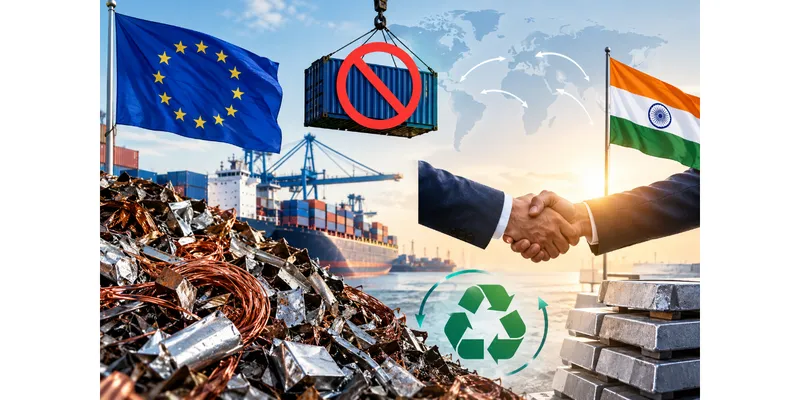
Industry representatives warn that the EU Waste Shipment Regulation could disrupt India-EU trade relations, restrict recycled material flows and weaken circularity
Indian metal recyclers have called on European policymakers to reconsider proposed restrictions on recycled metal exports to India under the European Union's updated Waste Shipment Regulation (WSR). Speaking at the Bureau of International Recycling (BIR) World Recycling Convention in Malaga, Spain, on October 27, industry representatives raised concerns about the implications for the upcoming India-EU Free Trade Agreement (FTA), international scrap trade and the development of circular markets.
Indian Recyclers Question Proposed EU Export Restrictions
During the plenary session of BIR's International Trade Council, Dhawal Shah, Partner at Metco Ventures (India), described the proposed EU restrictions on recycled metal exports to India as “a broken promise” ahead of the planned signing of a major FTA between India and the European Union.
Under the updated WSR, India and several other major metal-trading economies have been excluded from a provisional list of approved non-OECD countries eligible to receive certain waste shipments from the EU. Malaysia and Vietnam are also among the countries excluded from the list.
The list is expected to be finalised following consultation on November 21, ahead of the regulation's implementation in May 2027. BIR and Recycling Europe have called for a delay.
Shah, who said he had been doing business with Europe for 30 years, expressed concern over what he described as a change in the region's approach to trade transparency.
“I've always looked up to and respected and really valued Europe’s transparency, the way it processed things. However, that seems to have changed.”
He questioned whether the European Commission's stated objective of ensuring environmentally sound management of materials was also being influenced by economic considerations.
“It's nothing to do with environment anymore. As a country, as India, as the fourth largest economy, we really don't want to be played around. We need some straight talking. We need some clarity.”
Concerns Over India-EU Free Trade Agreement
The proposed restrictions are particularly concerning for Shah because of the upcoming India-EU FTA, which is due to be signed in December.
“It is called the mother of all FTA agreements; it represents 25% of the world GDP. There was also an agreement that, while we negotiate this, we will not change any of the federal laws which impact trade. But somewhere that promise was perhaps broken.”
He argued that the updated WSR could create an imbalance in the proposed trade arrangement by allowing intermediate aluminium and copper products from the EU to enter India while restricting imports of scrap materials.
“Intermediate products of aluminium or copper can flow into our country [from the EU]. We welcome that but my simple question here is: ‘Why not scrap?’ Maybe better sense will prevail, and we may have some corrections.”
Industry Leaders Warn Against Restricting Secondary Material Trade
Opening the session, International Trade Council Chairman Emmanuel Katrakis of Galloo Group (France/Belgium) said discussions within the council were increasingly focused on restrictions on secondary material movements rather than free trade.
He noted that the past two years had seen strong lobbying for export tariffs and, more recently, export bans targeting non-OECD countries. Similar trends were also emerging in North and South America.
Caroline Craenhals, Chief Executive of Belgian Scrap Terminal (Belgium), said Europe was attempting to establish a circularity loop by closing its borders but stressed that “a loop is not a cage”.
“When we close markets through export restrictions, we don't just restrict trade, we weaken recycling itself,” she said.
Craenhals warned that losing important export markets could leave Europe with a surplus of recycled materials without sufficient demand from domestic industries.
She supported traceability, environmental standards and responsible trading, while emphasising the need to distinguish between waste dumping and legitimate trade in high-quality recycled raw materials.
She also called for greater progress on End-of-Waste regulations to improve market access, alongside demand-side measures to strengthen circularity within Europe.
US Recycler Highlights Differences in Trade Policy
Kevin Gershowitz, President of Gershow Recycling (USA), offered a different perspective on the impact of regulatory changes and business adaptation.
Referring to the EU's WSR, he said: “I'm glad I'm not in the EU”.
Gershowitz described how his family business had grown from “scrap peddling” in New York in the mid-20th century into a major company by adapting to changing market conditions.
“We constantly pivoted. We had the foresight. And when the market conditions changed, we were prepared.”
He asked delegates whether they were prepared for May 2027, when the updated WSR is scheduled to take effect, and noted that the changes would create both winners and losers.
He acknowledged the possibility of similar export measures emerging in the United States but said he believed the ReMA and its members had sufficiently strong relationships with Congress to challenge such proposals.
The strength of the US steel sector also meant that secondary ferrous exports from the country were unlikely to increase, he added.
Gershowitz distinguished between the approaches taken in Europe and the United States, where Europe is pursuing export restrictions while the US has focused on import restrictions.
“With an export restriction you shoot yourself in the foot; with an import restriction, you shoot the other guy.”
Argentina's Export Suspension Offers a Cautionary Example
Alejandro Jaramillo, Chief Executive of Glorem (Mexico), highlighted Argentina's experience with restrictions on recycled ferrous material exports.
In 2009, Argentina suspended exports of recycled ferrous materials to secure more raw materials for domestic industry. The restrictions, which were later extended to other metals, were initially intended to remain in place for 180 days but continued for 16 years.
Jaramillo said the government had identified several reasons why the policy had not achieved its intended results:
- Distorted prices.
- Reduced investment in recycling.
- Lower levels of material separation and collection.
- Continued shortages of the materials that had prompted the restrictions.
“My concern is if this [WSR] regulation does go forward in its current shape, it will set a precedent for Latin American economies to do the same,” he warned.
He also raised concerns about possible retaliatory measures and questioned whether European regulators had fully considered that risk while drafting the legislation.
BIR Calls for Demand-Side Measures to Support Circularity
Katrakis said more than 80% of the scrap metals recycled in Europe already remain within the region. In his view, export restrictions would not create circular markets.
He called for stronger demand-side policies, including tax measures, recycled-content requirements and green public procurement that rewards circularity.
He also advocated measures to support the entire value chain, including simpler rules for transporting recycled materials within the EU's internal market and protections against unfair trade practices without adding further burdens to European industries.
Katrakis criticised policies aimed at protecting energy-intensive industries while economic growth in the EU remained between 1% and 2%.
“To redistribute a cake that is not growing is much more difficult. When we had discussions with the European Commission, we said before you try to pass on a competitive advantage from one industry to another, you need to make sure that - as a value chain - we function, we work and we create value.”
The discussions highlighted growing concerns among recyclers over restrictions on secondary material exports, the availability of international markets and the impact of trade regulations on recycling businesses. Industry representatives called for policies that support demand, investment and the movement of recycled materials across markets.